It’s that somewhat peculiar time of year-the autumn glory is over, the birds have migrated south, and we’re waiting for snow. Freeze-up has begun, with frost now staying on the shadowed areas of grass all day, and thin ice is forming on the lakes and ponds. After the summer without them, the stars are back, sparkling in the lengthening night sky. Fresh snow has brightened-up the Alaska Range, and dusted all the other mountains. The colors of the forests are now the muted browns of bare limbs and dead leaves on the ground. The evergreens stand dark, waiting for snow to etch their limbs with white.
For me, the bright spot in this time of year is the Coho Salmon. Theirs is the last of the salmon runs in our area, and they choose the cold autumn waters for their spawning beds. There is one creek in particular to which I hike to watch the salmon each fall, and I was there in mid-October, happy to see that my heroes had returned at last. By the time I was able to make my first hike there, they had already spawned, but they were lively and the males still sparred with each other. Only a few had the white patches on their sleek bodies, indicating that their bodies were beginning to decay as they began their decline towards their life’s end.


The lake from which this creek drains was probably formed by a receding glacier, and at some point-long, long before humans came to this area-the salmon found this creek and began coming here to spawn. How and why they chose this particular creek is a mystery, but the rhythm was set in place and each fall the descendents of that first ancient salmon run return to this creek to continue this part of the genetic code for all salmon. They face many predators in their years in the ocean-when they arrive there they are small and it seems like everything wants to dine on them, even larger fish. Those who survive grow bigger, and wiser, and learn to avoid more predators and other challenges. When humans came on the scene, they added their own long list of challenges to the fish, from direct fishing to pollution. And when the salmon finally answer the urge to leave the sea and return to their freshwater natal homes, they face a fresh onslaught of predators and challenges, natural and human-made.
That’s why I consider these fish heroes. They have come through so much. Even the creek itself presents challenges. Winter snows sends trees crashing down across the creek and the fish have to negotiate tangles of logs and branches. Beaver have constructed dams along the creek, lowering the water in places to where it is just a few inches deep and the salmon have to thrash over rocks and pebbles as they make their way to pools to rest. The creek twists and turns, some bends so narrow that the water gushes through and the fish fight their way along, always driven to go farther. At last they reach the final obstacle-a large beaver dam across the west end of the pond, laying west of the lake. In the years when the beaver have been in the valley, they have kept the dam tightly constructed, repairing any breeches immediately. 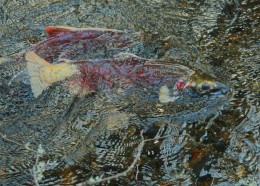 In those years the salmon have not been able to leap over the high dam with its many sharp-ended logs and branches bristling against their assault. In those times the salmon have to spawn in the pool below the dam, and along the creek west of that.
But this year the beaver left the pond and moved up to the lake and a breech opened in the dam and was left open. I walked out onto the old dam and stood watching for salmon in the pond and was glad to see some had made it over the dam and were swimming near it. I just caught glimpses of them before they moved into the deeper water of the pond. There were still many salmon in the pool-those who just couldn’t leap up the breech in the dam. And many were spawning in the creek itself.
I watched the males sparring-lunging at each other with their jaws agape, showing rows of teeth. They undergo a marvelous transformation just before spawning time, the males growing long, hooked noses and jaws lined with impressive teeth. They don’t tear into each other, however, all this armor is more for show. They knock into each other, pushing bodies away in shows of strength as they defend their chosen female and her spawning bed. Even long after the spawning is over, the ritual will still be performed, with the fish growing weaker each day, until at last they no longer push into each other, but just rest, facing up the current, waiting until they can no longer do even that. Then will come the final moment when at last they surrender to the current and let it carry them downstream, to fetch up against a log, or lay on a shallow bed of stones, breathing their last.
The predators are there, of course. At first they are few. They know the salmon are strong and swift and can dash for the safety of logs, hiding under them or heading for deep pools, out of reach for the moment. But eventually the predators will have their chance. When the salmon start to die, they move in. The first day I visited the fish, one eagle sat high in a spruce above the south shore of the pond. There were no dead salmon in the creek. A few days later I saw a few dead salmon in the water, and two eagles above the pond. The fish were still sparring in the pools and some were still bright red. A few days after that, it was a different picture. As I topped the last ridge and came along above the creek, an adult bald eagle sat on a birch bending over the creek. As I made my way down to the creek, an immature eagle was on the shore, standing on a salmon pulled from the water. Its crop was so full of salmon that when it attempted to fly, it could only skip along the creek, its great wings flapping as it struggled to get airborne. It finally made it just before the pool below the dam, laboring to get its heavy body into the air and flying low out over the pond, to land in a spruce along the east shore.
I saw five more eagles along the creek that evening, all sitting at various heights in the trees above the water, watching the salmon. Magpies and dippers were also there, the dippers diving to grab any salmon eggs they could find amongst the stones and pebbles of the creek bed. A few fish had been pulled from the creek, and many more were dead in the water. The pools were still full of active salmon, a few males still sparring with each other. Most now had white patches on their decaying bodies.
As I do every year, I stood on the shore and watched the salmon and thanked them for their journey and their gift of the next generation. They had made it through so many challenges to come to this very creek, and now they were completing their life cycle. It is an honor to witness them, and to watch the whole ecosystem of predator and prey, knowing all the contributions these fish have made. May it always be so.