This is part 2. Click here for part 1.
I left off my last story- which was ‘part one’ of the “Murre Invasion”- heading back to my temporary residence in Willow after having spent December 30th in Talkeetna. Billy Fitzgerald and Tod Marder had taken some rescued Murres by snowmachine to an open lead of water in the Su, about a mile north of the Talkeetna river confluence. Originally I had been asked to take Murres to the Alaska Wild Bird Treatment Center in Houston, but because the birds were healthy and open water had been located, it was decided to release them back to the wild. Being pelagic diving birds with legs set well back on their bodies, they need water in order to take flight, although, in just the right conditions, they have been observed taking off from land, but it’s extremely difficult for them.
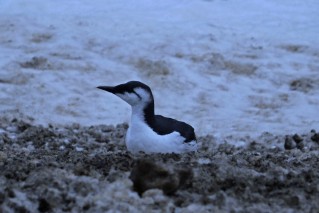
Just south of Caswell Lodge something on the snow berm on the west side of the Parks highway caught my eye. Son-of-a-gun, it was a Murre, standing on the brown snow left by the snowplow. I turned around, drove back, turned again, and pulled up next to the bird. By this time it had settled onto its belly and was busy preening. I grabbed my camera and went to the back of the car to get a tub ready and nabbed a hand towel to place over the Mallard-sized bird, not wanting to scare it with a large bath towel. The bird was unconcerned by the traffic barreling by- even when a big semi truck roared by, flinging snow and sand to the side of the road. The bird didn’t flinch. There was nothing in its ‘hard-wiring’ to warn it that these strange, noisy ‘creatures’ were dangerous. I knew this bird was destined to become a “Murre pancake” if I didn’t stop it from heading out onto the highway. I approached carefully. The Murre eyed me without alarm and continued to preen. Billy had told me that the Murres folks had been bringing to him had either come up to them or had let them approach and place a towel over them without much fuss. I got within a few inches of the Murre and then suddenly it startled and darted in the opposite direction, scooting itself across the snow by rowing its short, strong wings, its black webbed feet trailing out behind its stubby tail.
While a Murre’s body is a wonder in the water, designed specifically for diving and zipping after fish and other sea life, on land they are clumsy and awkward. Walking is accomplished with their black and white plump bodies held vertical, in a penguin-like attitude.
This may be a good time to interject some Murre biology: they are in the family Alcidae, and other family members include various murrelets, auklets, Pigeon Guillemot, Horned and Tufted Puffins.
Right now they are in their winter plumage. The chin and lower half of the face is white, with a pencil-thin black line running from the back of the eye down through the white area on both sides of the head. The underside of the body is white. In breeding plumage the entire head and neck is black, with only the underside of the body remaining white.
They have the most densely-packed nesting colony of any bird species. On top of cliffs there can be twenty-eight to thirty-four birds within sixty-four square feet. Adults nest while touching birds on either side. They don’t build a nest. The female, who begins nesting in her fourth or fifth year, lays her single pale-teal colored egg with black dots and squiggle markings, right on bare rocks. The egg is round on one end and sharply pointed on the other. Should it get jostled by the coming and goings of the parents, the egg will only roll in a tight circle, and not pitch over the side of the cliff. After a four to five week incubation, the parents then take turns feeding the nestling and two to three weeks later the chick takes its first flight and leaves the colony with its parent (usually dad), and moves to the water, where it will spend most of its life, usually leaving the water only to breed and nest.
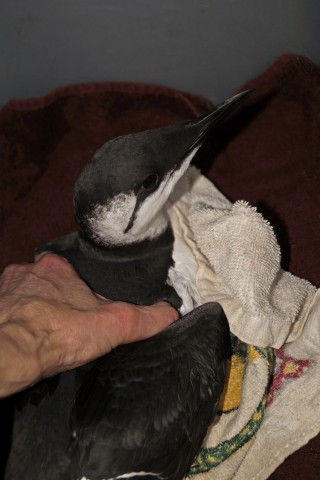
So as I chased after the Murre, I could easily picture the bird propelling itself over rolling waves the way it was rowing itself over the undulating snow layer. The only way I was able to keep up with it at all was because it kept fetching itself up against spruce boughs and stopping, which gave me time to struggle through the thigh-deep drifts and catch up to it. Finally it slid down into a bowl beneath a spruce and got tangled in spruce branches-enough that I was able to grab it with the towel before it could get itself free and take off again. For my efforts I received a stab on the underside of my wrist with its needle-sharp bill. I quickly placed the Murre’s head inside my jacket and it instantly became quiet and still. I struggled back to the car, filling my boots with snow, and placed the Murre in the tub, taking a quick photo to get a size reference with my hand on its back. The bird was in good condition. I couldn’t feel its keel bone (a sign of starvation), and its feathers were clean and in nice shape.
I called Billy. He and Tod had just returned from releasing Murres at the river. They would keep the Murre overnight and take it to the open water the next day. I turned around and drove back to Talkeetna. I met Billy at Tod’s place and gave them my ‘Murre in a tub’, where it would spend the night. They told me how that day’s release had gone and Billy said he would email the photos to me.
I called him a couple of days later to see how the release went on the thirty-first. A few more people had gone with them, and more Murres had been gathered. (Details were posted on Facebook.) Meanwhile, I had received a call from Carl Brooke, who lives up Montana Creek road. On the afternoon of the thirty-first he had been working out in his yard when “a black and white bird landed near me and stood up on its hind legs, looking at me.” (I smiled at the description, as all birds only have two legs….) He remarked that he knew penguins don’t live in Alaska, so he thought he’d call me to see if I knew what this bird was. I filled him in on what was going on with the Murres. He had been able to place a towel over it and put it in a box. Billy and Tod were already on their way to the river, so the Murre spent the night in its box in the bed of Carl’s truck. He checked on it a couple of times and it was doing okay. He called Billy the next morning, but found he and Tod weren’t making a trip to the river that day. He called the Bird Center in Houston-they said to bring it on in. I had gotten a call from a friend in Trapper Creek. Her friend had a “strange black and white duck” on a snow bank in her yard that couldn’t seem to fly. She didn’t have a vehicle. I had her call Carl, who had told me he’d be happy to transport birds to Houston, if need be. He was kept busy over the next two days, making three trips to Houston with several Murres people had gathered from Trapper Creek, Talkeetna and Willow. He said he had joked with the staff at the Treatment Center saying: “I’m like the three Wisemen. Though I may not have Frankincense, I’m bringing Murre.”
The Center personnel said the birds coming in from the north were in good condition. They would be released into the Inlet at Knik Arm as soon as possible. Murre strandings seem to be taking place after high wind events, when the birds would be caught in wind currents and taken inland and forced to land, where- in most cases- they couldn’t take off again. That’s when people were finding and rescuing them.
Carl also made a trip to the Y to take Murres to a woman with fifteen Murres people had brought to her. She was on her way to the BTLC in Anchorage with her charges.
I watched a short piece on TV, on New Year’s Eve, about the Murres filmed at BTLC. On the thirty-first they had expected just over one hundred birds to come in to the Center. One hundred-twelve had been brought in to the Center since November. Under a certain weight they couldn’t be saved, but the majority had been tube fed, cleaned and when brought up to a certain weight, released into open water- usually in Cook Inlet at Knik Arm.
On January second, during the annual Winter Bird Count in the Talkeetna and Trapper Creek area, only three Murres were seen. Billy had been going out to the river almost daily and had not seen any Murres in several days.
Then, on January 6th, I saw an article on the front page of the Alaska Dispatch News paper: Murres had been washing up on the shores of Prince William Sound in Whittier by the thousands. Over that prior weekend an estimated count was seven thousand, eight hundred birds dead along a little over one-mile stretch of beach. Fish and Wildlife officials said “the survey probably signifies an even larger loss- maybe tens of thousands- of Murres throughout the Sound. The on-going evidence seems to point to the intense El Nino event, driving the bird’s food supply deeper than the Murres can dive.”
On January eighth I listened to “Science Friday” on the Anchorage station, and the talk was about El Nino. It was stated that while El Nino cycles every two to seven years, an intense event only happens every fifteen to twenty years. After the last one in 1998 there was a ‘whiplash’ the following year with an “La Nina” event, bringing unusually cold ocean currents and temperatures. This would be good news for the Murres, perhaps, allowing them to recover and start to rebound. But whether this will happen is anyone’s guess. El Nino generally lasts January through March, sometimes into May. So the Murres still have two to four months through which to struggle.
If anything positive can be said about the Murre’s plight, it’s that the predators and opportunists-from voles and shrews to coyotes, foxes, eagles, ravens, etc., are having quite the bonus, this winter. And the Murres food source, wherever they may be, not having the birds preying on them, may have the chance to increase in numbers, which could benefit many species in the long run. It may be a long time before we see the final outcome of this extraordinary Murre die-off and its ripple effects. For everyone who felt moved to help each stranded Murre, even though it may have seemed pointless, know that it mattered to that bird. A second chance may turn out to be a last chance, but it’s in us to help the suffering, and I will always applaud that part of our human nature. Thank you, one and all. Let’s hope for the best.
Story and photos by Robin Song