In this Natural Observations, Robin Song takes us on a closer look at some of the inhabitants of area wetlands, and some interesting relationships between them.
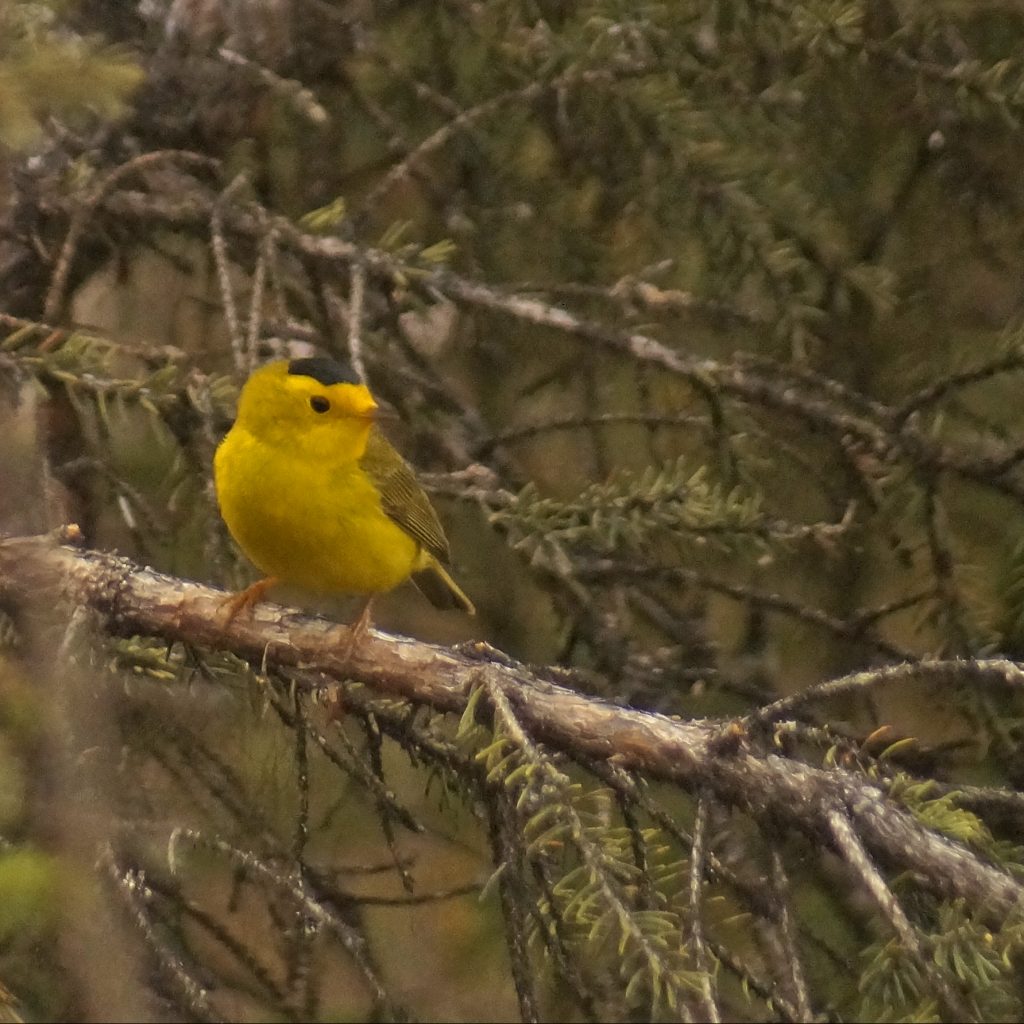
As winter changed into spring in the wetlands east of the house where I have been living just south of Willow, my excursions there with my two dogs grew more interesting. On the morning of April twenty-second, when I let the girls outside, I was surprised to find a pair of Lesser Sandhill Cranes standing at the edge of the forest in the large clearing just east of the house. They walked slowly through the long brown grass, exposed by the melted snow, unimpressed at being watched by two dogs, a human, and two cats. For the next few weeks I heard them calling out in the wetlands-sometimes flying, sometimes stationary. By mid-June they were apparently nesting, for they had grown quiet, not wanting to draw attention to their nest site. I’d occasionally hear them very late at night, calling from the same area. Cranes have been nesting in the wetlands for several years-perhaps decades before people moved into the area. I hope the wetlands remain their nesting territory for many more decades to come.
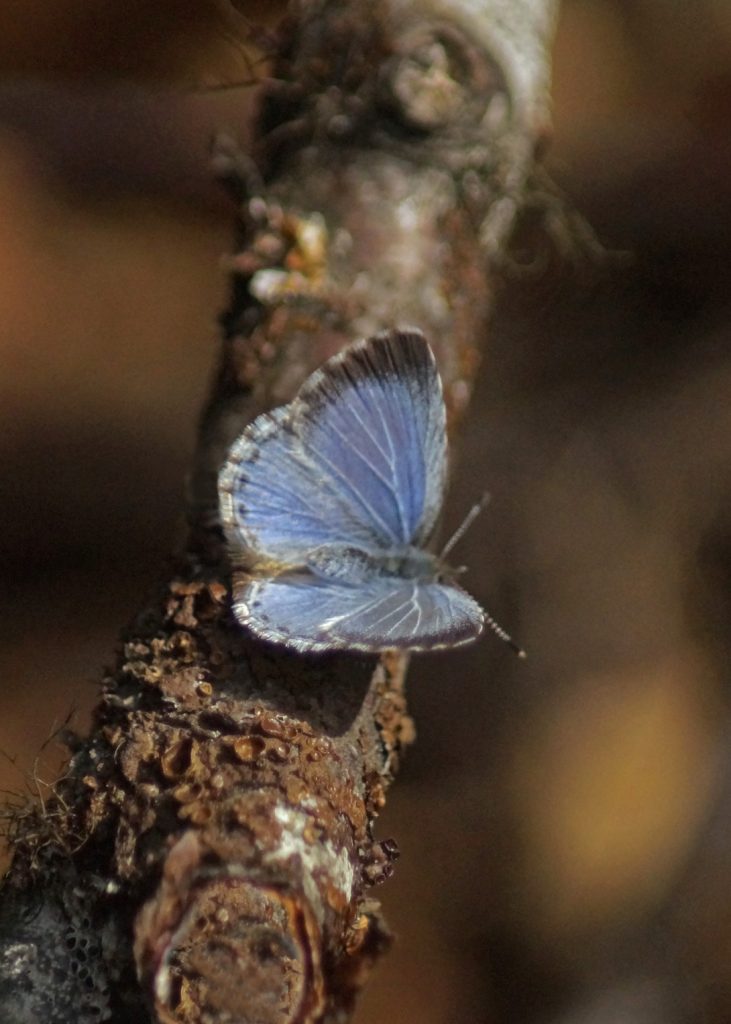
As the trees leafed out, songbirds arrived. I marked each species on my calendar, along with the first sighting of insects. The rites of spring is always an exciting time, for me. Now, on my walks out to the bog nearest the house, I made mental notes of the first Bog Rosemary, Wintergreen blossoms, Leather Leaf blooms, Twin Flowers, etc, to jot each onto the calendar upon my return to the house. I also took the camera along, waiting for special lighting on a flower, or a chance to photograph a favorite insect. On April twenty-fourth I noted there seemed to be an extraordinary number of Spring Azure Butterflies flitting amongst the Labrador Tea blooms. The males are azure blue, giving the species their name, while the females are a pale chocolate brown. When the diminutive butterfly lands, it brings its wings together, closing them vertically above its body. The underside of the male’s wings are pale brown with black and white spots. I was having no luck photographing the lovely blue of the male’s wings, even when one landed between Lyra’s ears. Then, finally, one landed on a birch branch and slowly let its wings open, exposing the blue. I approached carefully, so as not to disturb it into flying. For several wonderful seconds it left its wings open while I photographed it in full sunlight. I saw that the male’s body is covered with soft blue fuzz, something I couldn’t see with its wings closed. When the tiny male suddenly took flight, I sent it a heart-felt “thank you!” for the opportunity to get some rare beautiful open-winged photographs.
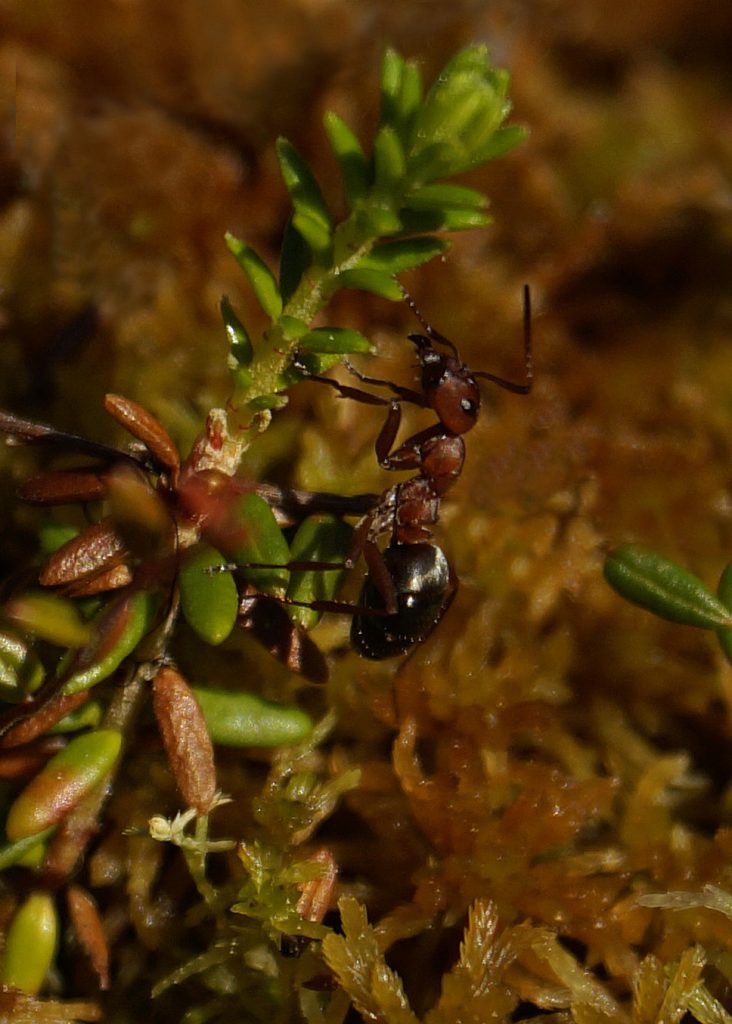
A magical day happened out in the wetlands on May thirty-first. It was a bright, sunny morning as the dogs and I traversed the musher’s trail winding through the bog. A splash of bright yellow caught my eye in the carpet of green moss. Like something from a Fairyland, a small clump of tiny ‘parasols’ on cherry-red, slender stems rose a few inches above the moss. There was not another duplicate of this plant anywhere in sight. I kept the dogs from stepping on this fragile wonder and knelt to take several photos. As I spent time doing so, I noticed several small ants scurrying through the moss in the trail. They were climbing up and down the stalks of plants, and weaving in amongst the moss and various other plants. I took many photos of them, which proved tricky, as they moved very quickly and the camera had a hard time focusing on them. I did manage to get one good photo.
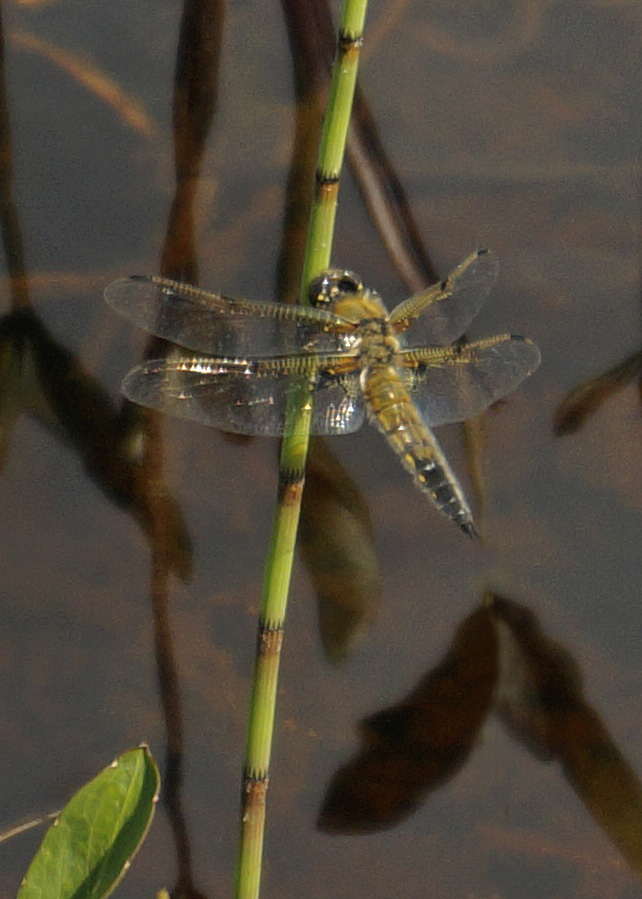
I headed on out to the pond, where several kinds of dragonflies and damselflies darted about. Again, the camera was hard-pressed to keep up with them, and I was getting a lot of fuzzy shots. Finally two landed long enough for me to work my way carefully up to them to get photos before they flitted away again. One was a small, slender yellow dragonfly with very glittery wings which flashed silver in the sunlight. The other was a quite large pale yellow dragonfly with a plump, fuzzy body. There were also a red dragonflies, but none of those would let me approach close enough to get a photo, whenever one would land on the stem of a plant. The slender, bright blue male Damselflies were also camera-shy, too busy chasing the brown females.
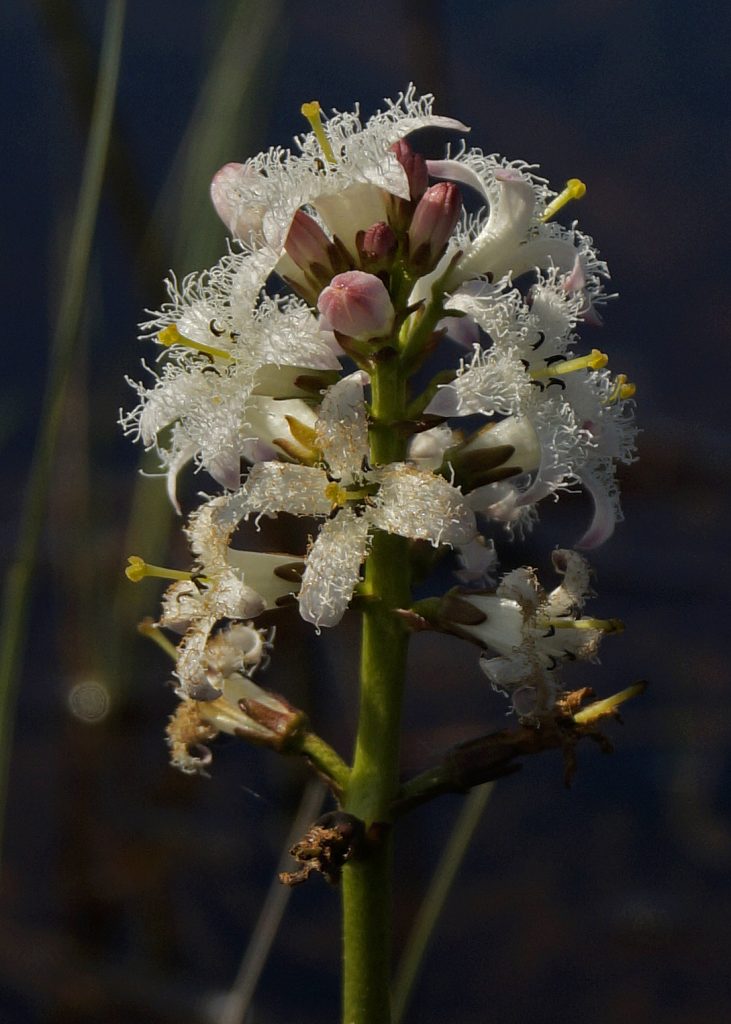
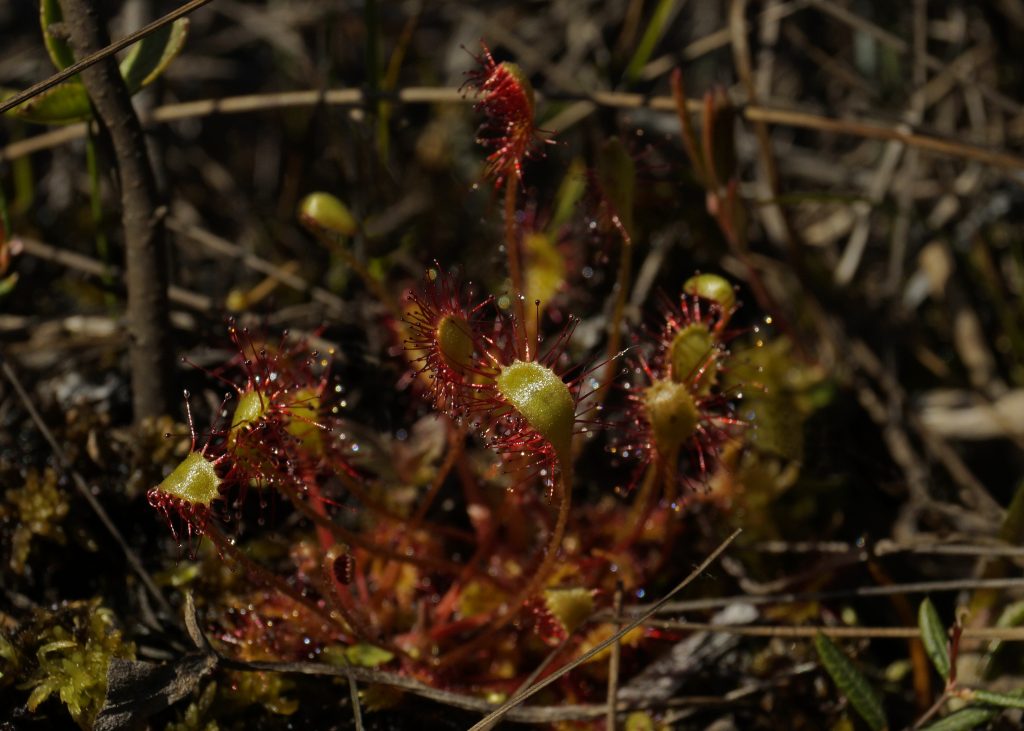
I noted one of my favorite bog flowers blooming, and stopped to photograph the lovely white Buck Bean, also called the Bog Bean. When studied up close, it’s amazingly complicated, with intricate frilly petals, black and yellow centers, and pink buds. Nearby I found the tiny Sun Dew-an insectivorous plant. Its blades are covered with reddish, gland-tipped bristles which exude a clear gelatinous substance used to trap small insects. Even though deadly to insects, this plant, when backlit, is like a sparkling jewel of red and gold.
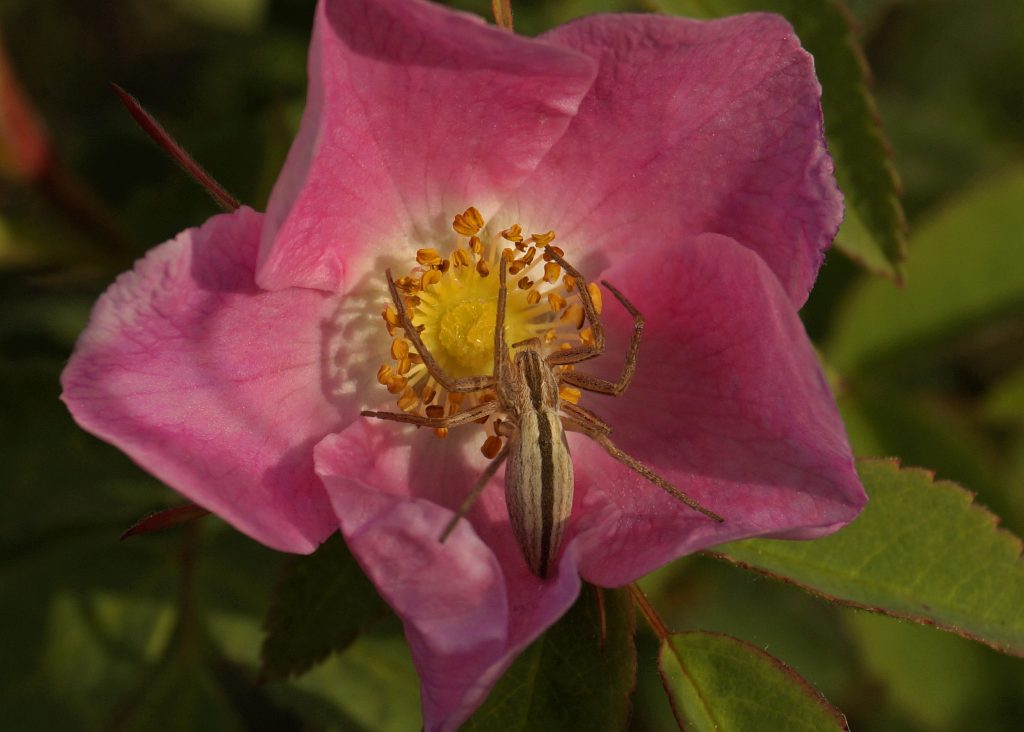
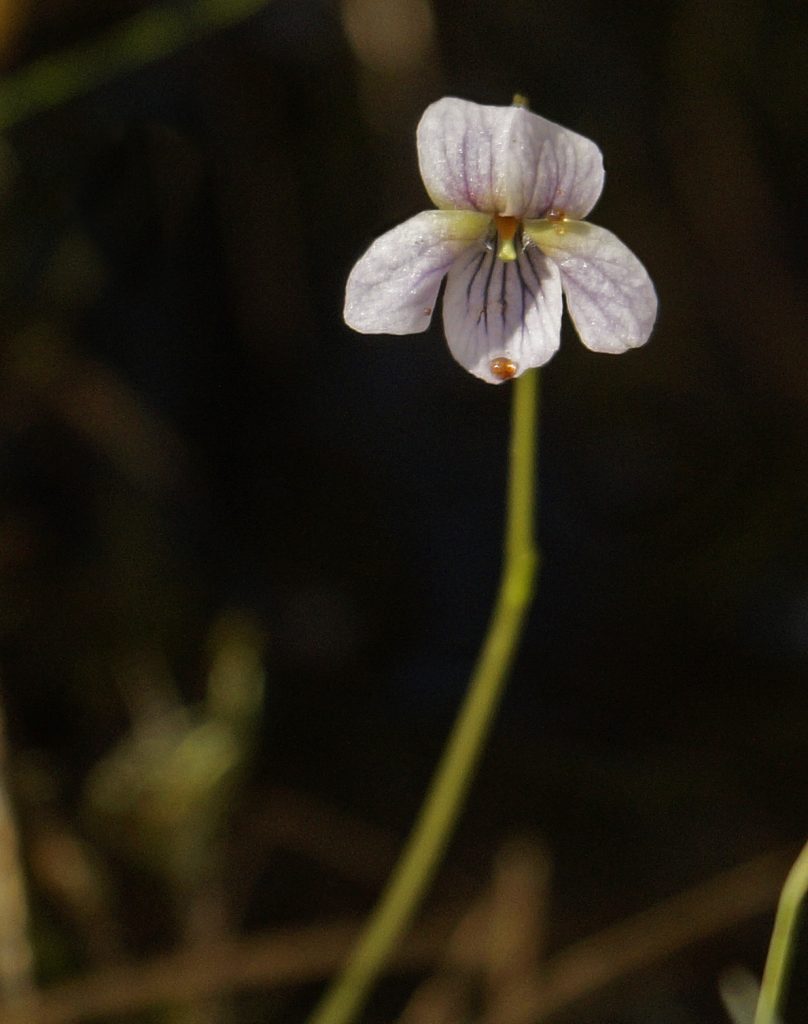
Heading into the forest, I knelt to photograph the tiny Bog Violet. Nearby I spotted a few pink Prickly Roses. I found one facing the sun, just right for photography. As I brought it into focus, I noticed something in its center. I went in closer and was amazed to find a sizeable striped spider sitting motionless.
Back at the house I went to work. I couldn’t find the striped spider in the Alaska Insect (and spider) book, so that one remains a mystery. I did find the yellow moss. It has a name bigger than it is: Splachnum luteum, and is listed as the most spectacular moss of western North America. It also comes in red. The plants only grow on animal dung-usually moose dung. I had missed that-but the moose nuggets were probably buried under the green moss and dirt in the musher’s trail. The plant’s spores are dispersed by flies, and it’s believed that the ‘parasol’ shape of the expanded capsules make for an easy place on which the flies can land. The flies then pick up plant spores before flying off to fresher dung, there to lay their eggs and facilitate dispersal of the plant’s spores.
I also found out that the Spring Azure caterpillar “possibly feeds on Labrador Tea”, according to the “Insects of South-Central Alaska” book. That would explain why I saw so many butterflies amongst the Labrador Tea plants. The book also states that the caterpillars feed on flowers and have a symbiotic relationship with some ants. The caterpillars secrete a sweet liquid which is used by the ants, and the ants protect the caterpillars from predators-though it doesn’t say how they do so.
Ants, the book states, belong to the family Formicidae. There are twenty-four species and seven genera in Alaska. They are widespread and-when numerous-are known to influence the types of species of insects living in their immediate environment. The Spring Azure butterfly caterpillar would be one example.
So I came away learning new things about ants and caterpillars, mosses and flies.
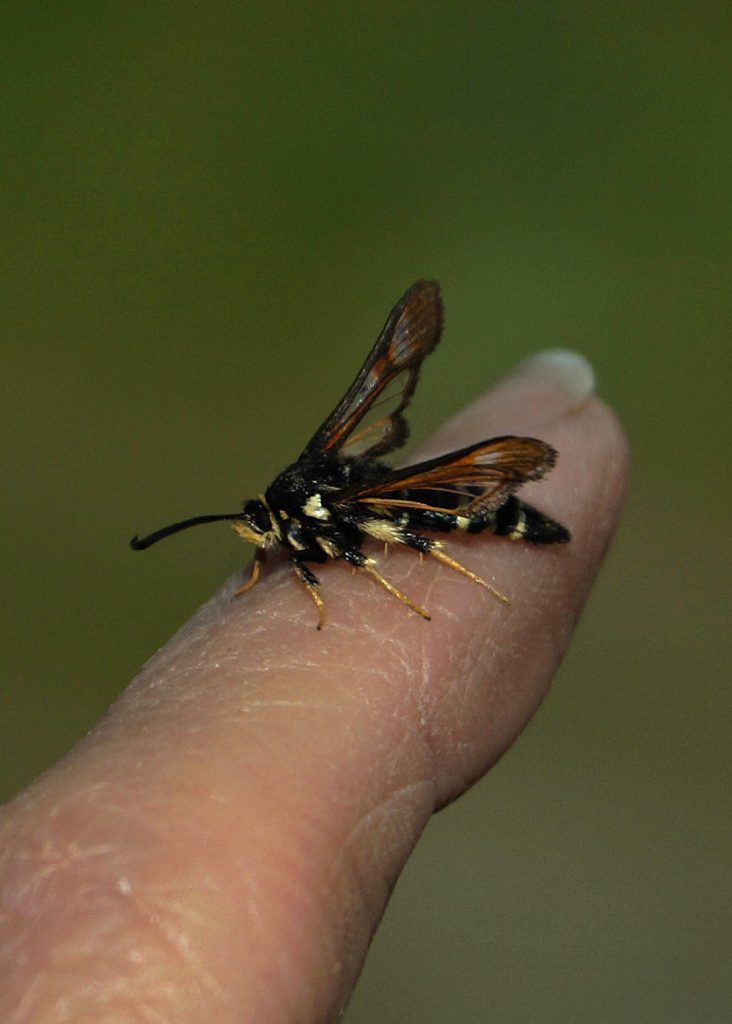
I had another treat waiting for me on the evening of June eleventh. When I stepped out onto the porch to let the girls go for their last outing of the day, I caught sight of an insect I had only seen in the book. I dashed back into the house to get the camera. I knew what the insect was, and was very pleased to have the opportunity to get photos of it. It was on the white trim of the porch window, which made for a good background, but then I wanted to get different angles, so I gently enticed it onto my finger. It was a Clearwing Moth, and a very co-operative one, at that. It slowly crawled around on my finger and then my hand as I snapped several photos, not even disturbed by the flash. It didn’t seem to want to fly away, so I carefully transferred it to the outside of the window when I had gotten all the photos I wanted, giving the moth the chance to fly off when it chose to. Looking it up in the book, I discovered that the colorful insect was a female. They get their name from the large areas of their wings which are transparent because they lack scales to cover those areas. The larvae of these insects feed on fireweed.
So, when you take a walk on a spring-now turning to summertime- day and really take the time to look at all the life going on around you; from birds to plants to insects, I mean really look, our Alaskan ecosystems are astounding. Take the time to appreciate it- you’ll be glad you did.
Susitna Writer’s Voice: Spring In The Bog, by Robin Song