A quick recap: on February eleventh I rescued a hen who had lost both her feet to frostbite, and was hoping to meet with a Veterinarian from Haines who had answered my email requesting help in regards to the possibility of fitting the hen with prosthetics in the future. I had done research on the Internet and discovered that prosthetics had been made for various birds and animals by printing them on 3-D printers. My friend CW has such a printer and agreed to make prosthetics if the hen’s legs were capable of supporting them.
The Vet in Haines had requested photos and videos of the hen, and I sent them, along with updates of how she was progressing in her re-cooperation. But after February fifteenth, I heard nothing more from the Vet. I finally gave up on the Vet and moved on to plan “B”.
I had named the hen “Jem” – a diamond in the rough. I could see that jewel sparkling through the grime, and I knew she just needed the chance to let it shine again. I wrapped the ends of her stumps in vegetable oil-soaked gauze and Vet tape to soften the dung-caked scabs so they would come off and I could see what condition the skin was in underneath. She was favoring her left leg, not wanting to put her full weight on it. I gently worked the dried poop off her neck feathers, and diligently kept her bedding very clean. Because of the wraps, she was being handled, and I was also lifting her out of the cage to transport her to the outdoor cage when the temperature reached twenty degrees each day. Then bringing her back in at night. She gradually got more used to being handled, growing more relaxed and trusting. She talked softly with clucks and trills. I knew working on her stumps was probably uncomfortable for her, and occasionally she pulled her leg away, but she never pecked at me and never raised her voice above her soft clucking. Her patience with the procedure of wraps and cleanings was admirable.
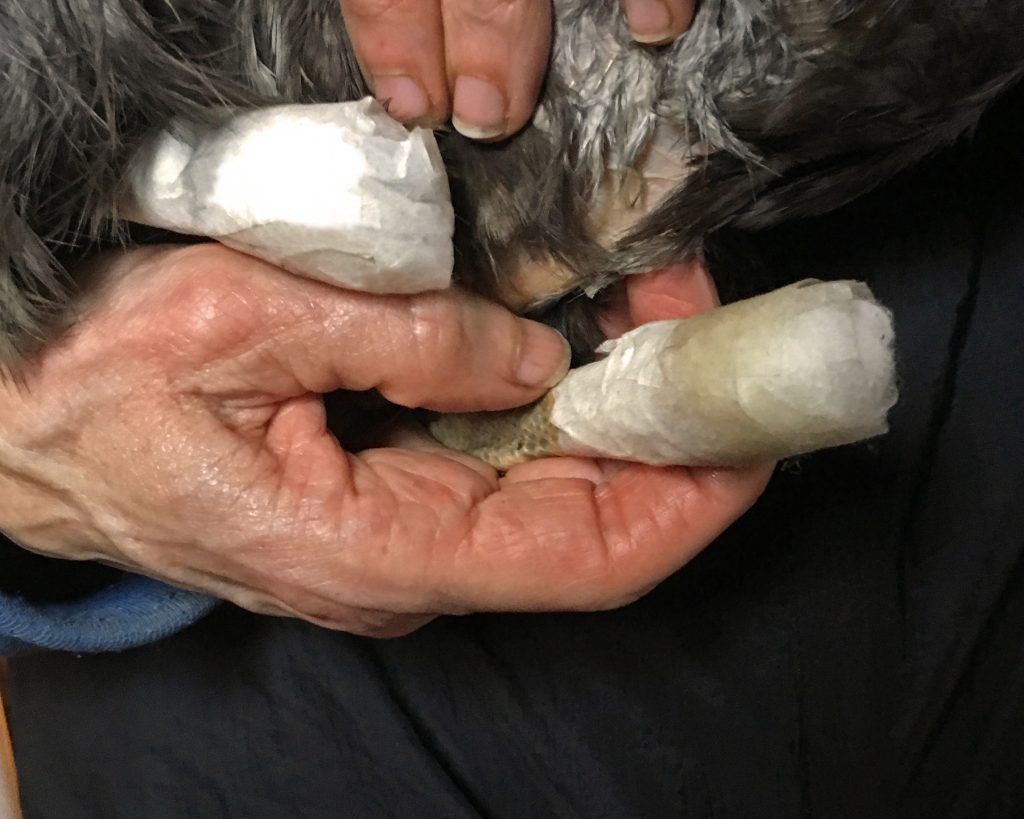
The second time I changed the wrap on her left stump, the scab came off, revealing an infection in the end of the leg. It wasn’t severe, but it did require attention. I used an antiseptic wipe and then applied Neosporin before re-wrapping it. A friend suggested using Melaleuca Oil mixed with Hydrogen Peroxide, which she brought to me. She also advised letting air get to the wounds on the stump, so I applied the mixture to a gauze pad and wrapped it in a single layer of Vet Wrap. This worked wonders, and two days after, the infection had cleared up and a new layer of healthy skin had formed over the healing wound.
I asked this friend if she would crochet booties for Jem so her stumps would be protected and she would have some support as well. And so, on Sunday the 24th of February, Jem was fitted with her first pair of booties. I put cotton on the insides to support her stumps, and wrapped the outsides with Vet Wrap to keep them clean and dry. It wasn’t easy, wrapping the tape around her legs, keeping her long fluffy feathers out of the way, and keeping her legs still when her instinct was to pull them away from the unfamiliar feeling of booties and tape. They were bulky and strange and she struggled to walk with them at first. She took a few steps, then laid down, panting with the effort in the warm cabin. After ten minutes I removed them, as she was due to go to her roost for the night and wouldn’t need to be wearing booties while sleeping.
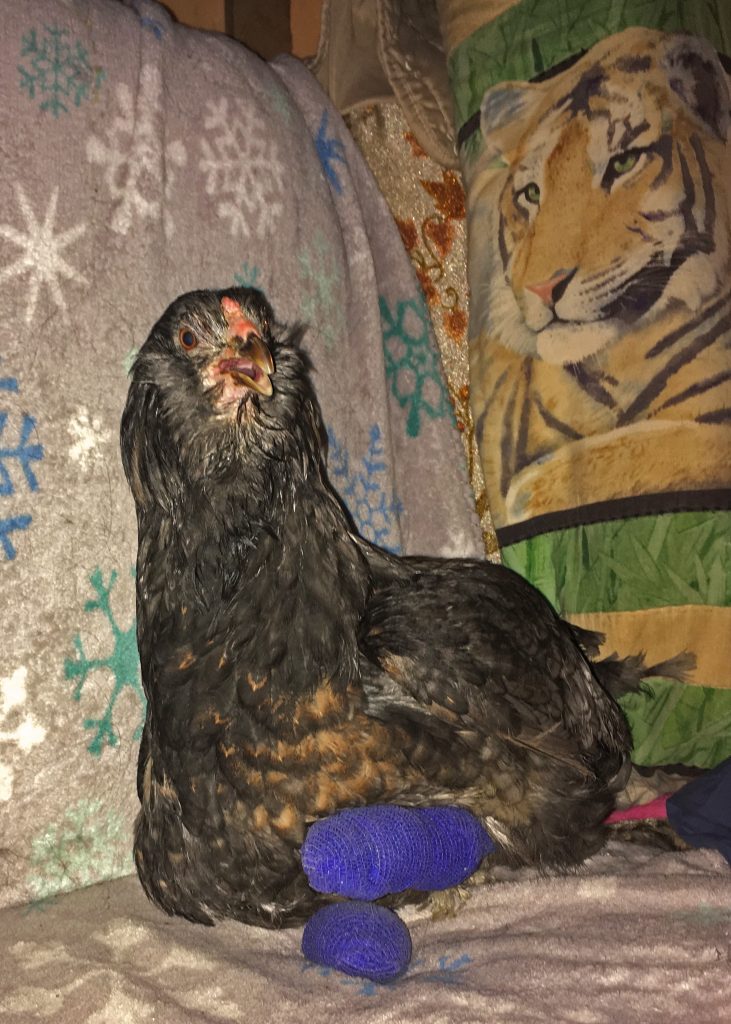
The next morning I carefully applied the booties again, then set Jem down on my dog’s bed next to the sofa so she would have a soft place to take her first steps. Using her wings for balance, she lifted her legs high, learning how to balance with the booties. They weren’t the right shape to give her the support she needed to stand upright on them, but-for now- they would give her a soft cushion for her stumps until prosthetics could be made for her. When I placed her in the outdoor cage, she moved around in the deep bedding comfortably.
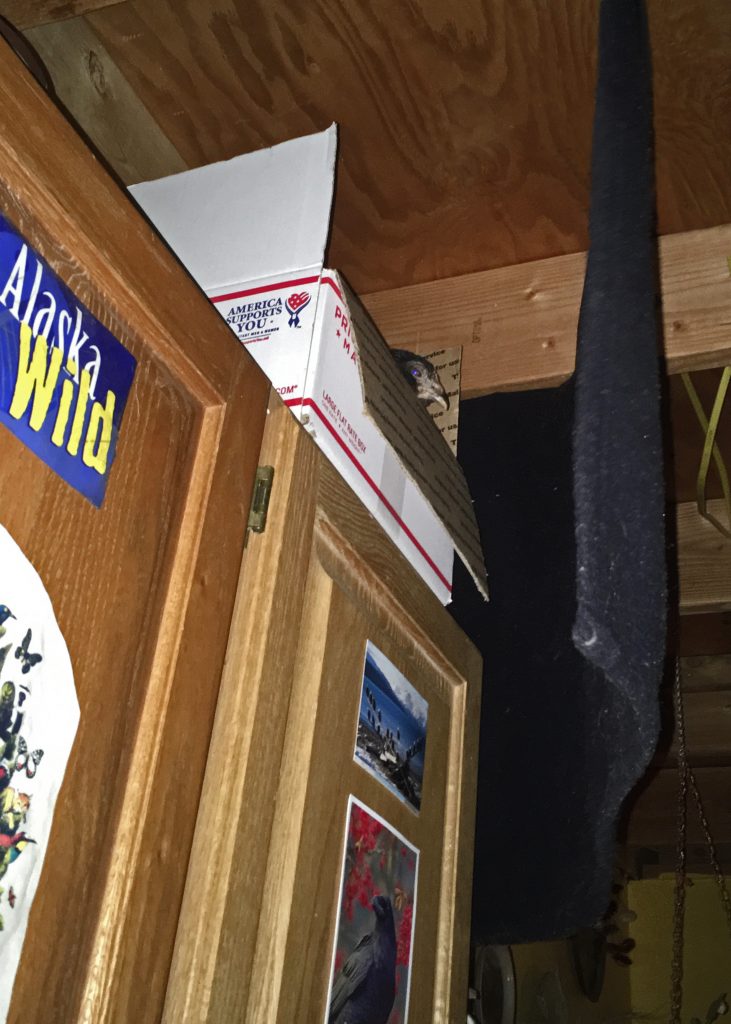
I noticed, on the third night, that she was looking up towards the ceiling while she was sitting on my lap after I had brought her in from outside and we were having a little time together before she went to roost for the night. Like all chickens, she wanted to roost up high. She couldn’t perch, of course, but I got thinking that she could be in a box and placed up high. So I fixed up a box large enough for her to turn around in, and bedded in soft shavings. I got out my step ladder and carried her up to the highest point in the cabin-placing her roost box on top of the kitchen cupboard. I knew she would be warm up there, so I hung a small fan near the cupboard and directed it to blow air across the front of her box. The ceiling fan is always on, circulating the air from the oil stove, so the little fan drew cooler air from the nearby cabin door. This worked to cool the area of Jem’s roost box. I hung a drape in front of the box to shield Jem from the light by my desk, and also from the heat from the stove. Each night I place her up there and she settles in and goes to sleep.
On Thursday the 20th, (our ninth day together) as I lifted Jem out of her cage getting ready to take her to her outdoor cage, I got quite the surprise; underneath her was a perfect pale green egg! She had finally put on enough weight and was relaxed and settled in so that her body went into egg production.
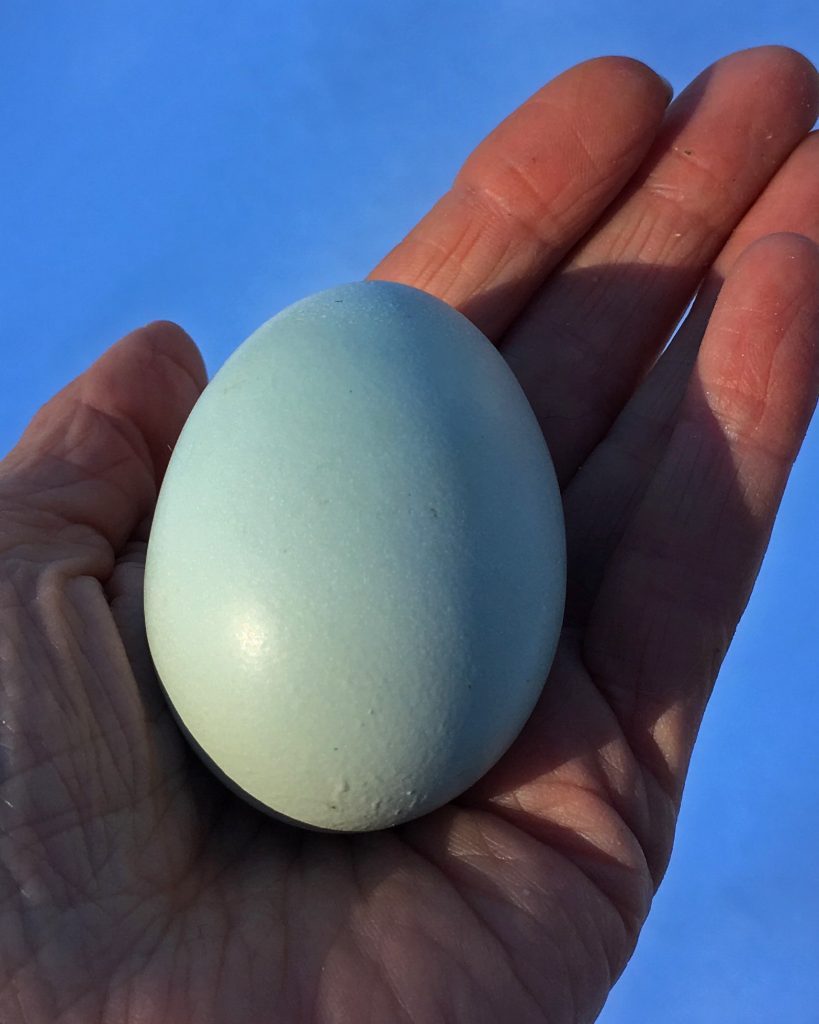
Jem is a breed of chicken called an Ameraucana. This breed lays colored eggs-primarily green, pink, and blue. They were developed in the 1970s from the original breed of chickens from Chile called the Araucana, which lays blue-tinted eggs. The Araucanas have pronounced ear tufts, and the Ameraucanas have beards and ear muffs.
Jem has the ear muffs and a beard and black feathers with amber highlights. She has white ear lobes, which in any other breed would denote that she would lay white shelled eggs, but this doesn’t apply with this breed. Her eyes are a deep sienna, and her legs are pale yellow.
After two weeks of good food and abundant water, clean, dry bedding and lots of attention and love, she put on weight and her feathers grew fluffier and more abundant. There was also a shine to them. Her eyes were brighter and her comb had plumped and gotten a deeper shade of pink-orange. She now trusted me and when I held her at night to remove her booties before she went to roost, she often rested her head in the crook of my arm and closed her eyes. I stroked her neck feathers, now soft and healthy. The rank smell had been replaced by the sweet smell of alfalfa and the smell of a healthy chicken, like faint new-mown grass. I marveled at her bravery.
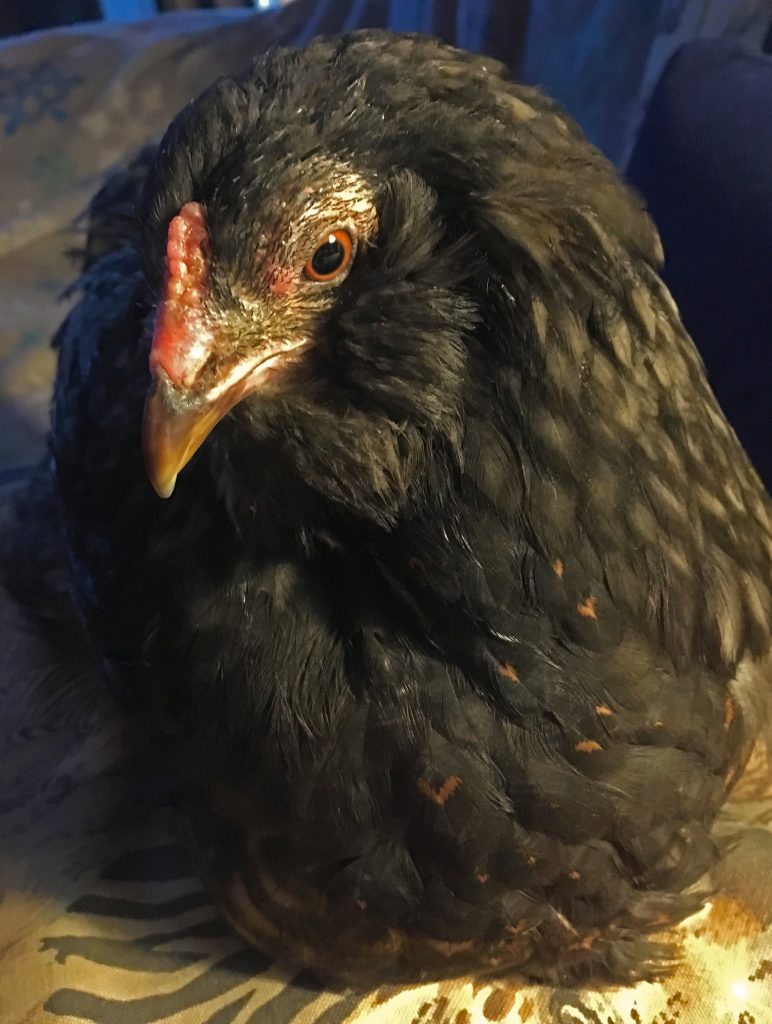
Through no fault of her own she had found herself in a dire predicament. She’s young-less than two years old- and she faces a life without her both of her most important limbs, her feet. She’s vulnerable and she knows it. She has to place her trust in me. Every time I pick her up, she has to give herself to me, and she does it without struggling. When I place her back down, and watch her moving awkwardly, using her wings to balance as best she can, I marvel at her determination. Sometimes after I’ve changed her wraps and I’m kneeling in front of where she’s sitting on the sofa, we look into each others eyes. I wonder what she is thinking. Where does all that bravery and will to live come from in one small hen? She is an inspiration. Her story has just begun. She has a long road ahead. I will keep telling what happens. Jem’s prosthetics come next. And finally meeting with a Vet. Not the one I had hoped, but – as it turns out – a local Vet with a big heart.
I don’t know if Jem will be able to stay with me. Right now my other House Hen – Jorie – is not accepting her and I’m having to keep them separated. This is not easy in my small cabin. Will they work it out and become friends, or will I have to find a ‘forever home’ for Jem…Wherever she ends up, I will keep tabs on her and share her story. This brave hen has won a special place in my heart.
——————————————-
A Very Brave Bird, part 2 Susitna Writer’s Voice, KTNA
Robin Song, Natural Observations
March, 2019