A cool damp day in April, 12 years ago found me on my back under my new cabin, cursing and groaning, and stapling hardware cloth to the log joists above my head so I could then insulate the floor from above. I squirmed around with only 11/2 to 21/2 feet of clearance. I was bundled up with a few layers, including a carharrt jacket. The following day I was relieved to be done with that job but had a very sore muscle in my back, just down from the shoulder blade, a couple of inches from the spine. That’s a strange place to have a sore muscle, I thought. And I wasn’t sore anywhere else. The strange soreness went on for a week. I had no mirror and couldn’t see back there. At some point I began to notice a little pinprick bump when I felt the area with my hand. Finally I went out to a friend’s house where there was a large mirror. I took a look and saw a red dot with some swelling around it. A spider bite? I wondered. But what was that little bump? Finally it dawned on me. A porcupine quill! I’d seen porcupines going under my cabin looking for things to gnaw on. They must shed quills like animals shed hair. And I’d been squirming around down there. But it made it through all those layers?! I had my friend get some tweezers and she was just able to pull it out. It had travelled from where it had entered, headed for my spine, but began to exit an inch from it.
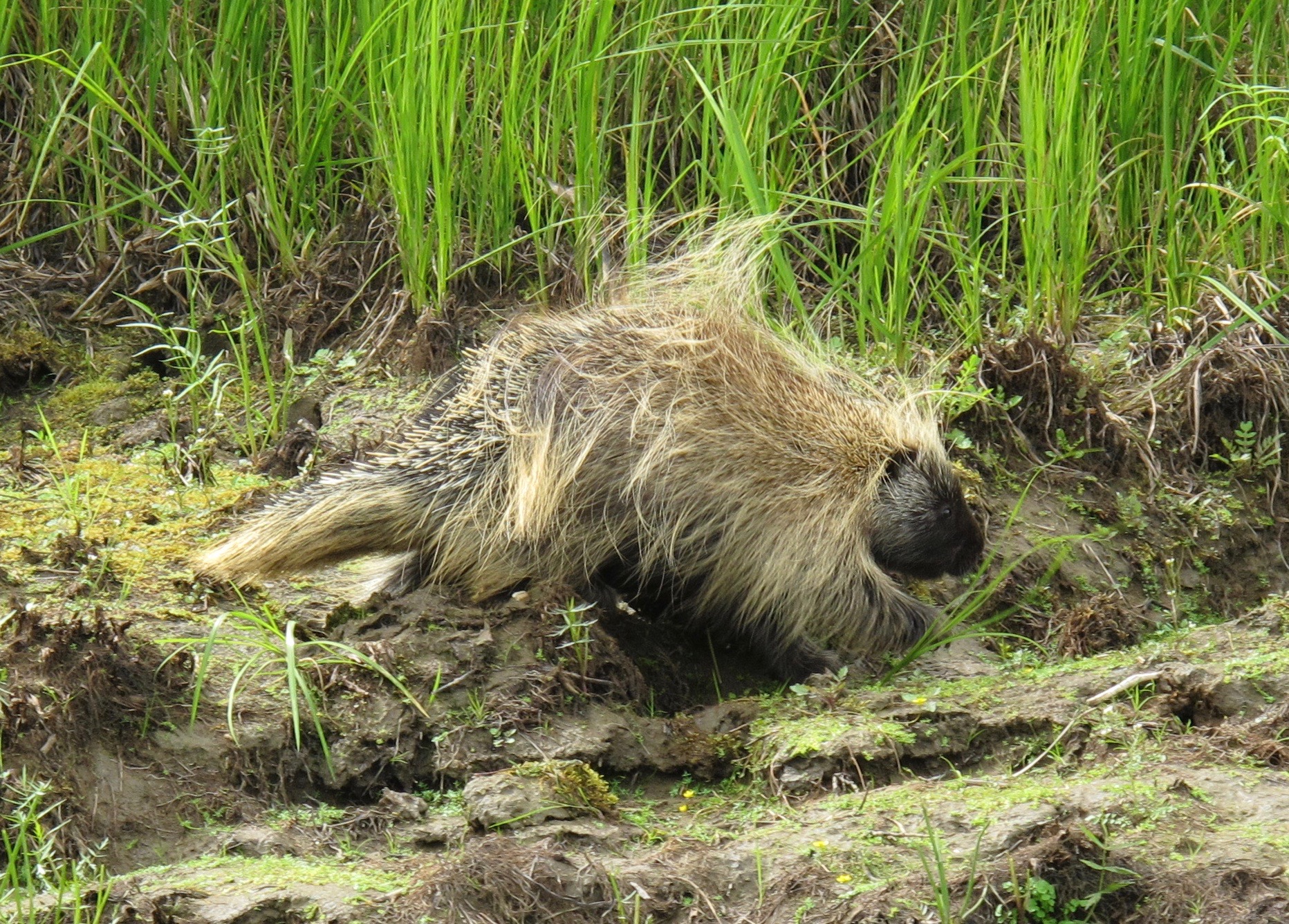
Porcupine quills are, indeed, modified hairs, hollow at the base, made out of the protein, keratin, which also comprises fingernails, feathers, horns, and claws. Like hair, quills are shed but start growing back not long afterwards at a rate similar to human hair. Contrary to popular belief, porcupines do not shoot their quills.
The name porcupine means “spiny pig” in Latin. In North America, they are second in size to the beaver.
The first time I ever saw a porcupine I saw 2: a mama with a baby on her back. Babies are born with soft quills which harden after a few hours. After a gestation period of 210 days, extremely long for a rodent, porcupines give birth to one precocial young: eyes open, teeth in place, and able to walk. The young nurse for almost 2 months but start eating after about 4 days.
The first time I saw a porcupine in Alaska I thought it was a wolverine. A stocky low to the ground animal striding across open tundra. Although mostly arboreal, porcupines are known to roam widely, including in alpine tundra. Porcupines are herbivorous browsing on the buds of willow, aspen and birch in the springtime, grazing on grass and herbaceous plants in the summer and leaves in the fall. In the winter they mostly subsist on the inner bark of trees, preferably spruce but also birch, aspen, and alder. However, the tiny amount of protein in bark is not enough for them to maintain body weight through the winter and they slowly lose weight.
In spring time porcupines feed on the buds and young leaves of birch, aspen, and willow before these plants start pumping out tannins in self defense, making them unpalatable and toxic to herbivores. This new spring growth is high in potassium. Porcupines need to balance this potassium with sodium. Females have the largest salt cravings due to hormones and significant sodium loss during pregnancy.
Porcupines are a frequent visitor to my cabin in late April and early May. It’s rare that I see them other times. They are looking for salt and most human habitations are a good place to find it. They get salt from the glue in plywood, sweat impregnated tool handles, and extension cords. I used no plywood in the construction of my original cabin but they sure like the permachink log finish. One lower log has gnaw marks along it’s entire length. A porcupine is not afraid to barge in on my place and help herself to whatever she pleases. Several times I’ve almost tripped over one as I dashed down my stairs to grab something under the overhang. Recently I heard one under my shop and went out to look. There was a porcupine in the most vulnerable, awkward position you could imagine. She had wedged herself between a lower log and a pile of lumber and was gnawing on a piece of cedar driftwood I had gotten in Kodiak. After witnessing this obvious desire for salt- they don’t chew on lumber from around here- I decided to start putting salt out for them. I sprinkle it on stumps around my grounds. It appears to really work. I return at the end of a summer to find deep grooves gnawed into the stumps, the salt gone, and personal things intact. Squirrels like it, too. Although giving them the finest Himalayan pink salt or Celtic sea salt is probably overkill. Where there’s no humans, porcupines are known to find natural salt licks, eat mud, and gnaw on shed antlers.
The summer I built my first cabin is the first summer I saw a porcupine at my place. I was on round 3 of logs so I could still see over them from the inside. A porcupine came waddling up my trail, headed right for my work site. She went up to the anchor rope of my come-a-long and started gnawing on it. I peered over the logs and down at her and said, forcefully, “No!” She paused and considered this word, “no,” and then went right back to gnawing, peering up out of the corner of her eyes and giving me that “Whatever” look, like a bad dog. So I stomped on down, walked right up to her, and yelled “No!” My presence was enough to instill the meaning of “no” and she waddled off.
That night I was about to fall asleep in my backpacking tent when I heard rustling foot steps. My heart started to race and I wondered, bear? but then remembered the porcupine and figured it was her. Laying there I listened to her rustle through the grass right up to my tent. What is she up to? I wondered. I was not expecting what came next. She pounced on my tent: that part that comes down low in the back, the part only a foot above my head. There was a porcupine silhouetted against the dim summer night sky. But being rather slick nylon, she slid right down. But she did it again. And, whee! down she went. And then she pounced a third time and this time she stayed. There was a soft porcupine belly poised a foot above my head. I just couldn’t resist. I poked it and she rolled off backwards and waddled away. I realized, wow, porcupines have way more character than I ever expected of a rodent. At the time I was mourning the loss of our family dog who had died the previous winter. Suddenly, I just knew: her spirit had come back in a porcupine.
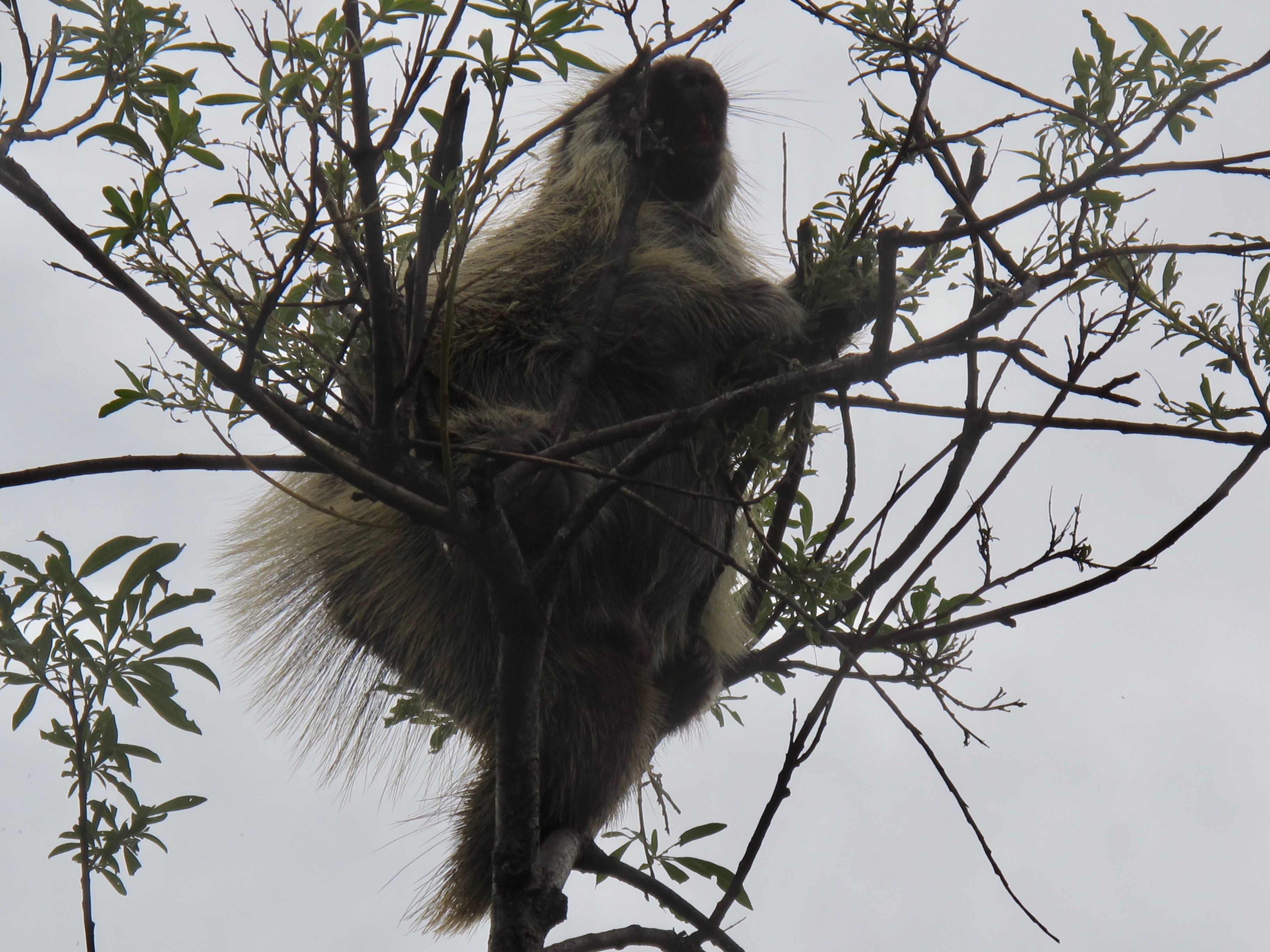
But whether they have the spirit of a beloved dog in them or not, porcupines really do have their own character. They are sensitive, have very soulful expressions, can look rather serious and just exude a vulnerability. On a canoe trip two summers ago I saw many porcupines on the Yukon come out of the forest and traverse broad quarter to half mile sandbars to wade into the river and take a drink. I realized they are probably much like bears and moose, wanting to escape the bugs and stifling conditions of the forest. I also saw them at the top of willows or alders, often in plain view, especially since many of the shrubs were under attack by a defoliating caterpillar. At one spot I camped I walked down to one of these willows to check out the porcupine just 10 feet above me. These animals seem to have a certain faith in humans. With the exception of sometimes getting shot, a porcupine will almost always be face to face with its attacker. Fishers, the relative of the marten, who don’t live in Alaska usually try to circle around the porcupine and bite it in the nose multiple times until the animal is incapacitated and can be flipped over to expose its tender belly. Other predators, like lynx, wolves, and coyotes probably do something similar. Porcupines have also fed many a hungry human easily running the animal down with a club. Thankfully, the taiga forest habitat of porcupines is vast and they have not gone the way of the dodo. I did not want to eat this porcupine; I was just merely curious. Studying it closely I thought it was getting sick on the willows which were probably sending out anti herbivore compounds in response to the caterpillar attack. The animal looked pale and then a two foot long strand of drool dripped down from its mouth and hung there. The poor animal was nauseous. My heart went out to it and I recalled the times I’ve been seasick with a similar stream of drool stretching down the side of a boat. I walked away to leave the poor animal to its own misery. But looking back I saw the porcupine going back to chewing on branches and looking completely fine and nonchalant. And then I realized- it was the nerves of me standing under it that had made the animal nauseous.
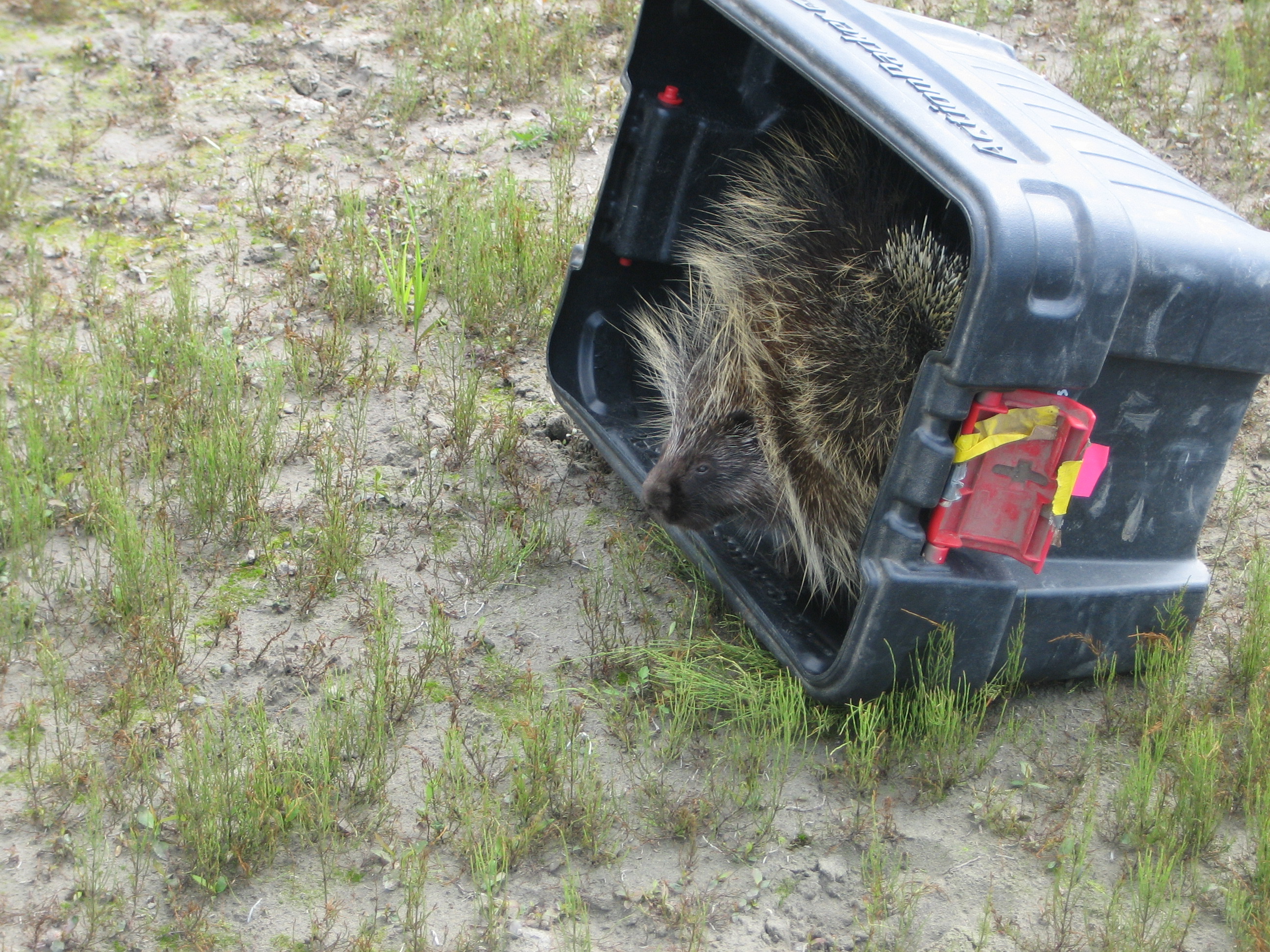
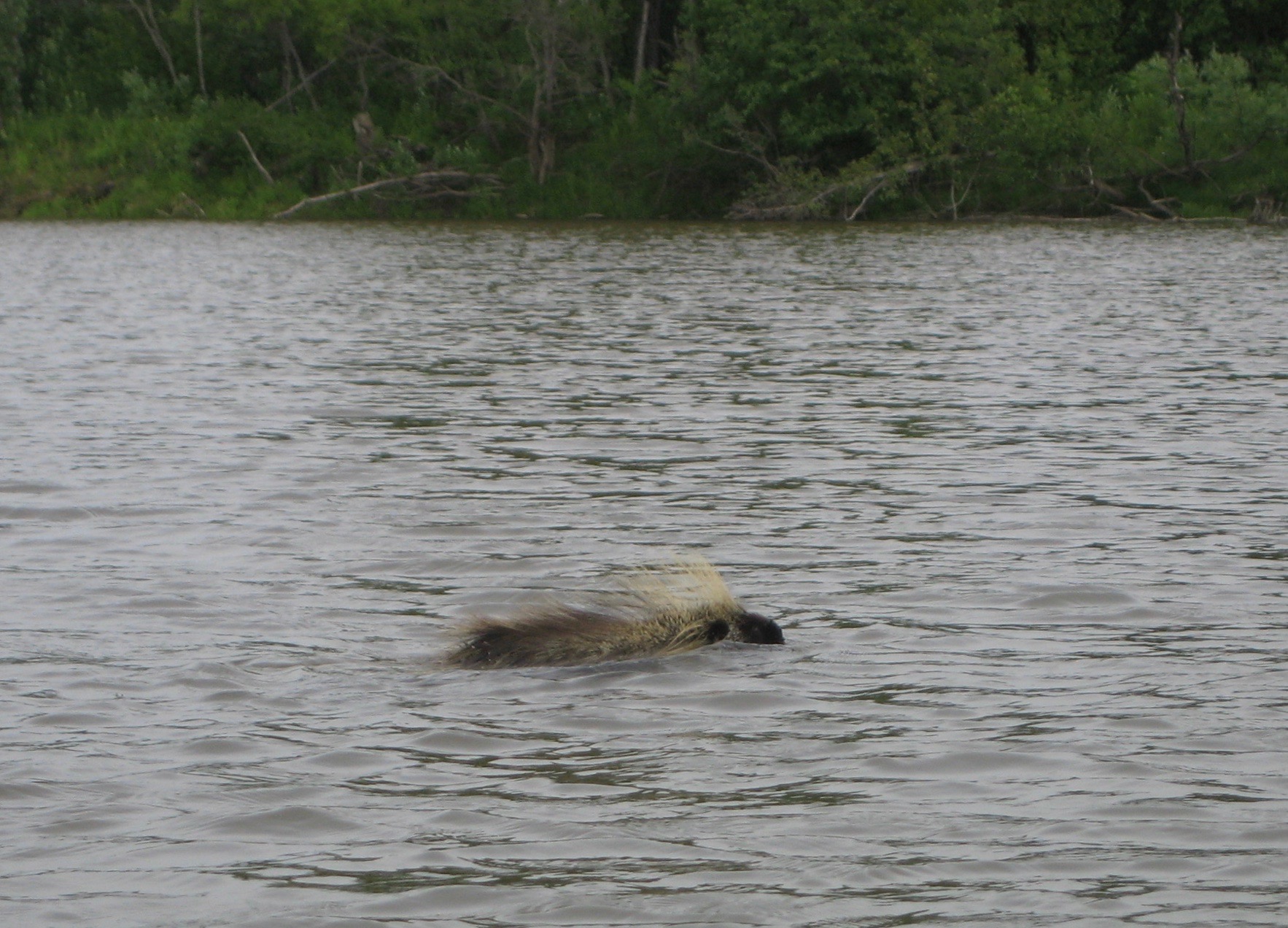
Where I worked for a Fish and Game sonar site at Pilot Station, we did what we could to porcupine proof the sonar cable- like hanging it from trees and shrubs. Bosses had a vendetta against porcupines since they can cause thousands of dollars of damage. They decreed that porcupines get shot when they’re found in camp. I don’t want to shoot a porcupine. Not even for the meat. I tried one once and it was too lean and not very tasty. One morning I showed up at the left bank sonar tent for my 5 am shift and knew something was up when there was a hole in the screen door. I went inside and heard noises. There was a porcupine on the shelf of a plywood stand, looking as vulnerable and awkward as you could imagine. I turned on the sonar and got everything running then wondered what to do with the porcupine who was cowering against the side wall and whimpering. I emptied a tote, got an oar out of the skiff, and carefully pushed the spiny animal off the shelf and into the tote. She made pitiful cries as I did so that made me both laugh and cry at the same time. I couldn’t help but feel deep sorrow for this vulnerable animal, but at the same time she had had the audacity to put herself in this situation. After a busy shift, a coworker and I took the porcupine upriver, across the river, and across a slough and let her go. From then on, at least while I worked there, we began a porcupine translocation policy. No sonar cable ever got chewed on while I was there. Later that summer though, I did see a porcupine swimming across a slough.
I like to keep the wild in our wildlife but if I could pick one wild animal for a pet, I think it would be a porcupine with their expressive faces and soft feet and underbelly. Of course, it would take a certain dexterity to cuddle with one, and then… all of those shed quills…well, okay, I best leave that idea as just a fantasy. But porcupines really are an endearing creature.