The valley ahead was notorious for its cutting wind. For several days Diane and I held tight in the last timber waiting for the weather to settle down. Morning dawned with a calming silence that enticed us to venture out with sixteen eager sled dogs. Breaking out of the trees to vast open tundra we had only our intuition to follow. No others had passed this way during the cold of winter.
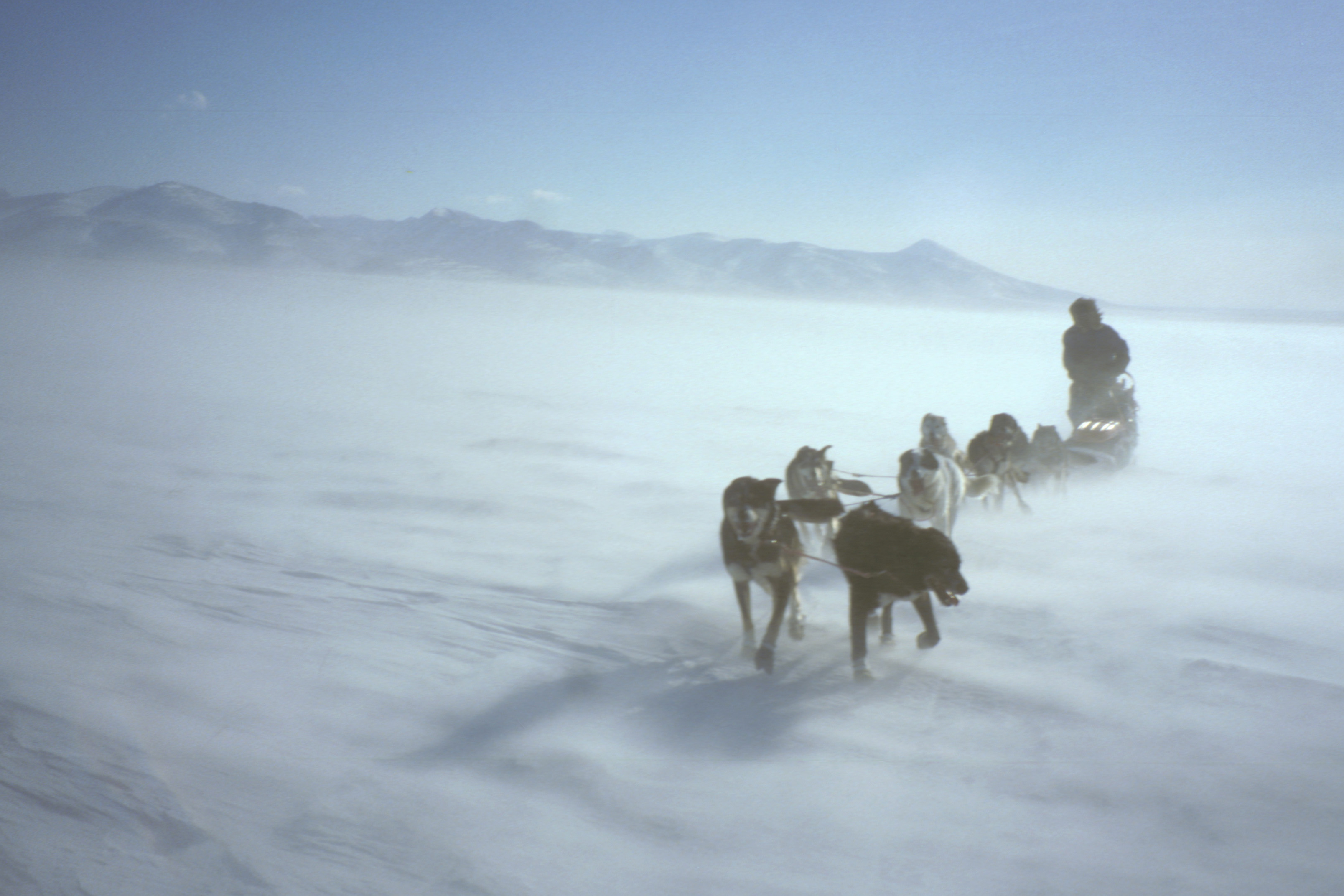
The ground blizzard intensified blurring all horizons. Miles later the wind caught us vulnerable to its power. Snow crystals slithered and swirled around tussocks and dog legs advancing down valley at a frantic pace. The advice of a weathered Koyukon elder rang in my ear, “If the wind is blowing do not go.” We pushed on into the wind.
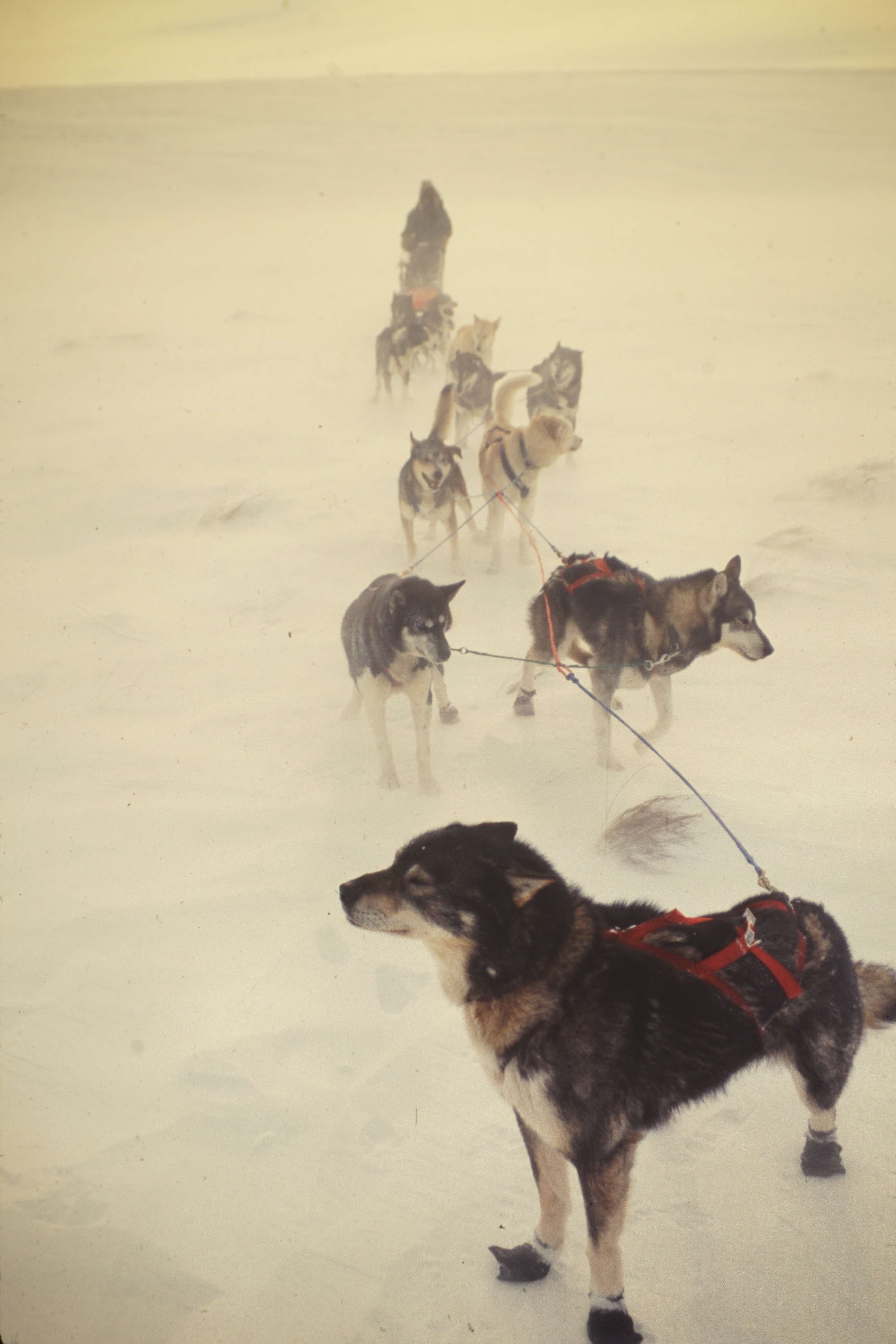
The dogs, head down, leaned into their harnesses pulling the sleds across the wind-sculpted snow on a trailless, ancient route between the Yukon and Kobuk rivers. In this barren, arctic landscape we found our way as generations of native peoples had. We carried the local knowledge of the route recounted to us by village hunters that was passed down through the ages. “Look for the big cone shaped mountain – Pyramid Mountain. It marks the way.” Interior Koyukon have used this passage through the mountains to trade with the coastal Inupiat for hundreds, perhaps thousands, of years. Storm induced anxiety was countered by the dogs wind charged exuberance. In this expanse of treeless, wind swept tundra we went north into the bitter wind.A rushing mass of blowing, hissing snow drowned out all landmarks. Facing straight into the wind became our compass. Shouting to each other over the roar we joined our two teams into one to drag sleds in tandem. I could snow shoe ahead when need be while Diane drove the dogs and handled the sleds.
During rest breaks the dogs instinctively turned from the wind except for Tiko, our main leader. He stood defiant looking straight ahead with insatiable desire. He led with intense determination in total control of his team mates, undeterred by terrain difficulties. Sensing where we needed to go he ran facing the wind.
Astride a big snow machine Cue following our dog sled tracks through the ground blizzard. His keen eyes noted where bands of caribou had crossed in front of the team. Our sled track cut a straight line through the sastrugi oblivious to the roving herds.
Cue, an elderly Athabaskan from Huslia, had grown up depending on working dogs. Well into his 60’s he was slight and athletic. For most his life dogs were not a luxury, but a means of survival. Traveling from camp to camp in search of game, his hard working dogs hauled winter camp, wood and meat. Evr on the cutting edge of technology Cue exchanged his dogs for a snow machine. Dogs required year round food and care. He could now hunt a larger area and leave his Ski-doo unfed for the summer.
Cue caught up to us atop a pass where we rested gazing at valleys with tree lined streams and mountains with wind blown tops. The dying wind allowed a soothing peacefulness to settle over the country. Nestled deep in his wolverine ruff I could see a grin on his wrinkled, wind burned face as he softly said “Must be a good lead dog”. He knew dogs. There could be no better compliment from Cue.
He came from a people made tough, ingenious and resourceful by the deep cold of Alaska’s Interior. The vastness of the Koyukuk River valley and far off mountains are as familiar to him as a city block is to most people. He has crisscrossed the maze of lowland beaver ponds trapping, plied the meandering channel of the river and its many back water sloughs in search of fish and moose. Traversing the treeless high country he was always on the lookout for anything that moved or left a track. Little goes unnoticed by his roving, attentive eyes. Passed down to him was the know how to live off this stark landscape. He is an ancient hunter, in a modern world, taking full advantage of high tech equipment.
A wolf howled, answered by a second. Instantly Cue gave chase on his powerful machine and disappeared into the broad, barren hills. Within minutes the sharp report of a high-powered rifle jolted the silence. For a moment all was quiet again then came the sound of Cue’s snow machine getting closer. Again wolves howled. He returned dragging the carcass of a huge wolf. His feet were bigger than my well insulated gauntlet mittens. Our dogs were mere pups next to his grey lifeless body. Secretly I cheered his pack mates that had escaped and mourned the wolf that stained the snow red. The irony of the hunt was not obscure to Cue. “Snow machines make it easy. If I come across the track of a wolverine or wolf I can follow and shoot it. There will be no more wolverines.” He was a hunter. He had always chased wolves. In the past he did so on snowshoes. The wolf was a cash commodity that bought gas.
He and his people are no longer nomadic and surviving solely off the land. Public schools, general store, city office, post office, airport, telephones, TV, medical clinic, running water, electricity and gas pump exert a gravitational pull to villages. It has been a fast transition for the Koyukon.
At sun set we entered the Selawik River valley where the snow piled deep and fluffy. In this windless oasis between the Continental Divide and Arctic Circle we caught up with Cue at a hot springs. A paradise of warm water in a cold land where cultures have met for generations. We staked out and fed the dogs. Cue skinned the wolf.
There were two simple, plywood cabins weathered grey. One for the Koyukon peoples and one for the Inupiat. In a meadow, thermally devoid of snow, sat one shack housing a soaking pool dug in the gravel and a sweat bath. A place to mingle.
We sat with Cue that evening, our faces flush from the warmth of the fire and the windy cold day. Listening to his stories we could feel the presence of the ancient people who had bartered and traded here. Furs from the interior and seal oil from the Chukchi Sea changed hands.
“The country is changing. The lakes are drying up. The mink are disappearing.” Cue opened the door of the wood stove to add another log to the fire casting an orange glow upon the room and his sad eyes. “Since pike fishing has been regulated they are eating all the ducklings.” He sipped tea from a chipped enameled cup. There were long spells of silence between each observation. “The winters are warmer and there is less snow.”
His winter hunting depends on thick, safe ice and snow to smooth his wilderness wanderings. “There used to be lots of wolverine before there were snow machines.” A wolverine pelt brings in good money. The wolf he shot today would not. The fur was worn with few long guard hairs. “The fur buyer pays $15.00 for a wolf head. I don’t know what they do with them.” We sat quietly absorbed in our thoughts. The fire crackled radiating its comforting heat. “In the 1970’s I escorted a teacher over to Kobuk.” He rotated the hot metal cup with both his rough hands. “When an Eskimo boy heard that I was an Indian he asked me how many cowboys had I killed.” Cue chuckled to himself for a long time. Opening the stove door he poked at the coals. A twinkle came into his eyes. “That’s what dog teams were 30-40 years ago. Must be a good leader.”
I awoke to the sound of wind. No, it was the creek kept open by the hot springs. A sound that we had not heard for a long time. The day was perfect, 0 degrees F and clear. Cue left first crossing scoured tundra of a blow hole to the security of distant spruce. By the time we reached the sparse forest Cue had an impressive stack of firewood on his sled. He sat and watched us pass by, rifle slung over his shoulder. Looking back one last time Cue was still tracking our trotting dogs. Two mixed-up cultures going separate ways.
The old hunter was at home and we had a long way to go.
“Must be a Good Leader”, by Brian Okonek