Recently, a borough document describing a potential plan for shutting down some solid waste transfer sites has caused a stir in the Northern Susitna Valley.
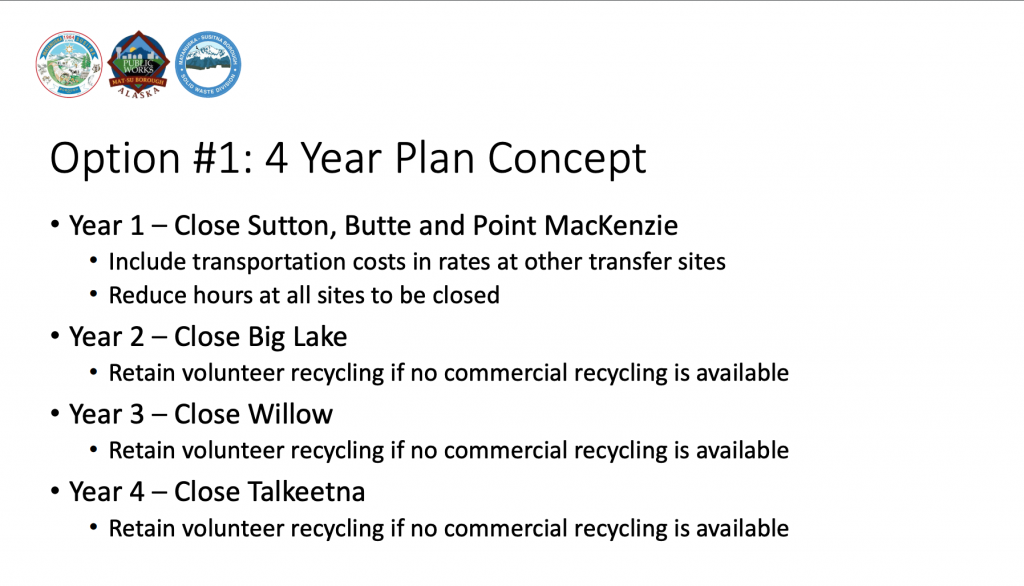
Near the end of January, Borough Manager Mike Brown’s weekly post (pdf link) on the Mat-Su Borough website included five options for reducing costs of the borough’s Solid Waste Division, which operates the central landfill and transfer sites throughout the Valley. Of those five options, the one spelled out in detail would involve closing multiple transfer sites, including in Willow and Talkeetna, over the course of four years. Many locals who saw the plan shared on social media expressed concern about the potential of the sites closing.
Terry Dolan is the Director of Public Works for the borough, which includes the Solid Waste Division. He says the options listed by the borough manager came after discussion within the borough assembly about reducing costs for waste disposal.
“His expectation was…if the [Mat-Su Borough] Assembly was interested in discussing the options there, that once they had the information, they could take it up in an informed manner and deal with it. And if they wanted to take up legislation that changes the way the system operates, then they could do that.”
As of now, that legislation has not been forthcoming, which means the options laid out within the document currently live purely in the realm of the hypothetical.
Dolan says the transfer sites listed in the hypothetical closure plan are in communities where commercial refuse service is available.
“We wanted to show what that would look like in terms of costs to residents if we closed the transfer station and they had commercial service. I’ll tell you the one where the commercial costs were the highest was Talkeetna.”
Due in part to the length of the haul from Talkeetna to the central landfill, commercial trash pickup would cost Talkeetnans around eighty dollars a month, more than double any other listed community.
Barring any legislation from the Mat-Su Borough Assembly, the transfer sites will remain open. That means looking for other ways to reduce costs for dealing with the Mat-Su’s trash.
While Dolan says the Solid Waste Division is doing better on operational costs versus revenue, replacing landfill cells that cost more than $5 million each is something that the division is still having to take out loans to pay for.
Retiring an old cell and opening a new one is so expensive because, as Dolan explains, it’s a lot more complex than just digging a hole.
“When you put a new cell in, there’s multiple layers on the bottom of real thick plastic…that makes it sort of like a swimming pool that holds the liquids in. And beneath that, there’s a layer of material that’s designed to seal it if it’s inadvertently punctured.”
One way of reducing the cost of new cells is extending the life of existing ones. That was the borough’s rationale for getting involved in community-based recycling efforts, including in the Northern Susitna Valley.
Jeff Smith is the Borough’s Solid Waste Division Manager. He says recycling is having a measurable impact on landfill cell life, and that other methods of reducing the trash that goes into them are also being employed.
“Just the recycling component, we save generally about two months out of the cycle of one cell. But that doesn’t include the composting that we’re looking at and some of the brush grinding…as well as the metal….Each little component we can pull and put aside adds a little bit of life to it.”
Both Smith and Dolan say another item being looked at is taking vehicle tires out of the landfill mix. With recycling, a common challenge is finding industries that want to buy the repurposed material. In the case of tires, there are multiple options, including the potential for water-permeable paving and even as material that can help with some of the landfill’s operations.
For now, there is no expiration date on the Willow and Talkeetna transfer sites, but that could change if an ordinance is introduced and passed in the borough assembly.