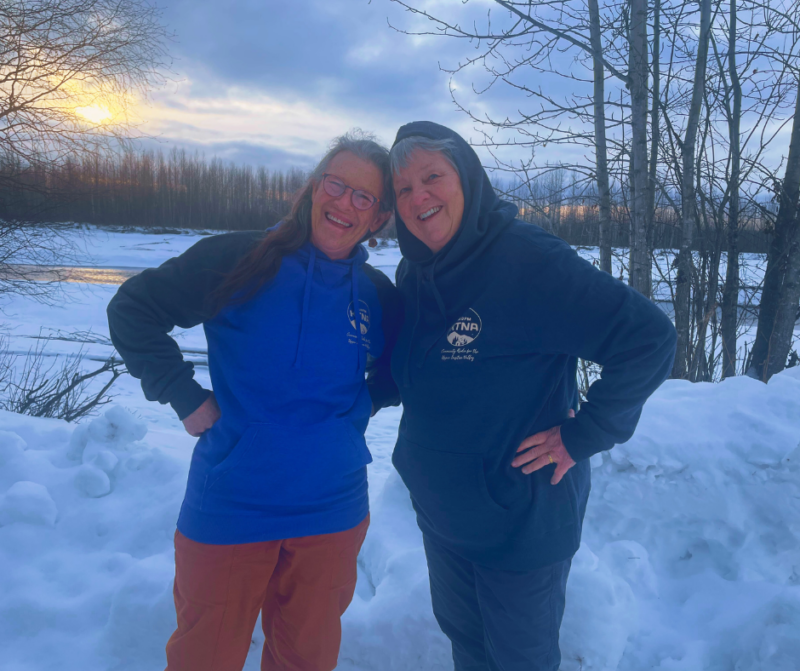
Further context: While Mike Sterling was a key player in getting Sunshine Transit started, a large group of community members recognized the need for public transit at a local symposium in 2008 and worked together to make it happen.
When COVID-19 hit Alaska, many businesses shut down for an extended time. Kim Schlosser, Executive Director of Sunshine Transit, didn’t see that as an option. Demand for public transportation in the Northern Valley did not slow down when the pandemic hit. Donning masks, the transit kept its engines running. Now, Sunshine Transit has its eyes on purchasing a building that will help them sustain the essential services they provide.
Sunshine Transit was started in 2009 by Talkeetna resident, Mike Sterling, with one van and himself as the driver. Thirteen years later, it’s become a lifeline that many can’t do without. When Kim Schlosser took over the helm of the transit in 2014, ridership had grown to 1,500 rides per year. By the time the pandemic hit, that number had ballooned to 16,000 rides per year. Schlosser explains that, while ridership was down slightly during the pandemic, it wasn’t down much.
“It went down slightly. But because we’re in such a rural area, they have to have it. It’s not an optional thing. If they don’t have our service, they either don’t get out or they don’t get their supplies.”
Sunshine Transit also pivoted during the pandemic, increasing their array of transportation services.
“We also added on delivery service, food box delivery from the food bank, prescription delivery so these people didn’t have to go out. They had grocery pickup from Walmart or Fred Meyer. We also picked up from Cubbies.”
Schlosser explains why she thinks the transit has become an essential lifeline for many in the Northern Valley.
“It’s a lot different transit than anywhere else because we care about our people. Whether we’re talking about school kids or we’re talking about senior citizens. We take people to the laundromat, we take people to the thrift store so they can buy things at a cheaper price. We have all these different kinds of runs.”
During the pandemic, Sunshine Transit used funds from the Cares Act to subsidize fees for it’s services. That allowed the transit to see the difference between offering a fee service versus a free service.
Now I can see how much it helps the community with not having to pay for a ride, even though its a couple dollars. Especially at the end of the month, because they get paid at the beginning of the month. At the end of the month we’d be getting quarters and dimes and nickels to pay. Towards the end of the month our ridership is down, but if it’s a free ride, it stays pretty steady.
The transit has recently moved into a 3,500 square foot building on the Talkeetna Spur Road that they’re hoping to purchase. The large space supports their fleet of 8 vehicles and 16 employees. Having an indoor heated area to park and maintain vehicles has been a game changer.
The transit has also purchased a parcel in Willow that they hope will house and grow operations there.
The new offices for Sunshine Transit are being funded by a mixture of governmental and private support. The Alaska Department of Transportation, the Mat-Su Brough Assembly, the Mat-Su Health Foundation, along with other local groups, have all expressed support for the non-profit. Once the required paperwork is navigated, Sunshine Transit hopes to make it’s rented home permanent; so it can get people wherever they need to go, throughout the Northern Susitna Valley.