What is it like to be a mountaineer in Alaska?
Nell: I just wanted to interview you because I’m new to this area, obviously, and I’ve been really fascinated by climbing. And so when I met you and then I looked you up and I realized that you were kind of a legendary climber, I just wanted to hear from the source.
Talkeetna-based Willi Prittie has a long white beard, a kind smile, a booming voice and laugh. You can tell that he’s wise—exactly the type of person you’d want to lead you up a mountain. I asked him how long he’s been guiding trips up here.
Willi: So probably 20 years on Denali, maybe even a little bit more than that. But I’ve worked 40 years as a guide and instructor in other places.
N: Yeah so you guided in South America, in Bolivia and all across…
W: Yeah, pretty much all of the Andean countries except Colombia. I never really guided there. But Ecuador, Peru, Bolivia, Chile, Argentina. Mexico also—the volcanoes there. Spent a lot of time doing that, and also a lot of time in the Himalayas, and other parts of the earth as well.
N: Do you have a favorite mountain that you’ve ever climbed?
W: You know, everyone asks me that, and it’s apples and oranges. They’re so different. I don’t know actually how many expeditions I’ve been on. I’m sure it’s 200 expeditions by now, because I still do them for myself. And as far as climbs, who knows? Hundreds and hundreds and hundreds of them.
Prittie has climbed, guided, and taught for most of his life. One of the most respected mountaineers in America, he’s amassed an unbelievable amount of ascents. He’s fluent in Spanish, and a great storyteller. He’s led trips to Mt. Sajama, Cho-Oyu, Pumori, Vinson, Aconcagua, Kilimanjaro, and the list goes on. He was involved in setting up and guiding some of the earliest guided Everest expeditions.
W: A lot of them blur together after a while. Some of them are very, very memorable. But in almost everything there are very cool, memorable places. And for me, time spent in the mountains is… it’s almost a sacred time to me. You know, getting out into the natural world, challenging myself, but just being in nature, and working in harmony with nature, and sometimes fighting to survive in nature. It was just the whole range of skills and mindset that takes was always very intriguing and fascinating to me.
He moved to Talkeenta permanently in 2005 to manage Denali mountaineering course programs.
Prittie is originally from Washington. He grew up on a remote farm 15 minutes into the mountains behind a little town called Sequim. The Olympic National Park was his backyard.
W: Four miles up on my bicycle I could get to trailheads that would take me any place in the largest national park in the lower 48. And there’s a lot of mountains in there. That was sort of my saving, I felt.
Prittie’s saving was nature. When he got tired of the congestion and traffic in Western Washington, he decided to move to Alaska.
W: So a buddy and I had actually taught ourselves how to sea kayak, and we were gonna go up and do the outside passage. And this was around I think 1972 or something like that. And we had this trip all planned and my buddy had some family emergency and couldn’t go, and I thought, well shoot, I’m gonna go anyway. So, I proceeded to hitch-hike the 100 or so miles with a rigid kayak. Home-built, rigid kayak.
He took his time getting to Talkeetna.
W: And loaded my backpack and my boat on the ferry and took the inland passage up. I actually got off in Juneau and did some climbing and some peaks around the Juneau ice cap, and stashed my stuff and then I rode a quick hop on the ferry north to Hanes and hitch-hiked because I wanted to see part of Alaska, and I wanted to see this place called Talkeetna. It sounded like a cool little village that everybody pretty much goes to that starts Denali, or most people go to. And my recollection is that that was even before the road was paved coming in here, so it was a very different place than it is now with paved highways, paved bike paths, and many tour buses every day coming in. But it was still pretty cool, and I swore at that point that I was gonna move up here.
In Talkeetna now, there are hundreds of climbers that come from all over the world. They have invested in guides, gourmet packed foods, and the best gear. 784 people submitted Denali this year.
But when Prittie was climbing in the 70s, things looked different.
W: The climbing community was much smaller, much different back then. And expeditions were very special things and very hard to get on. And you had to have a lot of demonstrated experience and know the right people and blah blah blah.
Prittie knew that he was happiest when he was climbing, so he moved back to Washington to become a professional mountaineering guide.
W: And then a few years after that, I met an individual who was a client of mine in a two-week mountaineering course and that was Todd Burleson, and we both ended up being guides for other organizations, and we decided, you know, if they can do things this poorly and make as much money as they are, we can do better, and so Todd started Alpine Ascents International, and I was kind of in right on the ground floor of assisting that whole process. And we developed a very good reputation in the climbing community and we were positioned very well for economic realities, and the growth took off big time. So I was busy for many years doing program development throughout Latin America and whatnot.
This is what kick-started his career with Alpine Ascents. And he has led a remarkable career.
W: Probably one of my most intense years was right around 2000. I got back from South America. I had a season down there where I climbed about eight summits, right around 20,000 ft.—either just over or just below. And I had a week to prepare for Everest, and so I jumped into preparations for that and I guided Everest. So I got back, and I had two days to prepare for my Denali expedition, which I did. And Denali ran late that year, and I got back from that and I had five days, I believe, to prepare for a big expedition to the Altai Mountains in Mongolia.
I asked him what the drawbacks were to being a guide.
W: So it’s something you need to want very badly, sometimes at the expense of easy living, or having a good homelife. You know, I was very lucky in that my wife guided with me but you know, it’s very hard to have a girlfriend who’s maybe not a guide when you’re off guiding expeditions, guiding climbs, and teaching courses all the time. Personal life is very difficult in those scenarios.
N: And was your wife also a climber, or was she?
W: She was. She wasn’t when I met her. Our first actual date was going to a rock climbing crag because I had to see if this was going to work. She was totally into it, and learned to climb.
Prittie’s wife joined him on many expeditions. They would go on personal climbs and trips before and after the guiding trips. Climbing was more of a lifestyle for him. I was curious about what his goals were in leading trips.
W: What I always told my clients at the beginning of every expedition or climb or whatever, is there’s three goals. Number one, everybody comes back. Number two, everybody comes back with all parts attached and fully functional. And number three, everybody comes back friends because life is too short for anything else. There’s no mention of the summit in there. That is not and never has been my definition of success.
Everybody is so summit-oriented, a lot of times—especially in the modern incarnation—it’s about this little patch of real estate. Well, okay. You know when you die you get a little patch of real estate, too. But you’re not anticipating that moment of death. It’s the journey getting there. That said, summiting is part of it and even though it’s not my definition of success, nor is it to this day, I’ve probably submitted 95% of everything that I’ve set out to do.
For Prittie, it’s all about the process. It’s about not being so goal-focused that you’re walking through some of the world’s most beautiful terrain with blinders on. But Prittie is still known for his high success rate.
W: And a lot of that is just having a really good plan. A lot of it is having a good safety plan, so that you know when not to go, when to go, when you back off and wait. And a lot of it is also having enough time in the schedule so that if mama nature says no, you can wait it out until you’re granted access by the power that be—weather gods, whatever—to actually get up and summit something.
N: And I’m sure everyone always asks you, but what were some of the closer calls, or the more scary moments that you’ve experienced?
W: The closer calls have actually been more on the stage of needing to set aside what I’m doing and rescue some other person, who’s not remotely connected with what I’m doing. It’s some general public person who has no idea what he’s doing that’s about ready to die because they were really dumb in how they did things. Unfortunately, I’ve had to pull a lot of people backsides out of a place where they shouldn’t have been.
I’ve had a number of close calls and unfortunately, I’ve helped out in more than a few body bags in that regard as well. People forget, this whole “Just Do It” type thing… well, that’s a great mindset if you’re just going on a sporting outing or a sporting event close to or in civilization. But you have to have a little more safety mindset when you’re in the wilderness. And “Just Do It” can get you killed. And you have to be really realistic about what your level of expertise and comfort is, what you’re capable of, and always remember that okay, maybe you summited this thing, but the journey is only half-way there. Now you’ve got a long ways to go to get back.
N: You think that if you leave time like you said, and if you follow precautions, and if you are smart, that there’s pretty low risk, even in these really really intense, massive climbs?
W: It’s a little bit all over the map. In general, yes, I agree with what you said. It’s about how you structure things and do self-care, maintain yourself, maintain your team, communicate with your team, and you just want to come back and be in good health. And it’s fine to try something. You just need to realize that if this isn’t working, you need to back off. You know one of my mantras early on is: ‘Those who climb and run away live to climb another day. That mountain is always going to be there. If you’re not quite up to it or the conditions aren’t good, fine go home. Train a little harder, get a little bit more experience, or try another year when conditions and weather is different. I am a firm believer in there’s many other things in life other than just climbing.
Denali, the tallest mountain in North America at 20,310 ft., can be seen from town. It’s striking.
N: I’m sort of understanding the ropes of Denali, or just like learning about it a little bit more, and I understand that it’s not the most challenging climb itself in terms of strenuousness, but that there are all these condition-dependent factors, like that crevaces that form in the glaciers, and wind, and snow, and speaking of fingers, a lot of people get frost-bite, and so I’m wondering if you can talk to me a little about that.
W: Yeah, sure. And by the way, crevices is in rock, crevASS is on a glacier.
N: Good distinction, thank you!
W: Well Denali, it’s very strenuous physically. Don’t let anybody tell you it’s not. Because if you’re conducting a regular expedition and you’re up there for two weeks or three weeks, you’ve got to carry all that food, all of the fuel, all of the supplies with you. That is extremely stressful and strenuous physically.
Technically—there’s kind of two sides to the technical equation. Because it’s a very heavily crevassed glacier that you’re traversing and there’s potential for steep ice and a lot of terrain that takes technique to go through. Somebody falls in a crevass, you have to have the technique and the understanding to get them out, or to get yourself out. So, from that aspect it’s technical. But it’s not technical in the big picture of things in terms of, you know, a very very challenging, super-steep mountain that every step of the way is technique-driven. No. It’s just very put one foot in front of the other and it takes a lot of physical stamina and endurance, but it’s not a highly technical peak in terms of that. And conditions can change, too. Are you plowing through a meter of fresh snow and breaking a trail? Or, are you on crampon points on 30 degree hard blue ice. Two very different sets of skillsets, and two very different things physically.
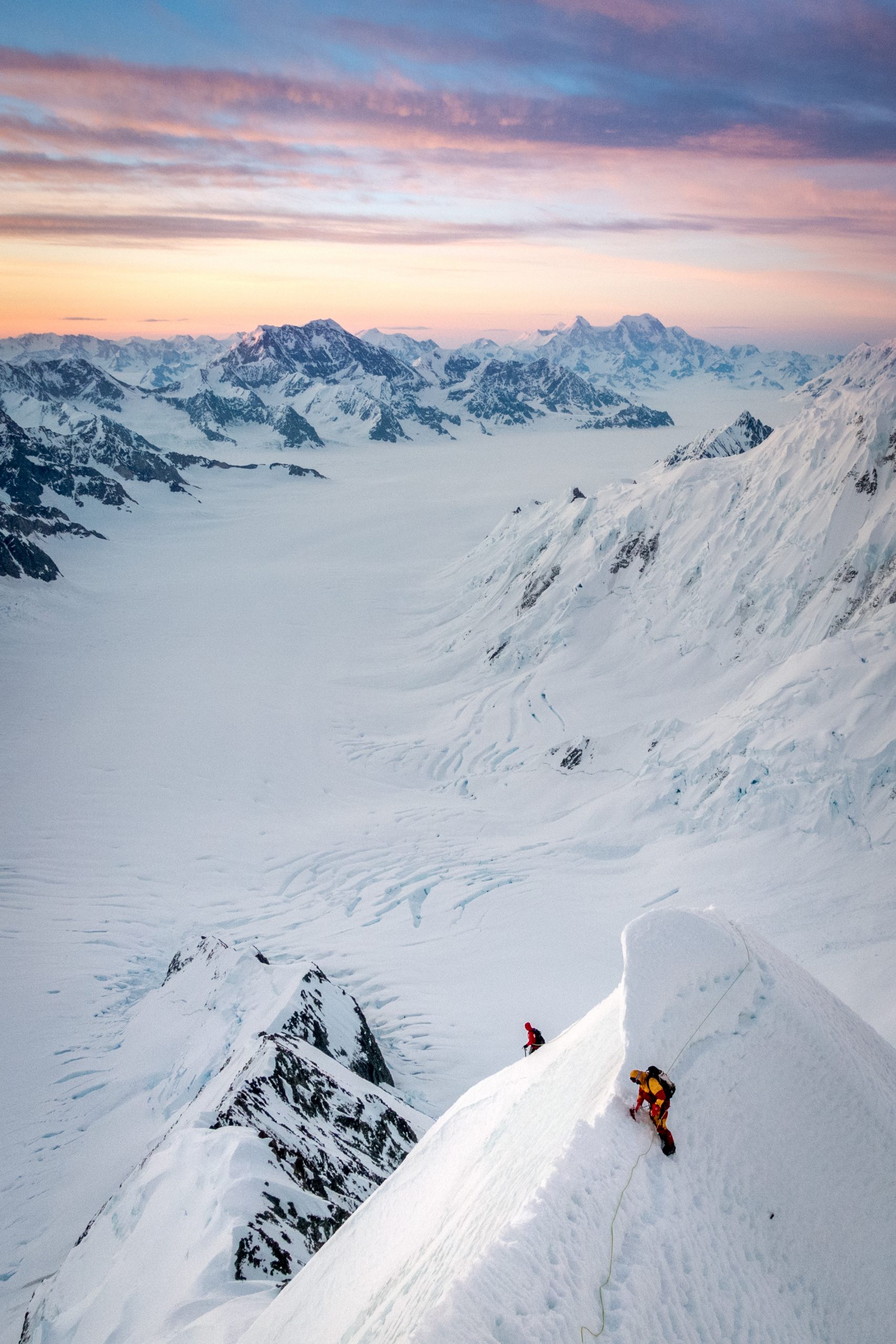
People who climb Denali land at 7,200 ft. and go to over 20,000 ft. It’s a tremendous range, with lot of weather and different conditions. I asked Prittie if while he’s doing it, he thinks about the fact that it’s such a dangerous activity.
W: Well, it is. But life is risky. You could catch COVID and drop dead next week. You could walk out there and somebody blows through a red light in downtown Anchorage and T-bones you and you die there. You could die out on a parks highway on the highway, or you drop over from some ailment. Life is risky, and the whole idea is to try to manage the risk. And society’s perceiving of risk, and how people perceive risk, I find very interesting. Because, you know, what is there? 30-40,000 traffic highway fatalities per year in the U.S. Everybody just accepts that as a part of life. But one person goes out and gets killed on a mountain, “Oh my god that was a risky activity.” Well, was it? It’s interesting how society norms play into all of that.
N: Do you think that part of the reason you’re drawn to climbing is that there is that sort of brush against risk? Some element of adrenaline or something, right?
W: Always, and the way I like to think of it is risk helps focus you. So, say you’re climbing a rock face or an ice face. It’s vertical. Yeah, you know you have risk of falling so you take precautions. You rope up, you have a belay, you place protection in whatever the medium it is that your climbing, and that helps mitigate the risk.
But still, you don’t want to fall. And so what that does is it really focuses your attention on exactly what you’re doing. All those problems at home don’t matter. You know, all of those issues that you had in your office or workspace, that’s the farthest from your mind. You’re worried about the next move, the next placement of your hand or foot or the next ice axe or crampon placement. You’re not even thinking about the summit. You’re just totally focused in on every move that you’re doing. It’s almost like a form of meditation, with nature’s assist in the terrain, if you will. And to me, it’s the focusing ability of having some kind of a risk circulating around you in the environment that I find very freeing, and very focusing and very cleansing of the mind and the soul a lot of times.
N: What do you think is the best part of climbing for you? Is it the people, is it that focus, is it that you put everything behind you and you’re just there with nature?
W: Wow, that’s a tough question. I think it’s all of those wrapped up into everything. I mean, it really depends on the trip, too. I mean, I look back on so many of the international trips I’ve done in 20, 30 foreign countries, and it isn’t even the climbs, at this stage—you know maybe it’s 20 years ago, or 30 years ago—that stand out, it’s the people. The wonderful clients that I’ve met, the wonderful local people that we work with. Sometimes very close together—one on one from other cultures.
W: But also, oftentimes it’s just being out totally surrounded in the beauty of the natural world that attracts me there to doing that. Sometimes just the mantra of physical motion, if you will. Getting up on a long moderately-steep snowfield, and kicking perfect steps for the next hour to get up there. The poetry of motion and doing it perfectly. To get yourself in the mindset that the flow is perfect is also an amazing thing to experience.
There’s been plenty of people in the past try to explain, why climb? I don’t think that’s an answerable question. First off, if you have to ask the question, you’ll never understand the answer, because it’s different for every person and everyone has to go out in life and find that thing in life that captures you. I think the important thing at life is, whatever it is, find that thing that really attracts you and grabs you, because that’s what’s going to make your life the most enjoyable to you long term. And the bottom line is, when we get to the end of life, the only thing you have are your memories. You’re not gonna take anything with you. So, most people don’t get to the end of life and regret not making more money or regret not doing this or that. It’s the experiences and the great memories and the friends that really really make life interesting and well-worth living.
N: As a young person, I take your word for it and I hope to live my life like you do, or have. You’re still climbing. When was the last time you went climbing?
W: Last week.
N: And where’d you go?
W: Oh, I decided to get out of the heat a little bit and I went up to Denali State Park and packed my skis up to the headwaters of little Cold Creek Trail. Did a couple of hiking summits up there and then put my skis on and did three really nice ski descents of some little hidden gullies and couliors and faces that were still holding good snow.
N: That sounds lovely.
N: Do you think anyone could be a guide? You have to have a certain determination, a certain fitness, a certain skillset, and like, what do you think it takes?
W: Over and above anything else, you need to be a people person. You need to be interesting, you need to be interested in other people. You need to be able to relate to other people. And if you can’t do that, if it doesn’t come naturally to you… It doesn’t matter how good your technical skills are, you’re gonna struggle.
N: Definitely. Well it seems like it’s taught you, and it’s guided your life in terms of values of flexibility, slowing down and appreciating things, being focused, being present, relating to people, exploring. Adventure, is the word that I would use. It seems like a very adventurous lifestyle.
W: Really, I’ve been so fortunate to be able to share so many holidays and festivals and family gatherings and extended family gatherings all over the world, and it’s been a very rich experience in that regard, yes.
N: Do you have last words, or advice or thoughts?
W: Get out there in nature, and see it. Be realistic about it. Turn your cellphone off. Turn your devices off. Listen to the wind. It’s nice to interact with people and jabber with your friends that you’re going out with, but occasionally go out there and just be quiet. Listen to the bird call. Listen to the winds. Listen to the water lapping on the shore of the lake, or the gurgle of the stream in the background. Listen to those natural sounds that so many of us are insulated from in our day-to-day life in nature.
And open yourself up to those kind of perceptions because a lot of that is a big part of what really re-create people when they go out into nature. That’s where the term recreation comes from. You’re going out there to re-create. Well, how do you do that? You do something different. I think it’s necessary and important as a human being that you occasionally do different experiences that are over and above and beyond what your normal day-to-day life is, and that helps us grow and mature as human beings.
N: Right. Yeah, it’s true. Well, I will in the rest of my summer here try to get outside and listen to the winds and really be present. So, thank you so much, Willi, for talking to me. It’s been a pleasure, really.
W: Well, you’re certainly welcome, and I hope to see you outside.
N: Yes, Definitely.
I hope we can all learn from Prittie’s sense of adventure, love of life, and appreciation for the world around him.
For KTNA, I’m Nell Salzman.