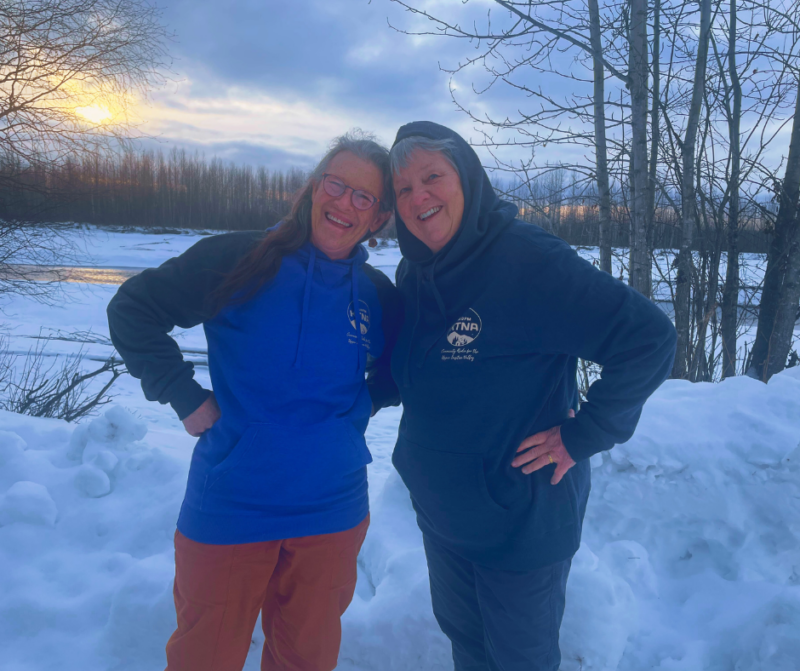
Twenty people ventured out into the forest or watched out their windows to count birds on January 3rd for the annual Christmas Bird Count. The National Audubon Society started the project in 1900 as a way to encourage more people to count birds instead of hunt them. The Society declares it to be the nation’s longest running community science bird project.
The Talkeetna and Trapper Creek Count is a seven-mile radius with a center point in the middle of the river. As many as 41 volunteers and as few as 13 have contributed to an astonishing 27 years of bird data right in our backyards. Long-time Trapper Creek resident Kathy Ernst helps coordinate the count.
“You keep track of feeder counts, how much time is spent on the feeder. You keep track of what you see in the field, the number of miles that are covered, and how many hours that is. It not only gives the Audubon people information about the number of birds that are seen, but also the amount of effort to find them.”
Some volunteers get out on snowshoes and skis, while others drive to different spots to count. Others count at feeders. Kathy talks about how different birds show or don’t show in the annual count.
“Redpolls for example. I’m going across the chart from 1993 to 2007. As few as zero, three, 50, 438, 491. So redpolls are a bird that you’ll have huge flocks coming through or none at all. The birds that are seen pretty consistent are magpies, ravens, there are always a couple of dippers seen, woodpeckers. Although, I think when we had more dead trees we saw more woodpeckers.”
The redpolls Kathy refers to are tiny sparrow-like birds that have a bib of pinkish feathers and a blotch of red feathers on their forehead. Beyond 2007, their numbers in the count ranged from a high of 737 in 2012 to a low of 12 this year and none in 2015. Most of the birds counted don’t show any specific trends upward or downward, though that might change as our warmer season gets longer. The spruce bark beetle may also push population numbers in either direction for certain birds, but the beetle only began impacting the Susitna Valley in 2015, which is likely not long enough to capture trends.
The citizen science data collection will continue with the birders gathering again for the Spring Bird Count the first week of May.