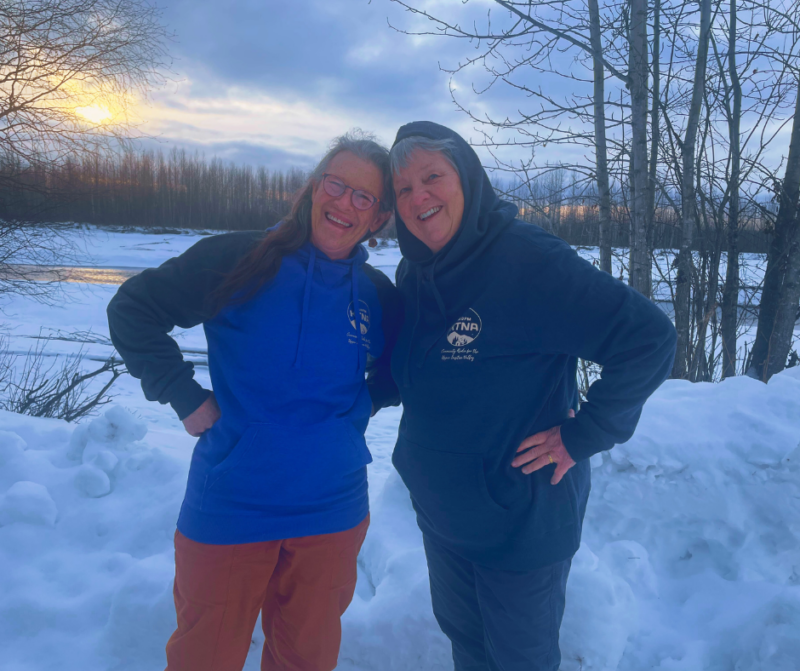
Photos by Billy FitzGerald
This is part one. Click here for part 2.
Last October I noticed a posting in our local Northern Susitna Birders group on the Internet about a sighting of a grounded Common Murre in the Talkeetna area. I thought that was odd. A seabird so far inland? What was that about? Over November and into December, a few more sporadic sightings were posted. I was intrigued.
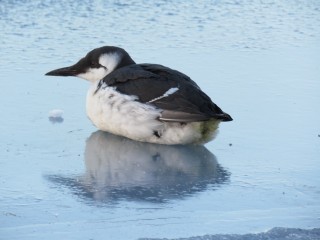

Another posting on December nineteenth: Starving Murres were being found all over South Central. Some were taken to the Bird Treatment and Learning Center in Anchorage, rehabbed and released in salt water. Dozens of Murres were reported in Seward- some washed up dead on shore, having starved. What was going on?
I had left Birch Creek Ranch- my home for the past ten years- and moved to a friend’s home in Willow on September 1st. It is temporary quarters for my dogs, birds and me until the Talkeetna cabin into which we will be moving, is completed. Unfortunately, the locale in Willow is just out of reach of KTNA, and is on the fringe of Internet access, so I am somewhat out of the ‘loop’ of what is happening up north. Whenever I make the trip up to Talkeetna, I go to the Library and get caught up on things. I read that there had been more Murre strandings and that now the birds were being taken to the two Bird Treatment Centers-one in Houston and one in Anchorage. There they were being cleaned, fed, and released into the Inlet whenever possible. Some birds had been too starved to save. Others were in fair to good condition. None should have been so far from salt water.
The first Murre stranding was reported in March of last year and is part of a broader seabird die-off in coastal Alaska and up and down the Pacific coast. Scientists say it’s possible the effect of warmer water in the Gulf of Alaska, which formed in 2014, is forcing the birds’ food source of small fish, krill, and other marine life to go deeper than the Murres can dive. This current of warm water is expected to combine with other warm ocean currents to form an extreme El Nino cycle in 2016.
In my research I found this on the Seattle, Washington website: “The Washington breeding population of Murres does not migrate. They are sensitive to oil spills, gill nets and over-fishing. In 1983 the population experienced a crash due to an El Nino event, dropping from 30,000 to fewer than 3,000 birds. Some populations have recovered, but others have yet to rebound, leaving the current population at one-third its former level.”
Then, on December 29th I got my first call. Billy Fitzgerald had gotten a call from his friend and neighbor-Tod Marder- that there was a Murre in his yard. They got it in a box and Billy called me to ask what I thought he should do next. I suggested calling the Bird Treatment Center in Houston and see what they said. He did and they wanted him to bring it in. I had told him I would drive on up to get the bird if he could meet me out at the Parks highway. He called back to say they were closing at one pm that day. It was eleven. There was simply no way I could make the trip from Willow, which takes an hour- one way- pick up the Murre, and make it back to Houston before the Center closed. The bird would have to stay in the box overnight. I suggested Billy put some water in with the bird and some sardines, if he had any. He said he did, and he would.
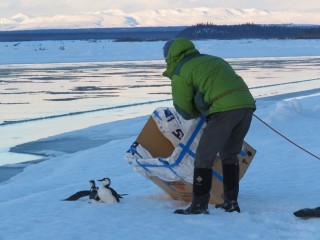
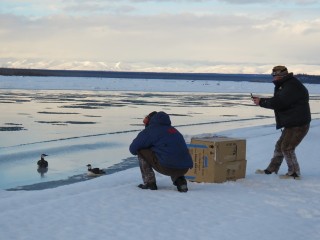
The next morning I dealt with an early-morning power outage, and when the power came back on at seven-thirty, I breathed a sigh of relief and continued with preparations to leave for Talkeetna. I called Billy as I neared Kashwitna Lake. He informed me of a change in plans. The woman at the Treatment Center had suggested that he release the bird-since it was healthy- into water on the river, as an open lead had been sighted on the Susitna, about a mile north of the Talkeetna confluence. She told him that five more people had called with rescued Murres that morning, and they were fast becoming inundated. He and Tod had gathered four more birds over the rest of the 29th and the morning of the 30th, including a woman bringing them one she had found standing in the middle of the Susitna bridge when she had been driving down from Trapper Creek. They were loading the birds into a Toyostove shipping box strapped onto a trailer pulled by a snowmachine. The box had a heavy-duty plastic liner taped to the bottom, and over that a big towel to give the birds traction. They discovered that when the birds were by themselves, they were feisty and defensive, but when placed with other birds, they became docile. That made sense, since these birds live in large colonies and fish together in large groups called “rafts”. They don’t like being alone.
When Billy and Tod arrived at the open channel, they discovered about three hundred Murres flying above and circling over the water, and a few dozen in the water. The weather was calm, with the Alaska Range in full view and clouds to the south. They unloaded the box and put it up on its side so the Murres could exit. When they did, the box was moved back and the men moved away to watch. Billy said the birds closest to the shore immediately came towards the newly-arrived Murres, as though encouraging them back to the water. When the released birds went into the water, each one immediately drank. In the box the water and sardines had been trampled, and there was no evidence that any of the birds had eaten snow, so no doubt they were very thirsty.
Billy stayed about three hours, watching the birds. He said all the time he was there, birds were flying back and forth above the water in great numbers. The ones in the water were diving, some resting, some preening. All seemed to be in good shape.
Meanwhile, I had completed what I had come to do in Talkeetna, and started back for Willow around two-thirty. I was a little disappointed that I hadn’t seen a Murre. Billy had left for the river long before I arrived. I had two empty tubs in my car, to transport Murres to the Treatment Center, but now they weren’t needed. I was glad they were being released into the river, instead.
Be careful what you wish for.
Story by Robin Song