Spring seemed to progress slowly, this year. I wasn’t complaining; I was enjoying daily ski treks and my two dogs were downright delirious to still be running everywhere in the forest without breaking through the crust.
But, of course, inevitably, the temperature slowly climbed and eventually the snow became patches, which my girls would race to and roll in with canine abandon, during our walks in the forest. Then they, too, melted away.
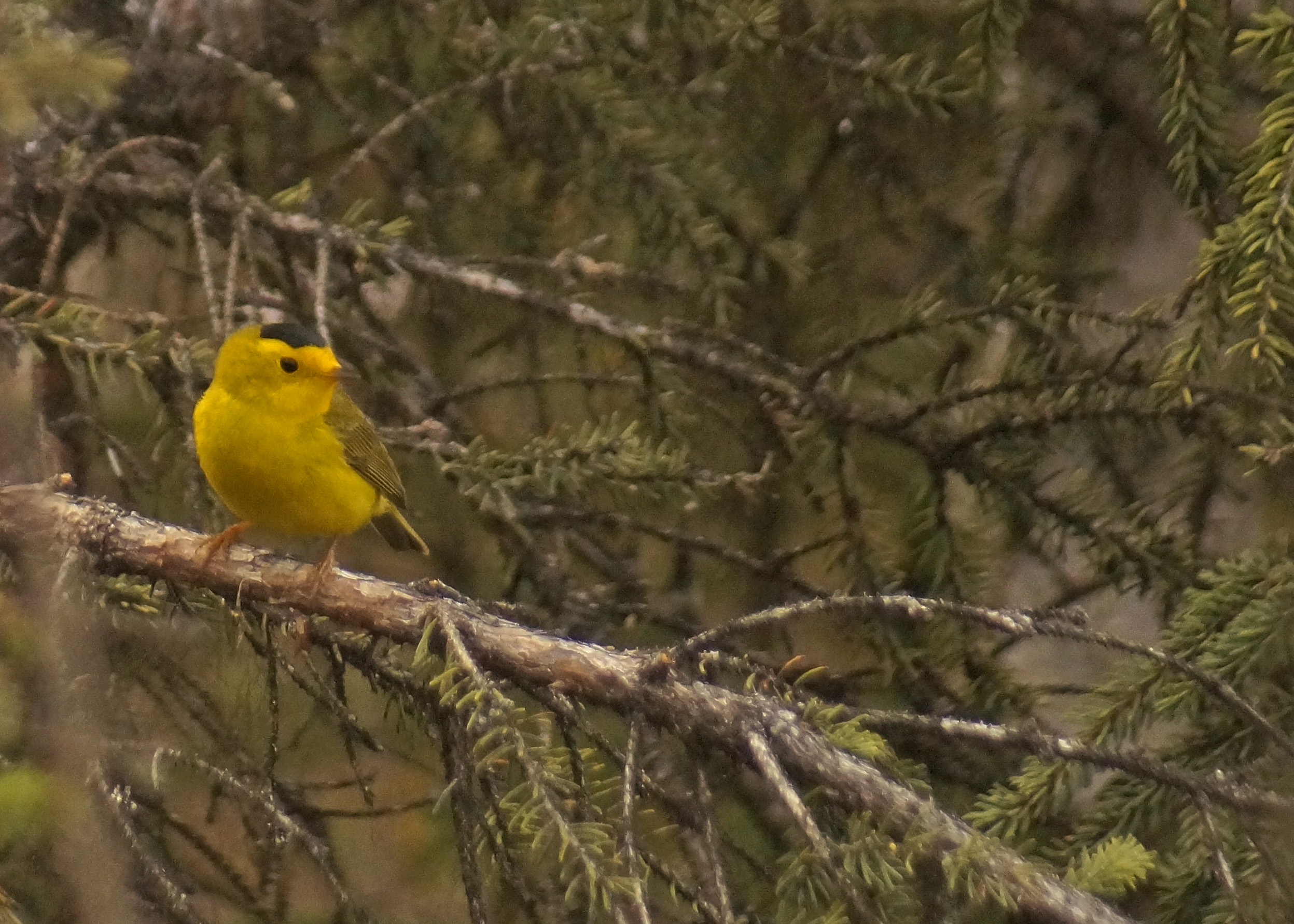
Buds appeared on the trees, and I awaited the annual migration of birds returning to the North Country- one of my very favorite events. They trickled in to the forest around my cabin. I listened for new voices each day. Juncos, then Ruby-crowned Kinglets were added to the chorus of the familiar birds I’d been listening to all winter. And, on May nineteenth, while doing chores outdoors, I heard a voice that stopped me in my tracks. Could it be? Had one of my very favorite birds made it back? Yes- there it was again; a high-pitched somewhat buzzy note coming from the forest west of the cabin. I sprinted to go grab my camera. I returned to the spot and waited. Yes-a flash of bright yellow amongst the greens of spruce and birch. The wonderful male Wilson’s Warbler had returned on his long migration from Central America! This species winters in Belize, favoring shade-grown coffee plantations. This little fellow-slightly smaller than a Chickadee-had flown all this way to return here to this patch of forest. I knew it would only stay a few days, refueling on insects, then it would continue on to its nesting territory- possibly in the lowlands of Hatcher Pass, where I’d found nesting pairs in the past- and await the arrival of the females. We don’t have many colorful species of songbirds in the Talkeetna area, so the sight of this amazingly yellow bird with its jaunty black cap is mesmerizing for me, as it flits amongst the greenery, seeking insects.
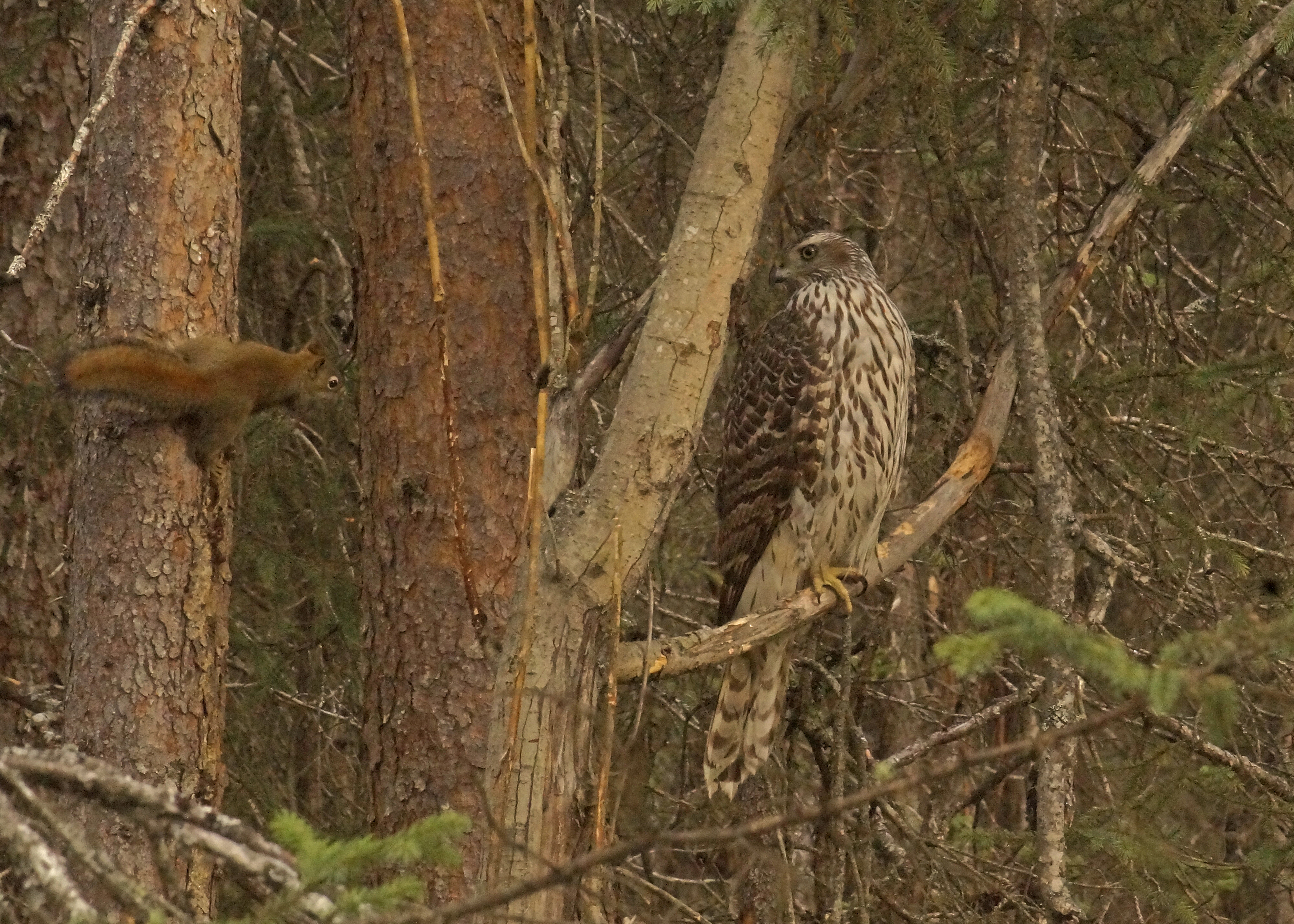
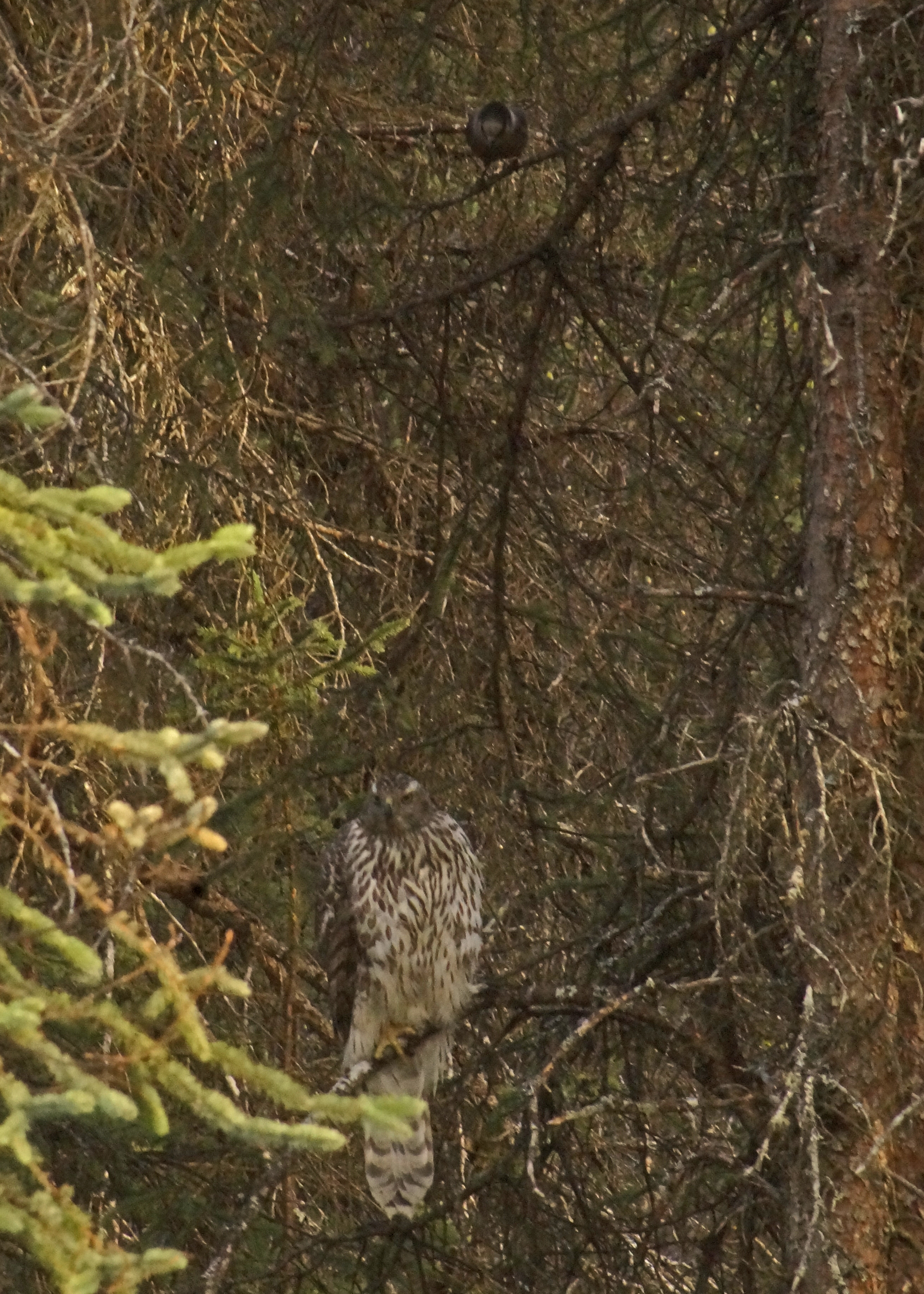
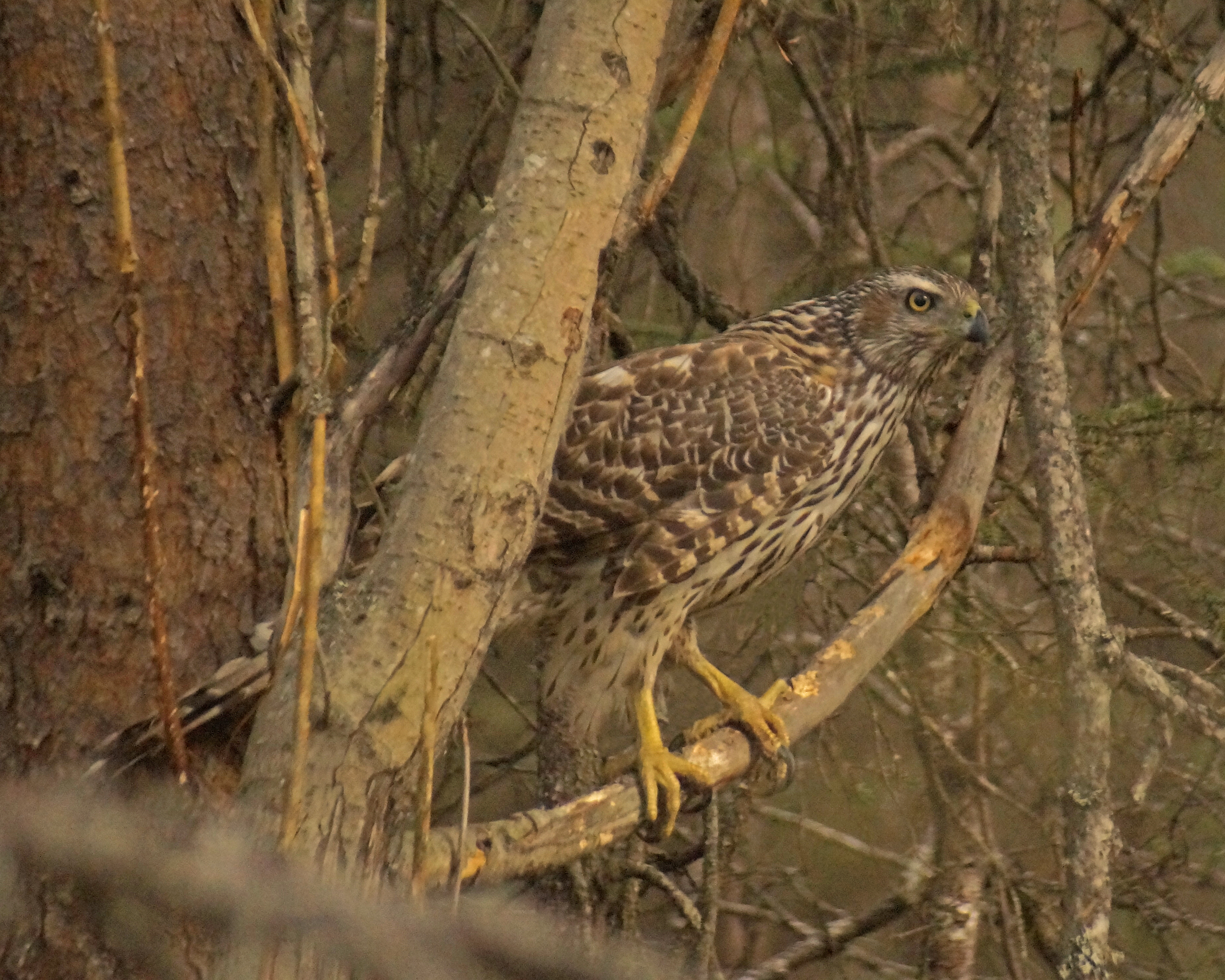
After getting as many photos as I could before it moved farther into the forest, I retreated to the cabin to examine my pictures. I couldn’t stop smiling at the photos of this exquisite bird. A few hours later I was again outside doing some chores, this time on the south side of the cabin. I was startled to hear the sound of large wings coming down through the trees in front of me. I was even more startled to watch a juvenile Goshawk descend through the trees and land on the forest floor just a few yards in front of me, intent on a squirrel, who dove into a hole at the base of a tree. As soon as the squirrel disappeared, the bird turned and leaped onto a birch branch about ten feet above the ground. I backed away and quickly went to the cabin for the camera, hoping the bird would stay long enough for me to get a few photos.
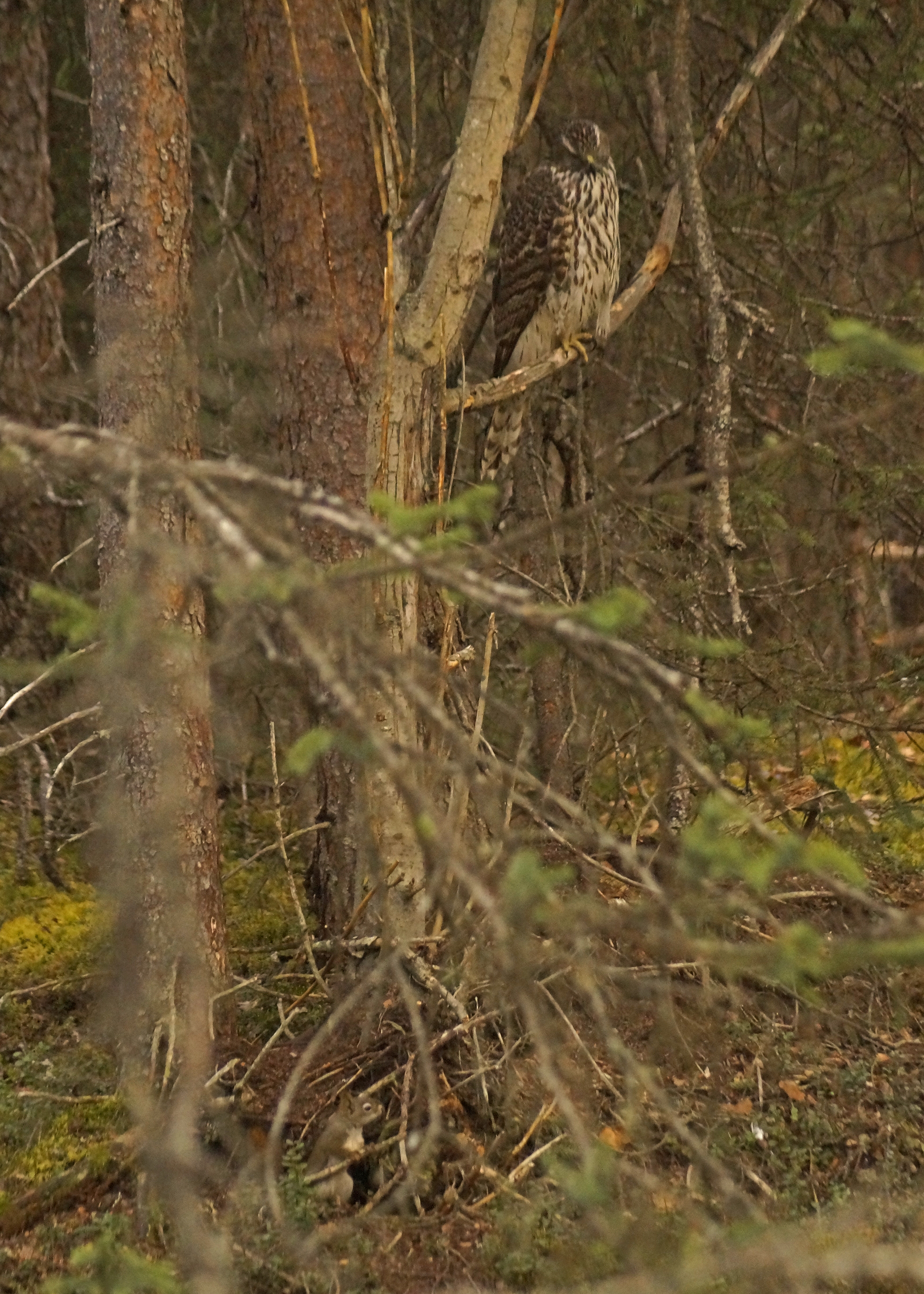
I got one of it on that branch, gazing over its shoulder at me. Then it turned and launched to a branch about four feet above the ground, next to the tree where the squirrel was hiding. It settled on its chosen branch, waiting.
I knew from research I had done in the past on Goshawks from encounters at Birch Creek Ranch, that Goshawks prey on Snowshoe Hares predominantly. And that it takes a good deal of skill to catch Hares. A high percentage of Goshawks don’t make it through their first winter because they are simply not skilled enough to catch enough Hares to see them through. If a juvenile Goshawk is going after Pine Grosbeaks, or squirrels, that bird is very hungry, for it has no chance of catching either.
I had seen Hare tracks lacing the snow all winter, and I’m certain this hawk had captured enough to keep it alive up to this point. There were still a lot of Hares around, and pretty soon there would be more as the new batch of leverets were born in a few weeks. If this hawk could nab one or two more, it would make it through until the inexperienced leverets ventured out on their own and became a food source for the young hawk.
Meanwhile, as I stood quietly watching, the squirrel poked its head out of the hole at the base of the tree. It looked and saw the hawk staring hard at it from the next tree over. The squirrel seemed to know quite well that the large bird could not maneuver its large wings in the dense branches and that the squirrel was safe from capture. To my amazement, the squirrel proceeded to climb the trunk of the tree until it was level with the hawk, and then turned horizontal, leaning out to chitter at the hawk. I think if that bird could have killed with looks, those bright yellow eyes would have dropped that squirrel instantly, it was staring so intently at it!
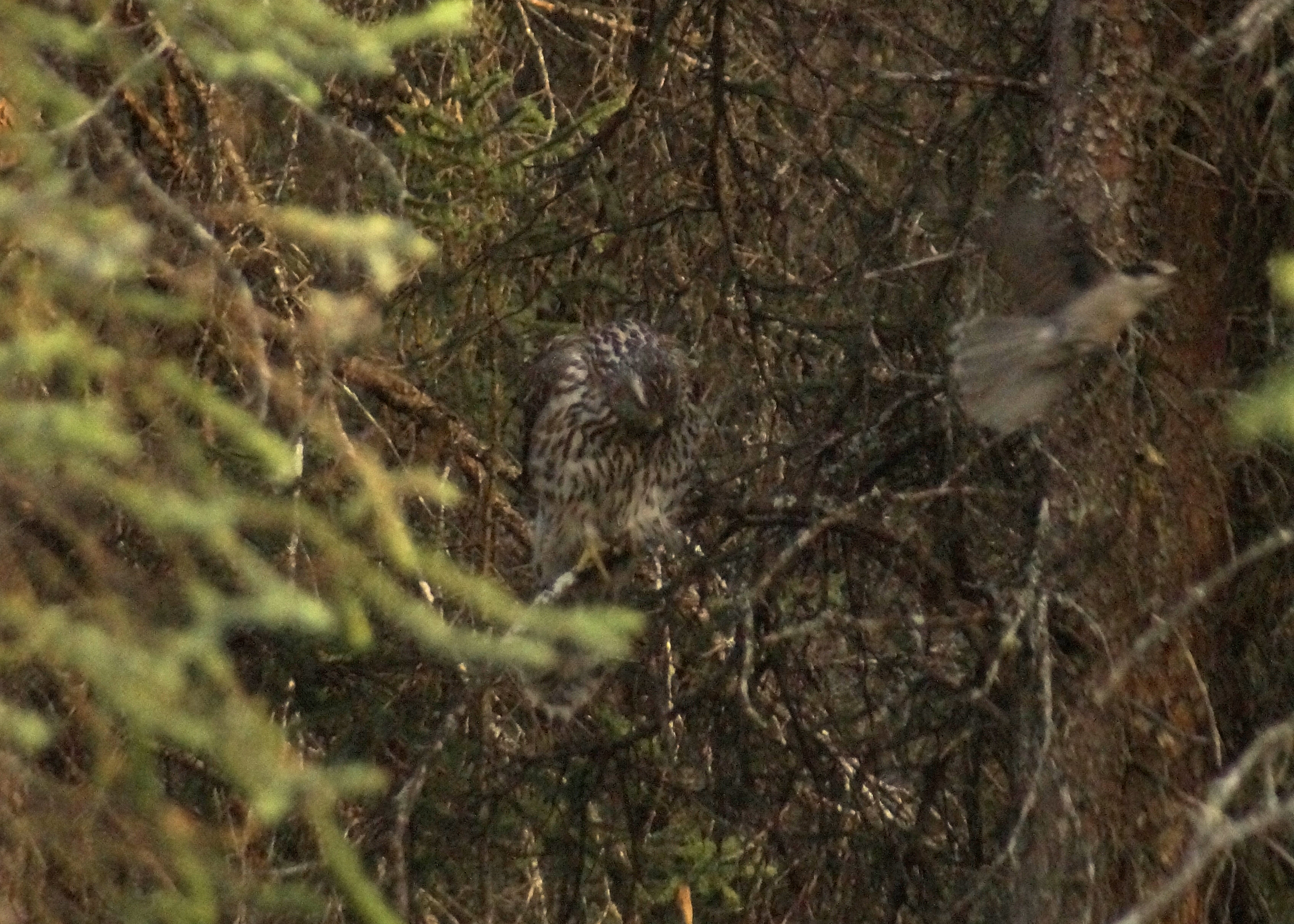
After a few long minutes, the squirrel descended the tree and popped back down its hole. It came to me that it was about the time that the Hares usually arrived each evening to eat sunflower seeds beneath my feeders. They didn’t know the hawk was there. I retreated to the cabin and watched through the window. Around fifteen minutes later the hawk moved to a branch much higher in a spruce east of where it had been. I had a direct view of it from the cabin’s south window. I kept tabs on it. It preened and seemed in no hurry to leave.
Then I heard them- a pair of Grey Jays had discovered the Goshawk. This was not the hawk’s evening, for sure! For the next thirty minutes that pair of jays took turns diving at the hawk, which did its best to ignore them, preening and stretching. But it would wince each time a jay swooped close by its head. When a jay would perch a few feet on a branch over its head, the hawk would swivel its head this way and that, watching the bird, sometimes turning its head upside down to get a better view.
After awhile, I realized the racket the jays were making had alerted any Hares in the area to the presence of the hawk. Nobody would be approaching as long as the jays kept up their attack. And night was arriving soon. I stepped out onto the porch and took a few photos. The hawk finally gave up and flew toward the porch, then turned sharply, heading into the west. About five minutes later I again heard the jays and spotted the hawk high in a birch in the south. The pesky jays were diving at it again. The sun was setting. I don’t know the end of that story. All the birds would be going to roost for the night soon. I wondered if the hawk would out-wait the jays, or if the jays would accompany it wherever it headed off to its roost.
That night the Hares didn’t come to the seeds, wisely keeping a low-profile. They didn’t arrive the next morning, either, and I wondered if the hawk had indeed gotten a meal. But that evening the Hares arrived at the seeds under the feeders as usual. But I didn’t see the two largest Hares, which I suspected were bucks. They usually came early in the morning. While I have gotten to know individual Hares over the winter and miss seeing certain ones, I also know that they are here to provide food for predators. The magnificent Goshawk deserves the right to live, too. Though difficult, it’s best to remain impartial, when observing nature-especially the relationship of predator and prey.
As Spring gives way to Summer once more, the birds are bringing their fledglings around the cabin, now. The Common Loon pair on the lake to the south of the cabin call in the wee hours of the morning, and the Swainson’s Thrush males sing in the quiet hours from their lookout perches in the forest. A few mornings ago a fluffy leveret hopped from the edge of the forest out onto my drive. I thought of the Goshawk as I watched this young Hare exploring its new world. I hope the hawk found a meal and has survived to raise a family of its own, this summer.
“The Squirrel and The Hawk” Susitna Writer’s Voice, KTNA
Natural Observations
Robin Song
061418