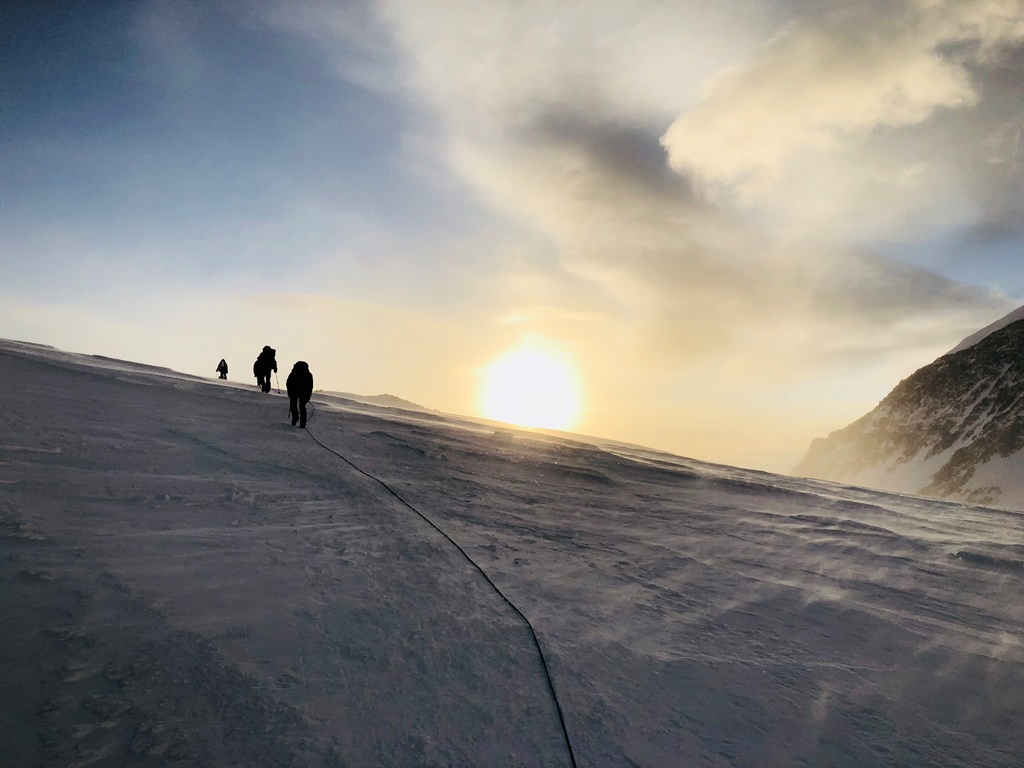
Climbing season has wrapped up on Denali, and while the summit rate was a bit lower than normal, National Park Service rangers are calling the season a success. KTNA’s Phillip Manning spoke with three mountaineering rangers about their thoughts on the 2018 climbing season.
Earlier this month, the last of over 1,100 climbers came off of Denali. While the summit rate this year was slightly below average, mountaineering rangers for Denali National Park and Preserve are calling the season a success. The biggest reason for that is, for the first time in fifteen years, there were no fatalities on North America’s highest peak.
South District Ranger Tucker Chenoweth says, no matter how much education and other efforts the National Park Service makes, plain old luck plays a major role in ensuring no climbers die on the mountain.
“I would like to say it’s because of our proactive stance and rangers and our educational efforts, but that’s probably putting too much faith in our abilities. I’d say, in general, it’s a fair amount of luck. Based on some of our near misses, I think some of those easily could have gone the other way.”
The most notable of those near misses was when Polish newlyweds fell during their climb, sliding over 700 feet before coming to rest on the Peters Glacier. Even though other teams saw the climbers fall, it took time for conditions to improve enough for rescuers to reach them. Ranger Dave Weber says the urge to rush out and help someone has to be tempered with patience to ensure that the rescuers themselves will be as safe as possible.
“We know there’s someone out there who needs help, but right now the avalanche conditions are too great, or the weather’s too bad for us to safely get to them, or we can’t fly to them because the weather is so poor. Those are really tough times to have to feel like you’re sitting back and waiting, but knowing the best thing for that patient is to show up with a capable team and not get any of us hurt.”
Weber says rescue efforts and techniques have improved in recent years, and that coordination with first responders outside of the Alaska Range gives injured climbers a much better chance at recovery. For instance, he says there is an advanced frostbite treatment center in the Lower 48, but the treatment has to begin within 24 hours of the wounded area thawing. With coordination, Weber says one person this year was able to reach the treatment center in time.
“We did have one patient this year who froze all ten fingers, all then toes, and part of his face up at High Camp, and we were able to get him all the way to Salt Lake City to that treatment in eighteen hours due to coordination with LifeMed and Mat-Su Regional Hospital.”
Other common medical issues on Denali come from spending time at high elevations. While there are often mountaineering rangers at high camp near 17,000 feet, they have to rotate during the season, because the air is so thin. Ranger Jake Beren was a guide on Denali for more than a decade before becoming a ranger this year. He says spending a lot of time that high on the mountain makes a person weaker.
“There’s a diminishing return at seventeen camp. It’s nice to be up there for a little bit, but, especially when you’re working hard up there, I know personally I tend to waste away as opposed to get too much stronger after a few days.”
Long periods at high altitudes can lead to pulmonary edemas and other potentially life-threatening issues. This year, all of the mountaineering staff is grateful that none of those led to fatalities. Tucker Chenoweth says he is grateful for the work of his team and mountaineers who pitch in during crises, and he hopes the trend of every climber coming back alive continues.