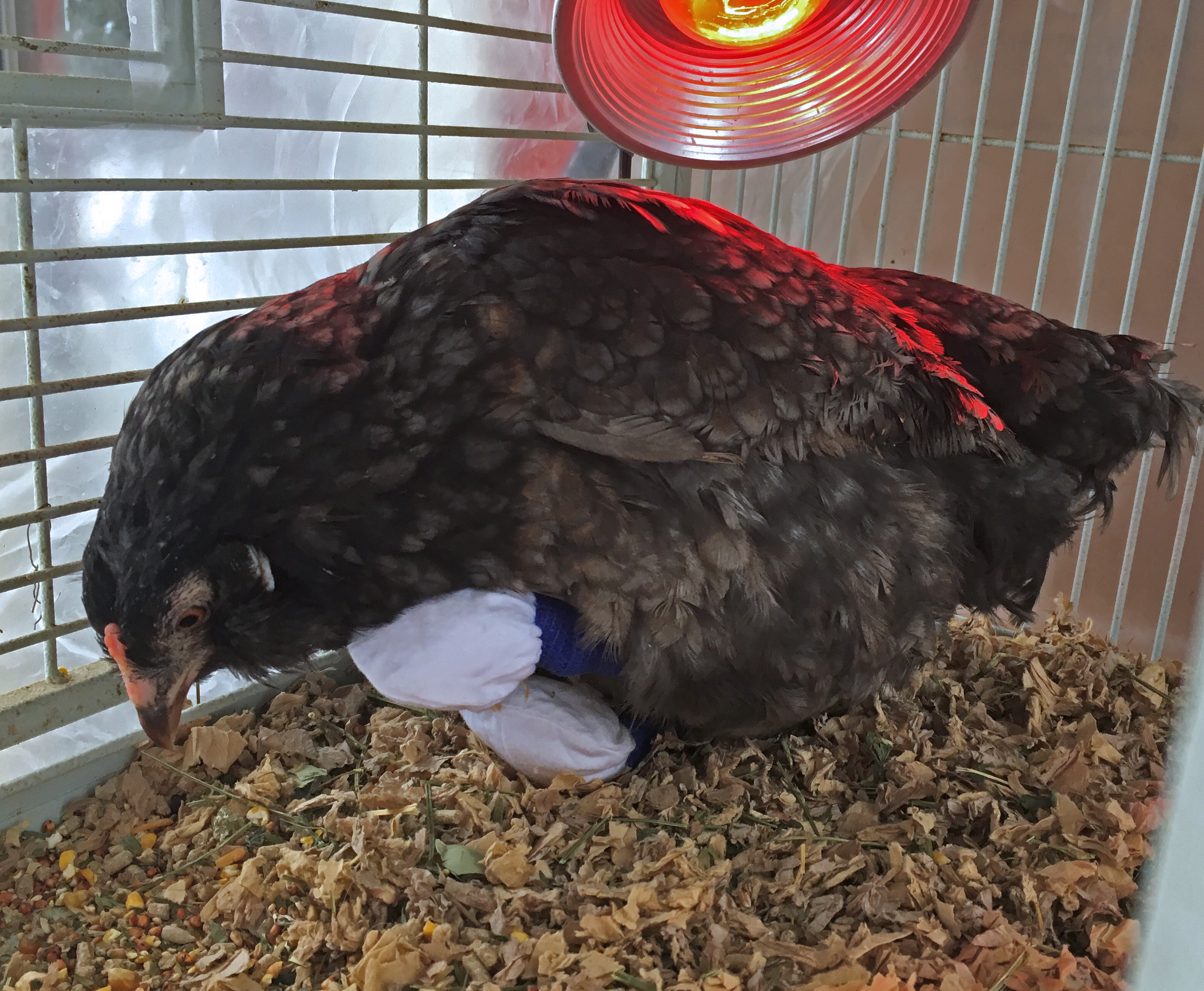
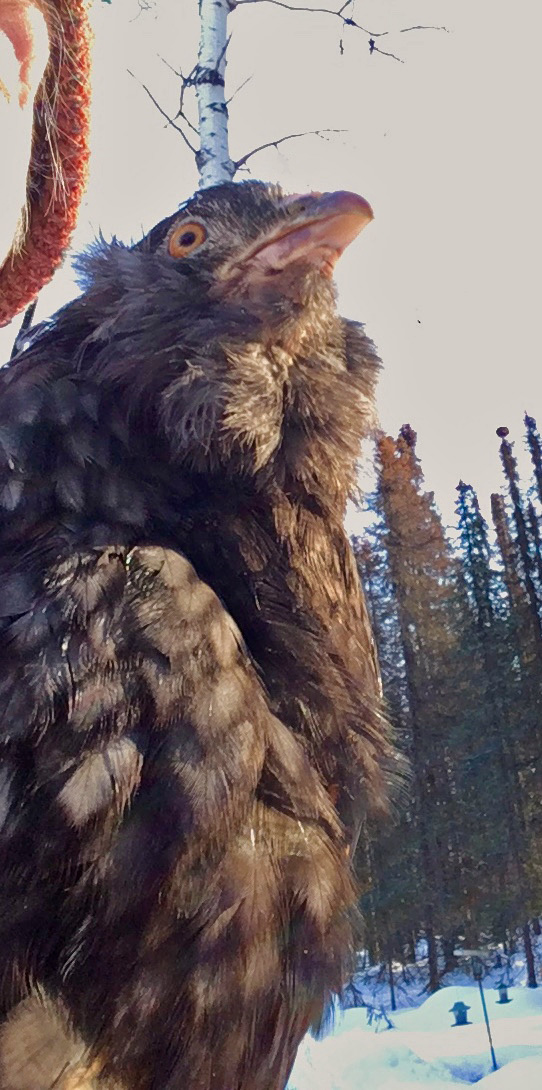
It’s been a little over six weeks since I rescued the black and amber Ameraucana hen I named “Jem”, who had lost both her feet to frostbite. In that time she has regained almost all of her normal weight, grown in beautiful, fluffy feathers, and, on day 9 of her being with me, she laid a lovely pale green egg. She lays an egg an average of every two to three days, now. Her confidence has grown to where she has become a selective eater. Whereas at first she ate everything I brought to her because she was starving, over time she grew more selective in her choices, training me in her likes and dislikes. She’s not fond of dairy products, refusing all yogurts, butter, and most cheeses. I offered these in hopes of putting weight back on her quickly. But I found adding sunflower seeds to her regular hen feed helped put the weight on her. For treats she loves Romaine lettuce, fresh spinach, organic canned corn, and popcorn-lightly salted.
When I lost contact with the Vet from Haines, I put Plan ‘B’ into action. Our local Vet, Jennifer Pironis, who owns Golden Pond Veterinary Services, had returned from Outside, so I contacted her and told her Jem’s story. While she didn’t have experience with poultry, she didn’t shy away from a new challenge. On March sixth, on her way back from Wasilla, she arranged to stop by my cabin and meet Jem. I knew from past experience with Jennifer that she would do everything she could to help, and research on Line how best to proceed. I trusted her.
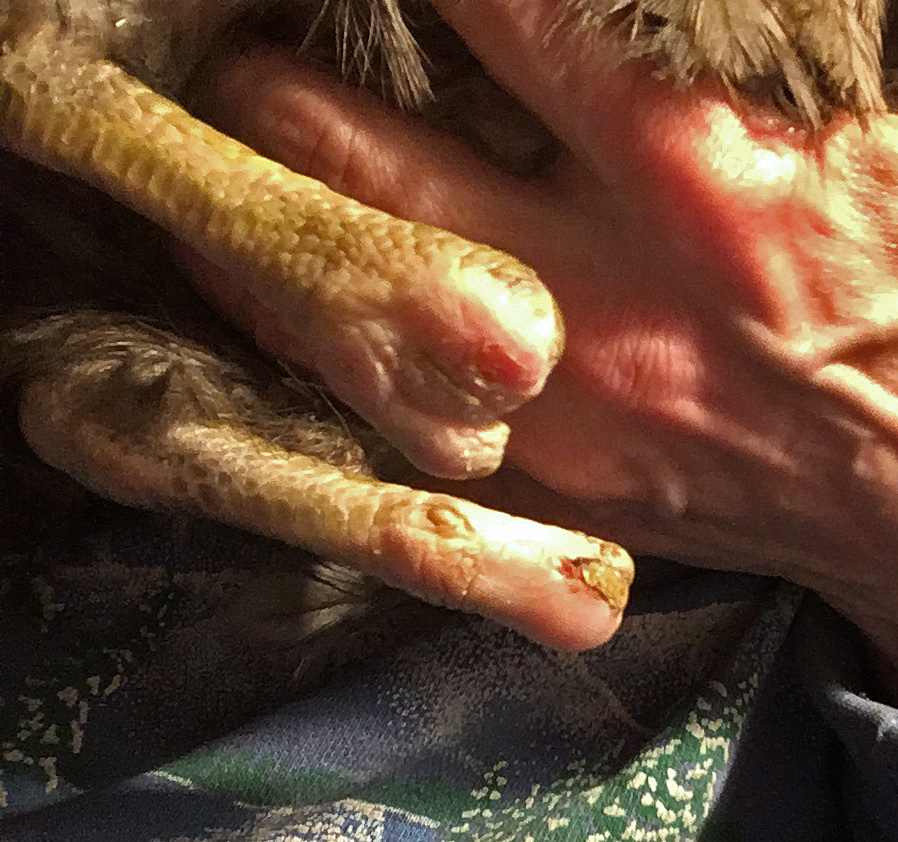
She spent an hour and a half with Jem and me, examining Jem and talking with me in detail. I explained how I had been wrapping Jem’s stumps with vegetable oil-soaked gauze and tape to help soften the scabs so they would come off. I had gotten the left one to come off and had found an infection underneath. I had cleared that up, and was now waiting for the right scab to come off. When I unwrapped the gauze from that stump, Jem suddenly jerked her leg and the scab popped off. It flew and hit Jennifer on her shoulder. She didn’t flinch, and we both grabbed for it where it fell, so we could examine it. She got it first and held it up under the lamp light. It was dry… no sign of infection. I lifted Jem and held her so Jennifer could examine both stumps closely. No sign of infection. The new skin coming in was clean and healthy. Jennifer explained that the skin would need to be toughened in order to withstand being encased in a prosthetic. She recommended a gel that would help do this.
When I set Jem back on her pillow next to Jennifer, the exam continued. Jennifer paused, at one point, and showed me her arm. She was wearing a tee shirt, and there, crawling up her forearm was a tiny tan-colored mite. That was the first I knew that Jem had feather mites. I would need to send for dusting powder, and also alert the owner of the flock that the birds would need to be dusted. Jennifer was intrigued with the idea of prosthetics for Jem and considered her a good candidate by her gentle, willing nature. With all the fussing done with her legs, Jem is tolerant and patient. Even her occasional struggles against procedures don’t last long. She is easy to calm down. She seems to realize that she can trust me and knows that eventually the work I’m doing on her legs will have a good ending.
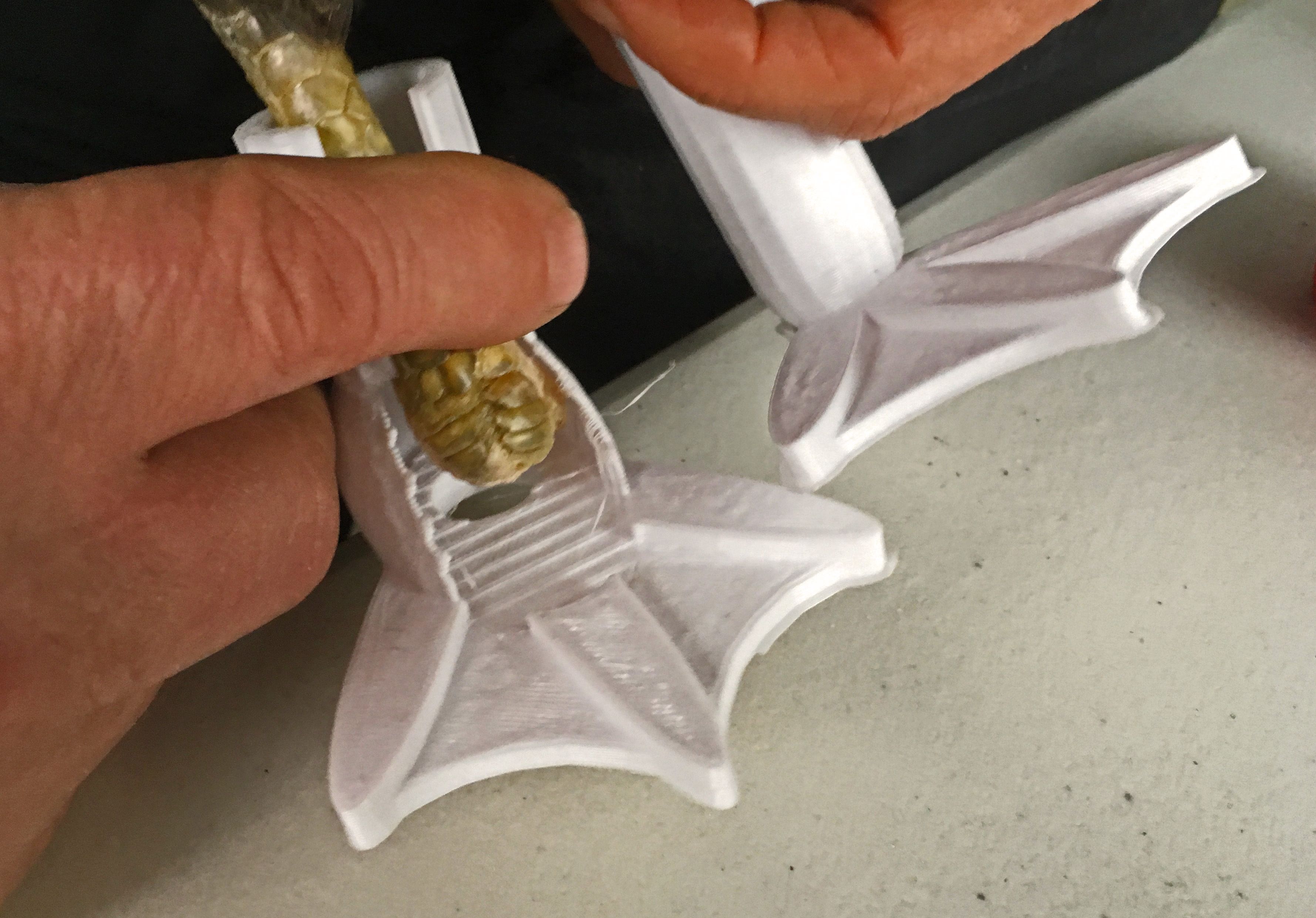
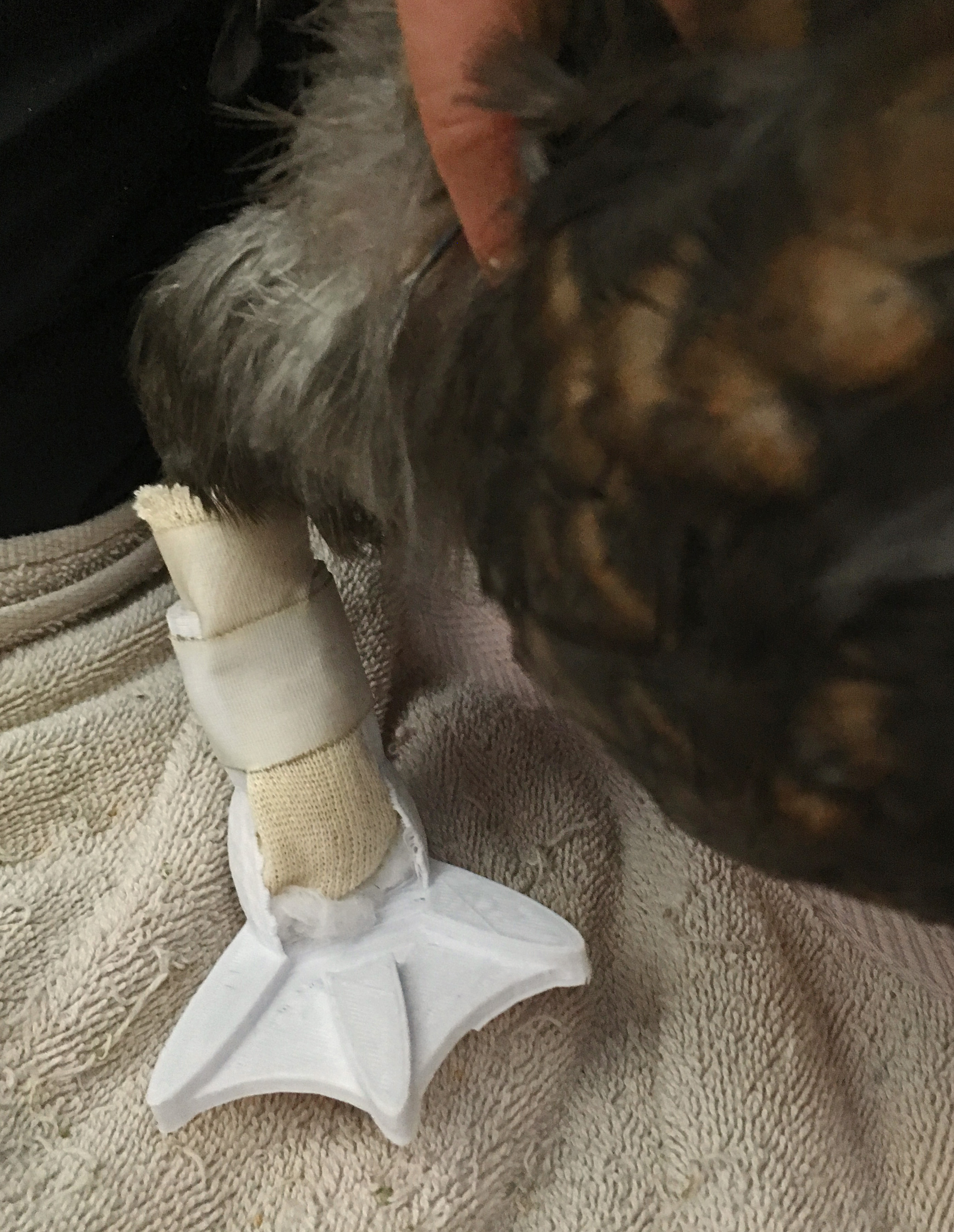
On the ninth, CW arrived from Willow, bringing the first prosthetics made by his 3-D printer. They were prototypes, made of a harder plastic than the future permanent pair will be. He drove Jem and me over to Jennifer’s office so she could help us get Jem fitted to her prosthetics and see how the hen would react. Jennifer had done research online and found links to sites about various bird prosthetics and how some had worked out and why others had not. She discussed with us various kinds of wraps to experiment with, being focused on air flow, temperature, and moisture on Jem’s legs. There is also the concern about pressure points and whether the stumps should rest on the bottom of the tube going into the prosthetic foot, or be suspended inside the tube. CW had made two kinds; both were shaped like a duck’s webbed foot, which would give Jem a wide, stable base. One had an opening in the tube from top to bottom, the other was a closed tube. We saw immediately that the open tube would be best. It would move with Jem’s legs and allow her both support and mobility. The permanent pair will also have holes all along the tube to give the best air flow, and have a hole in the center of the foot to allow drainage, should Jem step in anything wet, and also allow air flow from the bottom.
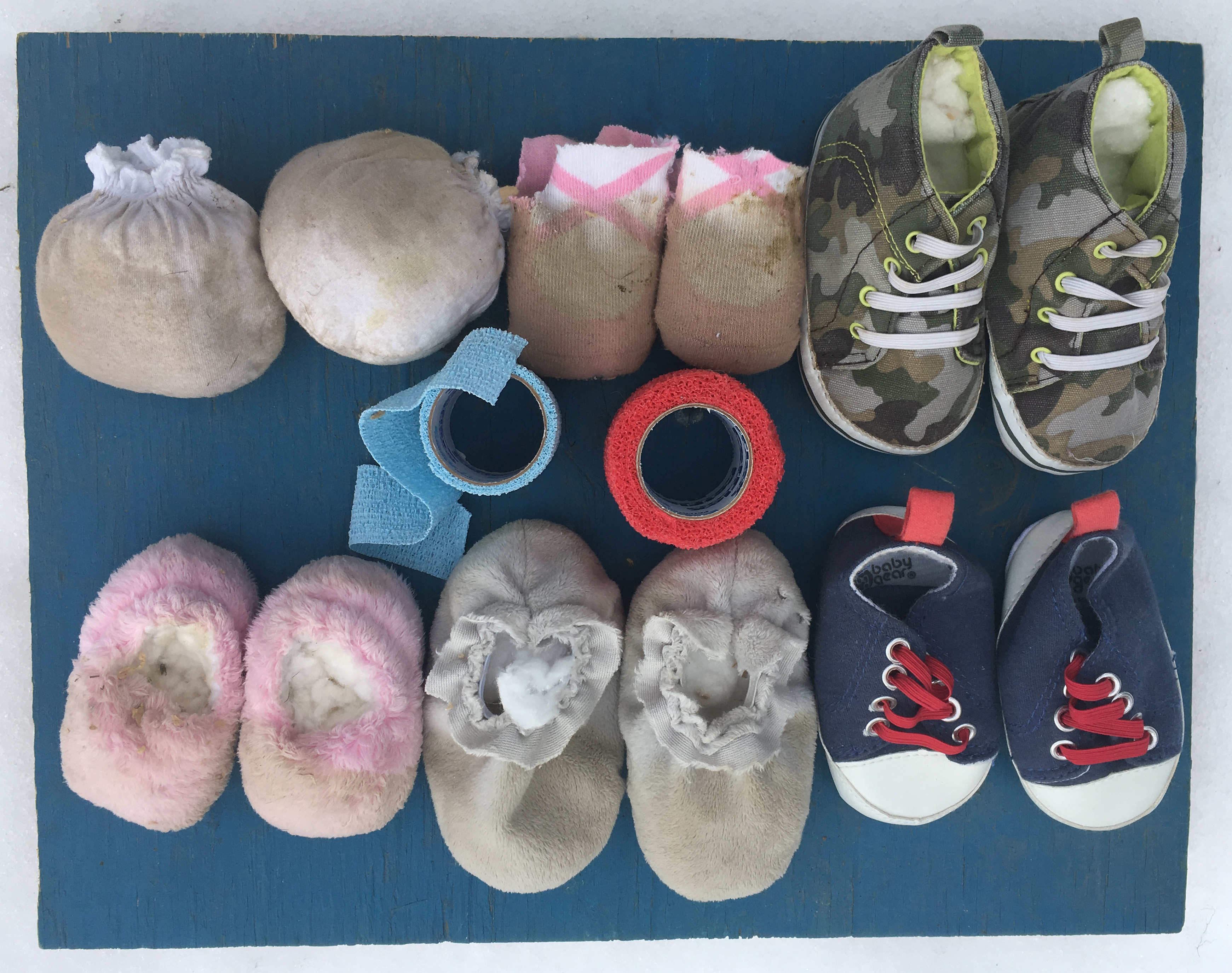
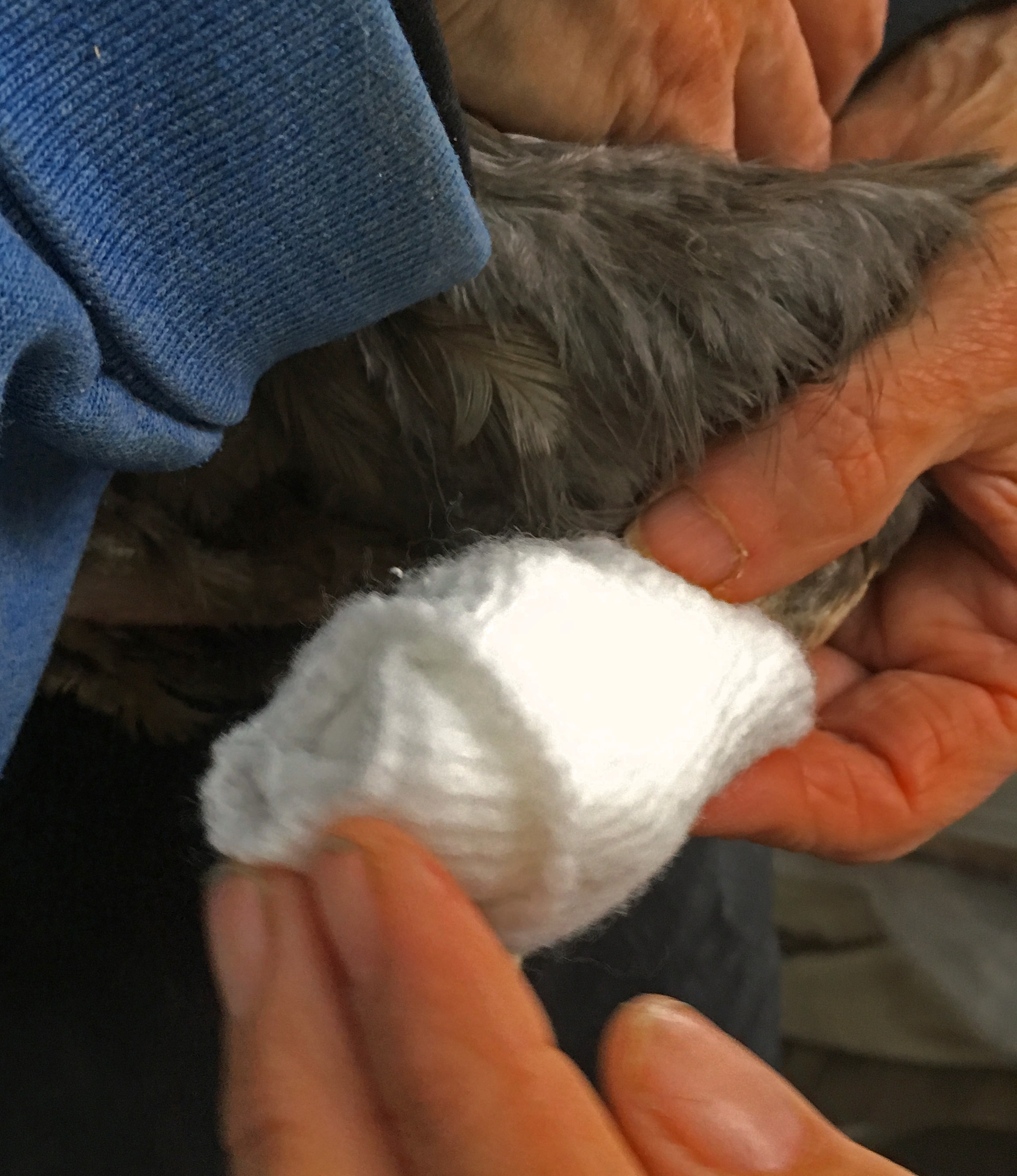
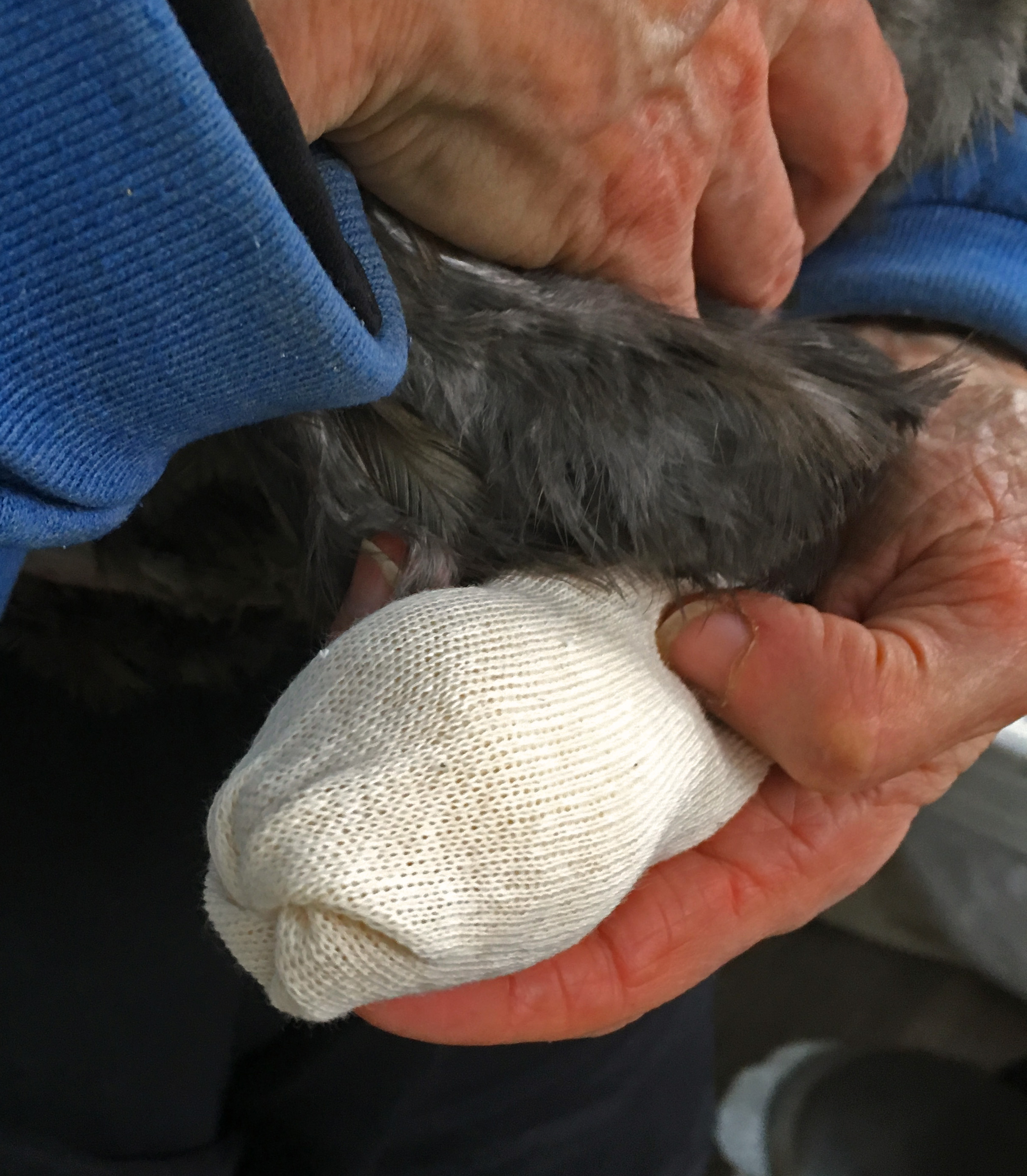
Jennifer discussed various wraps and showed me how to apply a soft breathable cotton padding to the stumps, then wrap them with a mesh-like cotton sleeve that is used to wrap limbs inside casts. These formed a soft ‘sock’ which was secured with Vet Wrap around Jem’s leg. We fitted one leg inside the prosthetic with the open tube, securing it with Vet Tape. I then held Jem suspended, encouraging her to lower her leg until the duck foot touched the floor. She struggled a little at the strange feeling, then relaxed and put a little weight onto the foot. When she stood quietly for several seconds, I ended the session. I learned long ago to always end on a positive note, when working with animals.
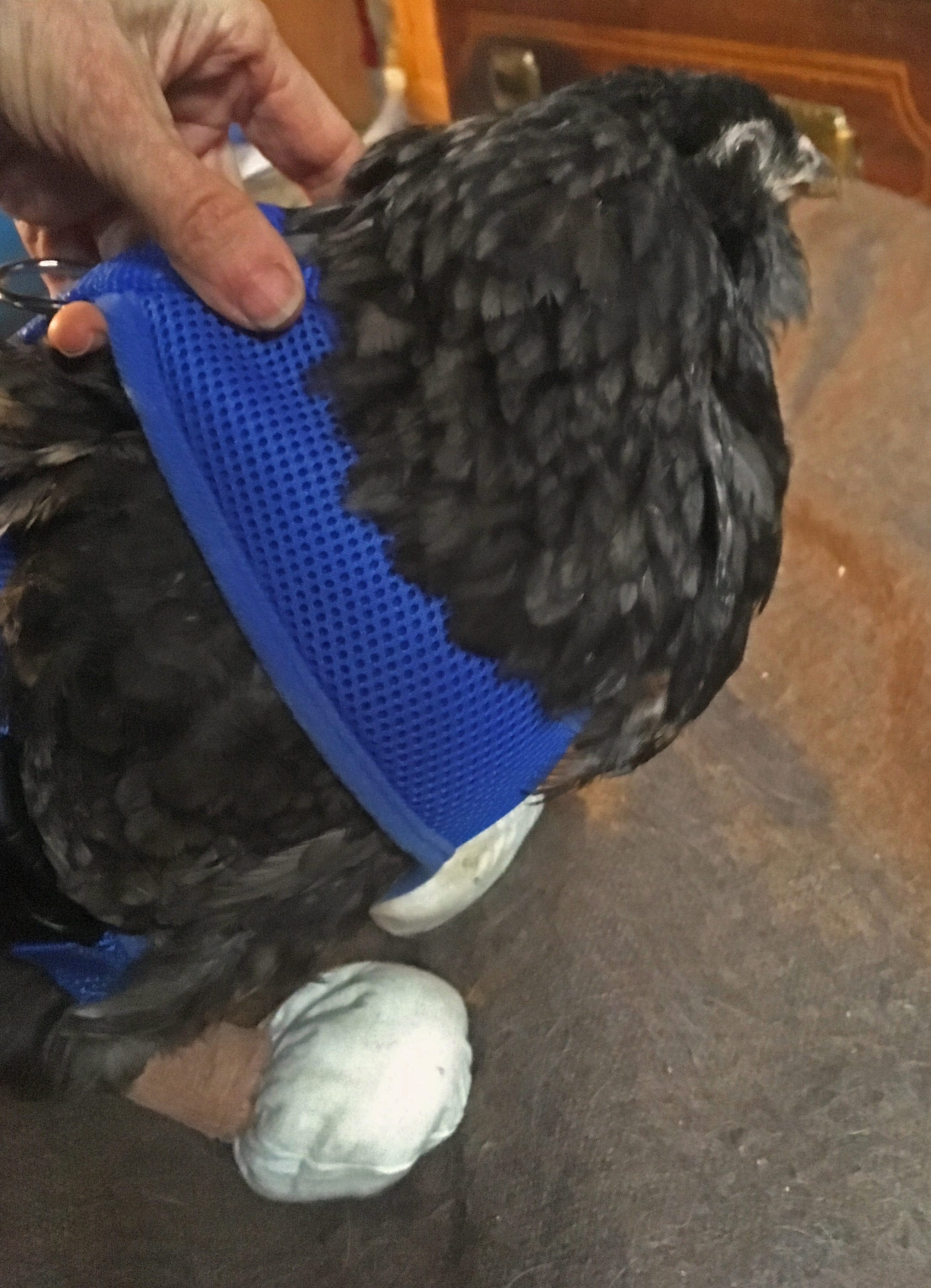
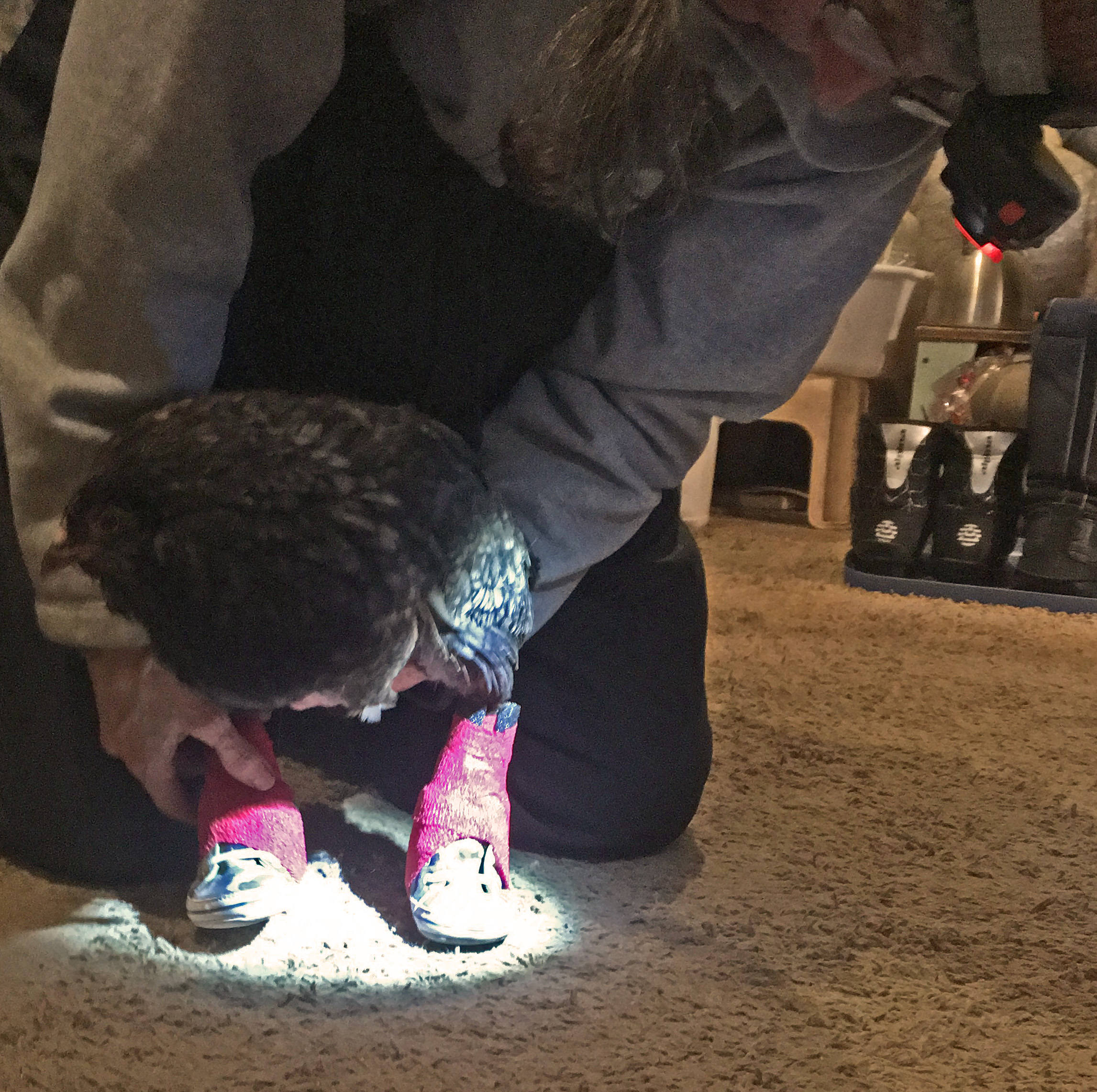
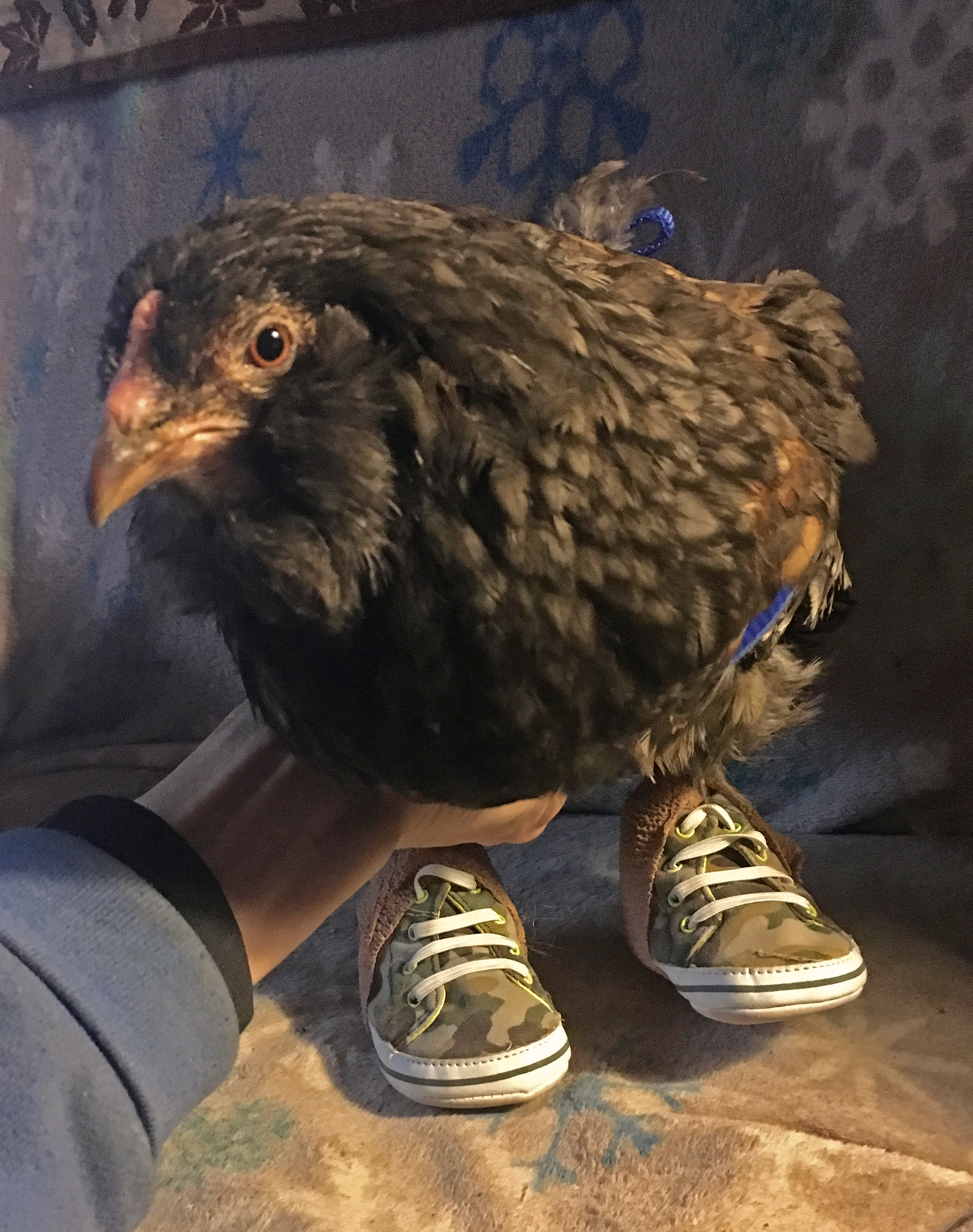
Highly encouraged, I bought a chicken harness during my next trip to Wasilla and found several kinds of infant booties and socks, and even a couple of pairs of infant shoes. I began therapy sessions with Jem each morning, holding her in the harness after I had secured the wraps and booties to her legs, encouraging her to lower her legs and put her weight onto the booties. None of the booties or shoes had a wide enough base to support her full weight, and would tilt to either side when she started to walk. I learned that the flatter, rounder booties worked best for her, and adjusted cotton padding to support her stumps front and back.
The harness needed revising, so I gave it to a friend who is a good sewer, to work on getting it just right. Meanwhile, I sent for the gel Jennifer recommended to toughen the skin on Jem’s legs. After it arrived, we settled into a daily routine. I fetch Jem from her night-time roost box in the morning, putting her on her pillow next to me on the sofa and massaging the fragrant gel into the skin of her legs. It contains lavender, sage, marjoram, calendula, and thyme in its ingredients. Next come the wraps, then the booties over those. Then Jem is moved to the outdoor cage with the heat lamp, for the day. I go out several times to take treats to her, clean the bedding, and put her down onto the porch or into the dusting box so she can walk around as much as she wants, and take a daily bath. The mites have been cleared out of her feathers after I dusted her, and she no longer scratches. Her feathers have taken on a clean shine, with all her dust bathing. Enticing her with lettuce or spinach, I can get her to walk six feet across the porch without stopping, now. This is strengthening her muscles.
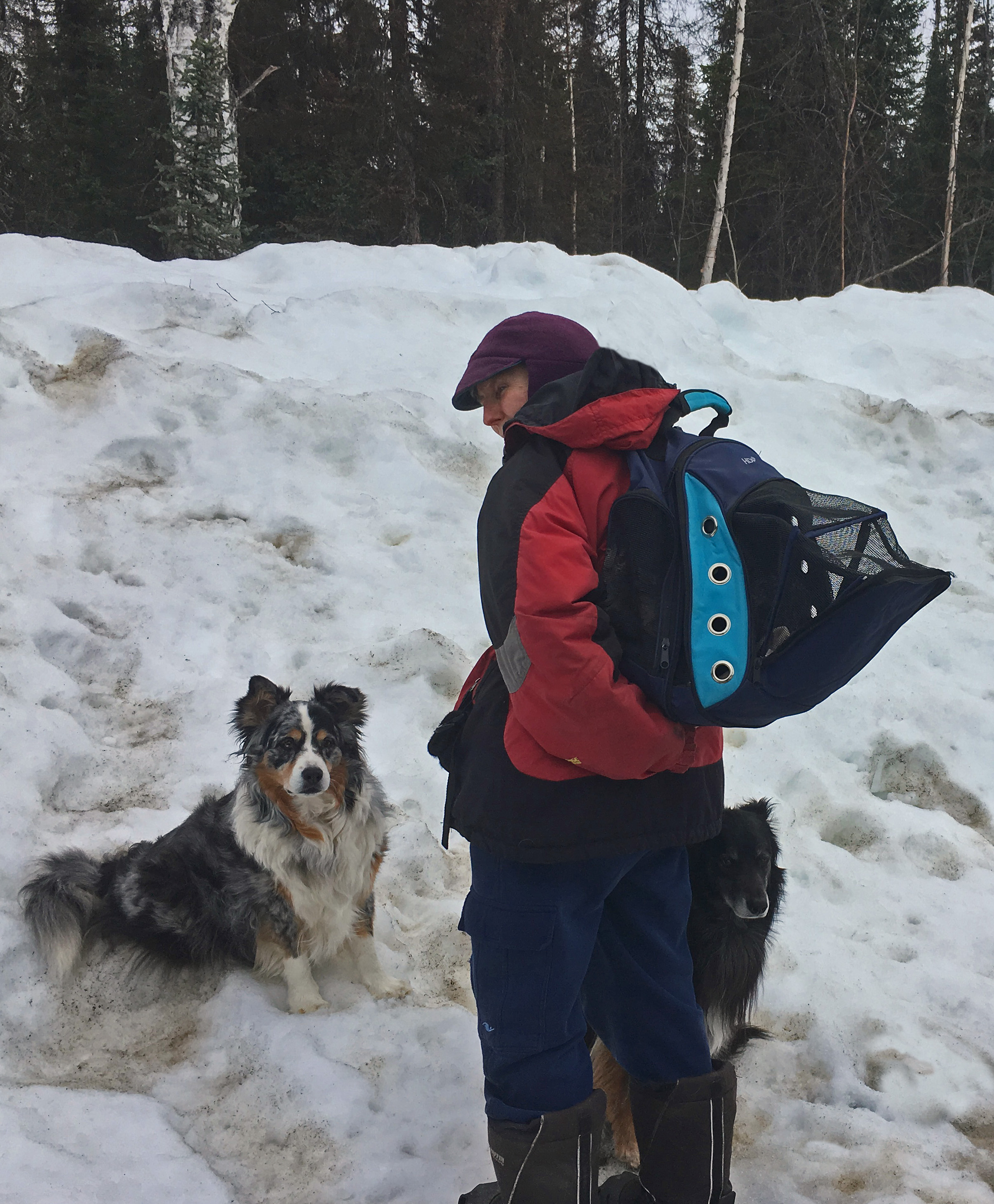
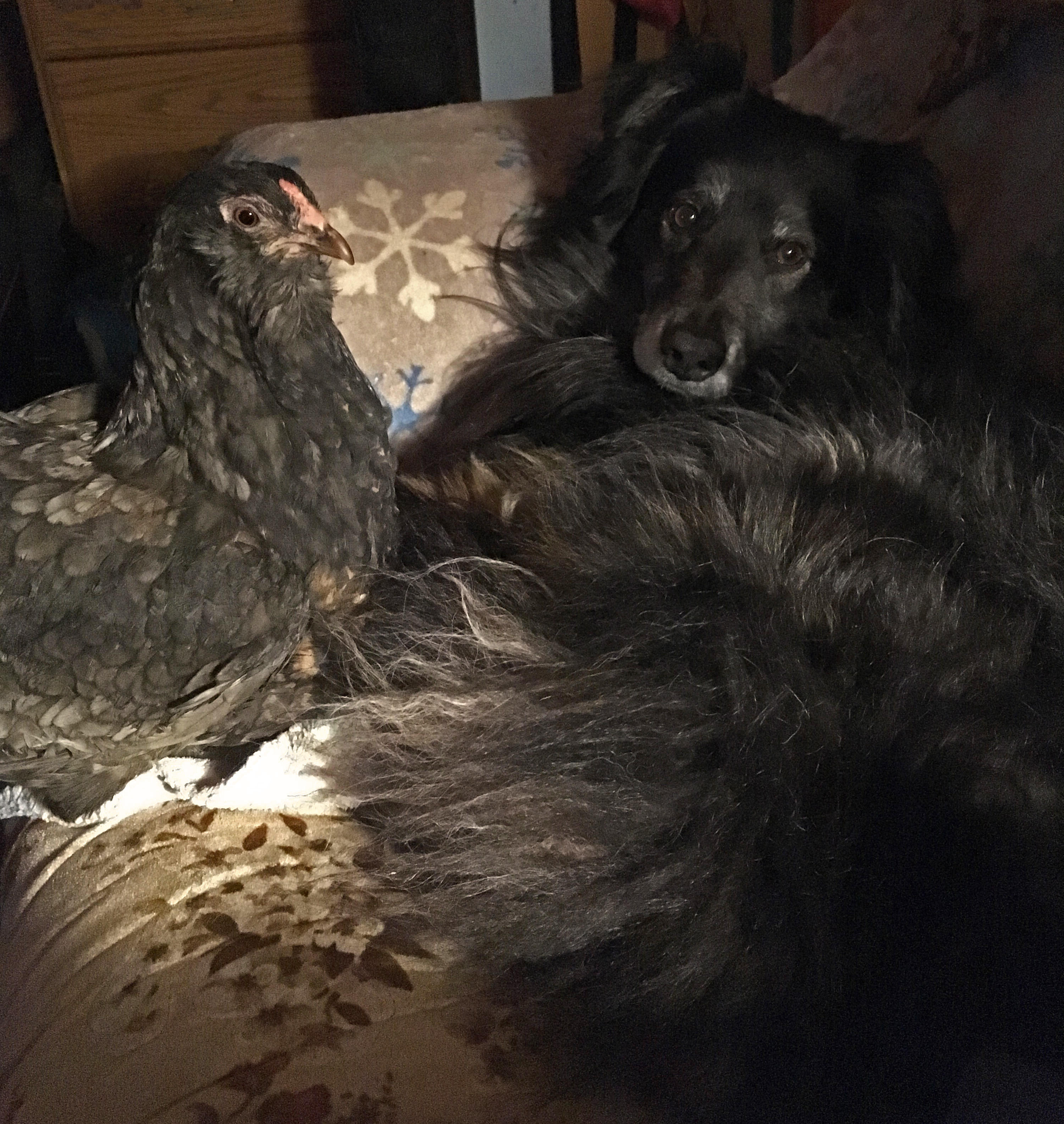
Sometimes I put her in Jorie’s backpack and take her on dogwalk with my girls. Jorie is slowly becoming used to her presence and doesn’t attack her indoor cage any more.
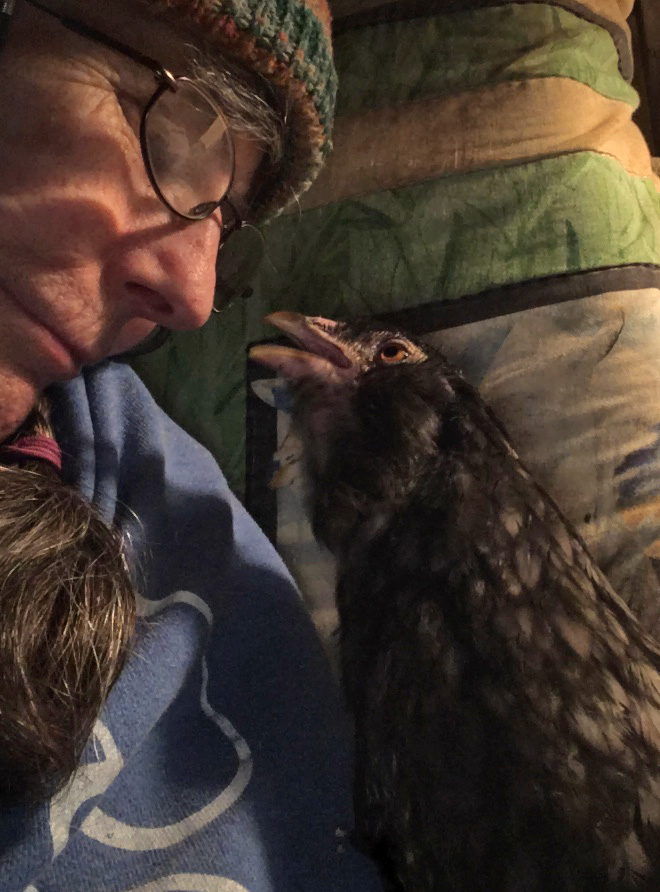
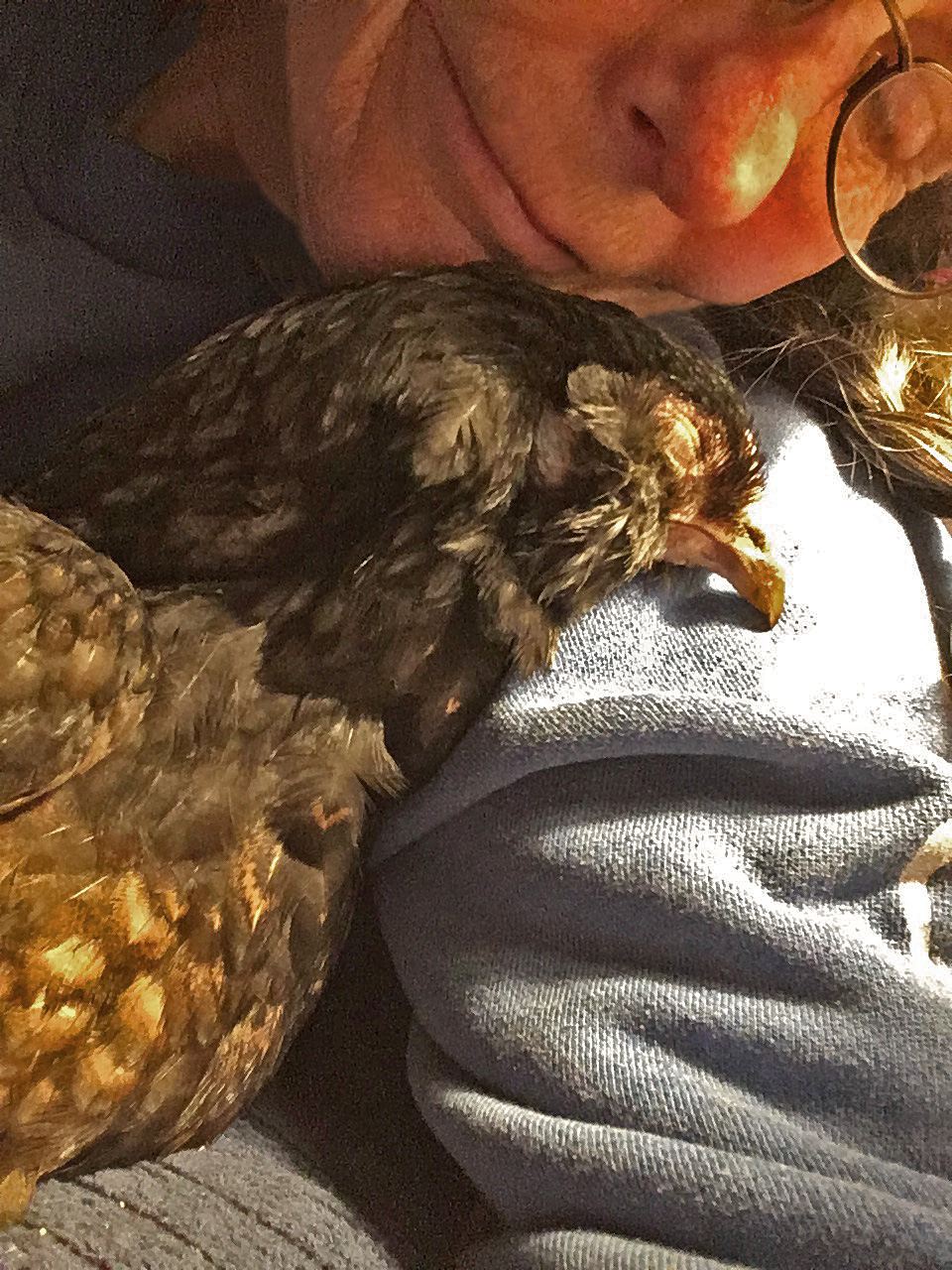
After Jorie has gone to her roost perch in the loft at night, I bring Jem inside and remove her booties and wraps, then massage her legs once again with the gel. Often she dozes off, her head resting on my arm or shoulder. I enjoy this quiet, peaceful time with her. Then I climb my step ladder and place her in her roost box on top of the kitchen cupboard for the night, switching on her fan to circulate cool air for her through the night.
The next step is to get the skin on Jem’s legs toughened up so they will be able to withstand the rigors of riding inside prosthetics. Then will come more therapy sessions with the prosthetics, helping Jem to learn to walk in them, and to lay down and stand up in them. We still have a long road ahead, but with this brave hen’s determination, and my love and patience, I think she will become a walking bird once again. She continues to amaze me with her willingness to test her boundaries. Last night, on her own, she flew up onto the back of the sofa. She carefully turned around on the narrow surface in her booties, then settled down onto her belly. She shows me that her self-confidence is growing, and that makes me want to do everything I can to help Jem regain as normal a life as she can. She deserves that chance.
Su Writer’s Voice,KTNA
Robin Song, Natural Observations
March 27, 2019