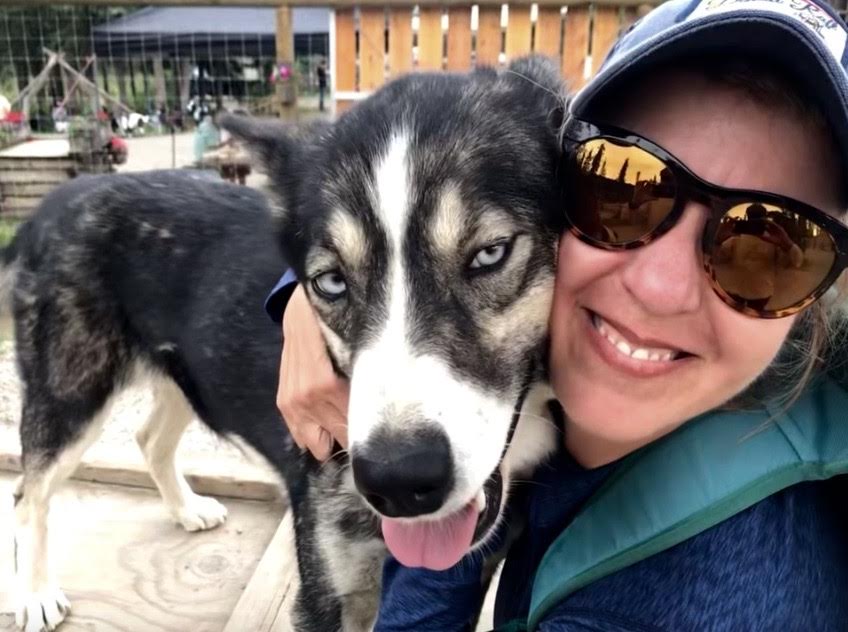
Former Talkeetna resident, Emily LaPorte, is spending the summer working at Denali National Park. As a seasonal worker, she’s found it’s difficult to have a pet. But after responding to an advertisement to be a part-time companion to a sled dog, Emily’s discovered that she’s found a new friend.
Denali National Park and Preserve is home to the only working sled dog kennel in the entire National Park Service. Dogs have played a key role in Denali since 1922 when the park’s kennel was first established.
Dogs are used in the winter to help haul supplies for building projects. They’re also used to aid scientists with research projects and they help monitor wildlife and patrol for poachers.
But in the summer when there’s no snow, the dogs still need training and exercise. Former Talkeetna resident, Emily LaPorte, explains how she is helping out.
“I am a volunteer dog walker. We have 26 Alaskan huskies and in the summertime, because they’re not running the sleds, the Park Service has paired either NPS employees or people who live around the community with a particular dog.”
Emily’s dog is a two year old female named Pika. Emily describes how she takes Pika for walks along the road.
“It’s kind of like a skijor setup. So it’s a padded, thick waistband that has a clip. And then the leash comes out from that so it’s kind of a hands-free system. I don’t know what she’s like in action on the sled, but when we’re walking, she’s really well behaved and she doesn’t pull.”
Emily explains that it’s not just exercise that she’s giving Pika.
“One of the big things is to bond with the dog. They want one person to be paired up with a particular dog so that you get a relationship with that dog, and the dog gets to know you and is comfortable with you. Of course they would switch things out if it wasn’t a good match.”
Denali National Park has it’s own breeding program and puppies are born right there at the kennel. According to the Park Service, the puppies run free beside the dog teams their first year, learning the routes and the terrain. They then learn to pull by skijoring.
When the dogs turn two, they begin to pull light loads and until they are ready to take their place on one of the teams.
Next year the dog program will be celebrating its Centennial, marking the anniversary of using dogs in the park for 100 years.
Emily explains why the dogs are used for projects instead of more modern machinery.
“Yes, this stuff can be done with helicopters or airplanes or snow machines. The park really has put a lot of effort into like preserving and maintaining the wilderness culture of the park and wanting it to be done in a traditional way; in a way that is the least impactful on the environment.”
In addition, dogs are often more reliable than machines, when confronted with overflow or in temperatures of forty degrees below zero.
“That intuitiveness, that intelligence the dogs have, isn’t something that can be replaced by a snow machine. Also to keep them out of danger, to let them know if there was a dangerous animal around, if there were cliffs and crevasses, I mean all the things the dogs could sense that helped protect the mushers.”
Emily looks forward to her walks with Pika and she’s pretty sure the feeling is mutual.
“I also brush my dog so I think that she recognizes me. I’d like to think that she’s excited I’m coming.”
Emily doesn’t know if she’ll be in Denali next summer but if she is, she’s planning to participate in the dog program again.
“I would definitely do it again and I would of course request Pika.”
Although it’s easy to believe that technology is always the better way, Denali National Park is demonstrating that sometimes, what we did 100 years ago, is still worth doing today.