The U.S. Army Corps of Engineers is looking to the public for input on potential plans for flood control structures in Talkeetna. KTNA’s Phillip Manning attended a meeting held last month to discuss the projects, and has this report.
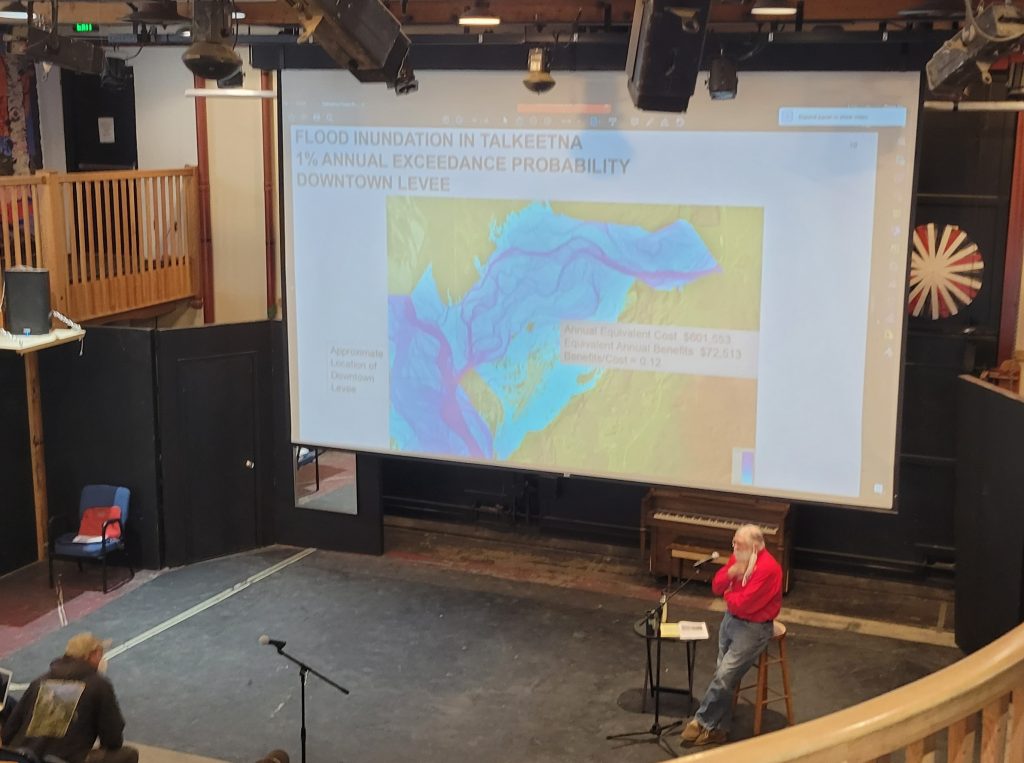
Almost nine years to the day after the last significant flooding event in Talkeetna, the Army Corps of Engineers held a public meeting in person and online to discuss potential plans to prevent damage from future floods in the area.
The current process is taking place under Part 205 of the federal Flood Control Act. Under Part 205, any approved project would move forward under what’s known as “continuing authorization,” meaning that any appropriation to fund it would not need special approval from Congress. Falling under Part 205 also means there are specific restrictions and requirements in place for any potential project as well.
First is the price tag. Any project would be limited to about a fifteen million dollar budget, with the federal government picking up two thirds of the cost and the rest falling to the Mat-Su Borough.
Beyond the absolute price, any project would have to be effective, as Project Manager David Williams explains.
“And the second one is that we have to have benefits from the reduction of flooding. If we don’t have benefits from the reduction of flooding, we don’t have benefits that can bring this project to the point where it will be able to be authorized.”
To be approved, those benefits over the lifetime of any project, about thirty years, would have to add up to at least the cost to build that project.
There are three potential alternatives that were presented to the public. One would build a levee in Downtown Talkeetna near the end of Main Street. This project would cost the most, and current estimates show it making up less than a fifth of the construction cost in protected property. In addition, the estimated price to build the levee tops seventeen million dollars. While more expensive projects are allowed, anything beyond the federal two-to-one match would have to be paid for exclusively by the borough.
Another alternative would build a floodwall in the Talkeetna River Subdivision. This project has the lowest cost at well under half-a-million dollars, but the estimated protected property value is still only about a third of the build price.
The option that comes closest to fitting the Part 205 criteria at this point is a ring levee that could be constructed to protect much of East Talkeetna. That project comes in just over ten million dollars, and current estimates show it coming fairly close to breaking even on protected property value.
While all three plans fall short of the cost to benefit requirement, that doesn’t mean that the project can’t happen, however. All estimates of damage are based on computer modeling that combines LIDAR mapping and data available from the September 2012 flood. The Army Corps of Engineers recognizes that there could be a lot more information out there than what a single computer model can show. As a result, they are asking locals to fill in the information gaps. Williams says input from the public can be very important in determining whether a project moves forward.
“You can have good numbers and a lousy story, and you won’t get your project through. You can have poor numbers and a good story, and it goes through.”
Some of the things that meeting attendees were told could be useful include reports of high water marks from 2012–and potentially other floods–as well as property damage that the model may not have accounted for, including sub-surface damage to basements, crawlspaces, and foundations.
Other economic impacts can also count toward the cost-benefit analysis. That includes businesses that suffered a loss of revenue due to flooding and other impacts on the area’s tourism economy.
Outside of the project proposals, themselves, many who attended the meeting raised issues related to flooding, including the rapid erosion near Main Street and the widely-held belief that the existing Talkeetna railroad bridge constricts the flow of the Talkeetna River, making it more prone to flooding. Williams acknowledges that there may be merit in looking into those, but says the scope of this project does not allow him to address those particular concerns.
“You’ve got two projects, here: One that I’m authorized to handle right now, and one I’m not authorized to handle right now under this authority. If you want to have more information on what needs to be done to work the Alaska Coastal Erosion side of this, send me an email.”
According to the latest project timeline, a tentative project plan is to be identified between now and November with a third public meeting taking place in December.
Full meeting audio: