Special web story (aired abridged version) – Residents that are currently on the Talkeetna Sewer and Water seasonal fee schedule are safe for now.
Thursday afternoon, the utility’s Board of Directors voted unanimously to postpone a vote on a proposed resolution to change fees until February.
The decision did not make Public Works Director, Chuck Braun, happy. Tempers flared briefly as the Board made their decision. Braun said he could no longer allow Talkeetna’s utility employee, Mike Kilgo to work as many hours on the system as he had been.
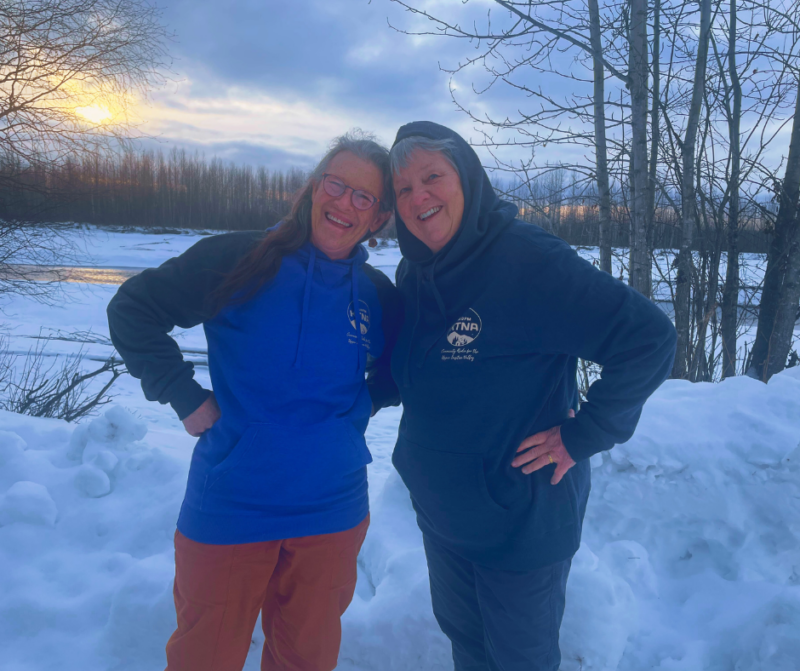
Two local residents, Kathy Stoltz and Pat Pratt, have volunteered to dig deep into the accounting of the utility to find an equitable way customers can pay and at the same time, bring the utility out of the red. Stolz presented some initial findings at the meeting and said she needed 30 to 60 days to present the Board with what it would take to get the utility out of debt. As Stoltz continued to talk and question Braun on some of his past statements, Braun calmed and discussion continued.
At the same time, Braun said he he needs to cut Kilgo back to working his allotted 20 hours in Talkeetna instead of the 30 or 40 that he has been working lately. Kilgo is a Borough employee and is only a part time employee for the utility. The remaining 20 hours are spent at other Upper Valley Borough buildings such as libraries and fire halls.
At the last regular meeting of the Board, Braun said that he was having Kilgo work all of his 40 hours on the Talkeetna utility in order to install the arsenic system and fix some things that had been delayed. Kilgo said he believed his job could easily be full time in Talkeetna alone and it might be that the Talkeetna utility could use a time and a half employee. Kilgo agreed that he had been spending all of his time in Talkeetna getting up to speed on the sewer and water system and helping install the new arsenic treatment system. (Many towns across Alaska, and across the lower 48, are scrambling to install systems that treat arsenic. When the EPA lowered the allowable arsenic levels from 50 parts per billion to 10 parts per billion, it threw hundreds, if not thousands of villages and towns across the U.S. out of compliance. Past Borough employee Chuck Jacobs, now employed in Homer, said at the time that Talkeetna was lucky since the arsenic in the system is at 14 parts per billion just over the allowable level. For years, he called Talkeetna’s water some of the best in the state.The new system being installed should be hooked up and running by mid November. The installation was originally scheduled for August. Project manager Jeff Walden listened to pleas from tourist businesses in Talkeetna as well as having a concern with a high summer water table and pushed the project back until tourists were gone for the summer. The utility received over a million dollars in grants in order to install the system. )
This spring, at the same time the Borough Assembly was approving the hundreds of thousands of dollars in grants for the Talkeetna utility, the Sewer and Water Board of Directors asked Braun to draft a resolution that would allow them to keep a better handle on part time residents to the system. Several years ago, the AK Rate Commission suggested several things the utility should do, one of them being a change in seasonal shut off and start up fees. The proposed resolution says that seasonal residents and businesses can have one free disconnect and re-connect per year but while disconnected the customer will pay the full sewer and water rate. Currently, seasonal residents pay a disconnect and reconnect fee, but pay a minimal amount throughout the winter. The proposal was greeted with anger by several seasonal residents.
The Board mailed the proposed resolution to customers in August. Seasonal resident Karen Schpansky went in front of the Talkeetna Community Council and the Chamber of Commerce making a plea for those residents that are only on the system for part of the year, calling the proposal inequitable. It was then that residents Stolz and Pratt got involved. Both astute business women with a keen sense of accounting, questioned the resolution and said they would put in time to figure out what it make take to get the utility out of debt AND keeping track of those that are deliquent with their bills. The idea piqued the interest of the utility’s Board and at the last meeting it appeared that they would be setting aside the resolution temporarily until the 2 women could show a more equitable fee structure. Stoltz said up front that everyone on the system will probably be paying more not less. She was shocked to find that there was no plan in place to pay for maintenance or emergencies. She has charted a comparison of Wasilla, Palmer, Anchorage and Talkeetna and is waiting to hear from Haines, McGrath and other villages comparable to Talkeetna.
After listening to Stoltz, the Board unanimously chose to delay a vote on the proposed resolution until their February meeting. The vote caused a brief flare-up from Braun. He said he had a fiduciary responsibility to the Borough and would pull Kilgo from his full time work in Talkeetna and push him back to 20 hours per week instead. However, after Stolz questioned earlier statements he had made, he back-pedaled and apologized, saying he would not abandon the Talkeetna utility. He said he has cooperated fully in getting them the numbers that they have asked for in order to present a future fee schedule. After the meeting, he said that when he lived in Barrow, the water and sewer fees per month were $160, almost twice what Talkeetna pays. He is interested to see the numbers that come out of the study being undertaken by Stoltz and Pratt.
Five or six people showed up to the Thursday meeting to oppose the proposed resolution. Jim Okonek said he was in favor of tabling the resolution because of the inequities. Jeff and Gay Davis said they were personally against the resolution, but asked that all the current loans on grants and cash flow be examined to find a more equitable fee structure for all residents. Jeff Davis said he wants to pay his fair share, but said he closes his town property for the winter and doesn’t use any water at his downtown residence when he lives up the tracks. “I have heard there are people that leave their water running all winter so their pipes don’t freeze,” he said. Board member Terry Mangione said there are some places that are not reliable and others that are. “My place has never frozen up”, but he said that he is well aware of others that do, and as such, leave their water running in the winter to avoid pipes freezing.
The utility has received 40 meters that Kilgo is installing on businesses in Talkeetna. Residents at the meeting questioned if it was a good idea to meter everyone. Braun said it would take around $3 -$4 million to meter every customer on the Talkeetna system. He said the utility is currently paying approximately $15,000 per year on loans incurred over the past few years. That doesn’t include the grants recently received for the arsenic treatment. Braun said all customers should get used to the idea that rates will rise substantially next year.
Board members asked what it would take for Talkeetna to become a LID – Local Improvement District – and Braun explained how he thought it might work. In an LID additional payments would be required for every single lot, even those that don’t have sewer and water hook up.
A special work session is scheduled for mid November where Stoltz will provide more findings. There will be no decisions made at that meeting.