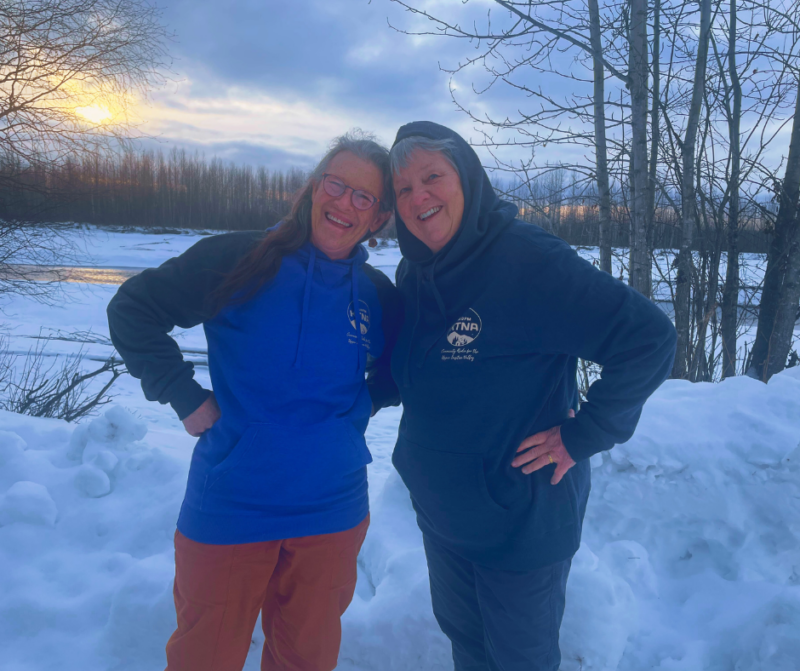
Robin Song thinks of this time of year
as a bridge between seasons.
She found very unusual tracks
in the crusty snow on a recent walk.

It’s a quiet time in the yearly cycle; what I think of as a “bridge”.
The winter is behind us, and the frenetic energy of spring hasn’t quite begun.
Migratory birds are just beginning to trickle into the North Country.
We’ve been gifted with an early spring,
coming on the heels of an exceptionally mild winter. This gave us one of the lowest snow accumulations on record. What that will mean for the summer water table will depend on how much rain the area will receive. Snow melt has been fast, with day after day of lengthening sunshine. I’ve heard people asking if anyone has seen ‘skeeters yet. I’ve been looking for Mourning Cloak butterflies, always the first to emerge from their winter sleep. On March 1st the first Trumpeter Swan was spotted on the pond across from Fish Lake. On March 5th I talked with a man in Trapper Creek who had been out snow machining a few days before and had come upon fresh black bear tracks a few miles north.
All the wildlife I’ve seen over the winter-especially the moose- have been in good shape. The birds coming to my feeders have also been healthy and full of energy. After the first storm of winter hit, three Dark-eyed Juncos arrived at my feeders. Why they didn’t migrate out with the rest of their species, is a mystery. Later in the winter, after a few more storms had passed, there were two juncos. That pair stayed the rest of the winter, and are still visiting my feeders daily. It’s a strange sight, for me, to see juncos in the snow.
The rest of the winter flock were present, from the pair of nuthatches to the gray jays. Of notable absence- for the first time in the ten consecutive years I’ve lived at the ranch- were the Boreal Chickadees. There has always been a pair coming to my feeders. I missed their handsome brown and sienna plumage and their calls, distinctive from the Black-capped Chickadees. The Redpolls hardly visited my feeders, which was also different. They elected to stay up in the trees, and fly overhead in flocks of various sizes. The Redpolls and Pine Grosbeaks were always the first birds I heard giving voice each morning, just as the sky was beginning to lighten.
The last weekend in March I decided to go for a hike up a creek I’d been wanting to visit all winter. It was beginning to open up, so I knew I’d better go before the sun worked on it much more. Even so, the snow was soft the day I picked, and I needed to test each step and watch where my two dogs went ahead of me to see how far they punched through. In a few places I saw their paw prints fill with water. Big thunderhead clouds moved in from the east, but the sun warmed my back and blue sky patches were still overhead. Redpolls flitted amongst the trees, along with a couple of chickadees. I snapped photos of the water making mosaic patterns as it moved along under the thin ice of the creek. A shelf of ice lined each shore and bridges of snow went across the creek here and there.
I was picking my way around a birch near the south shore when I spotted tracks. They were old, but still clear, as there has not been snowfall in quite a while. Some had gone down onto the ice shelf and been encased in the ice. I caught my breath. There was no mistaking that they were from a wolf. It had come out of the forest and walked to the creek, then milled around a bit, as if contemplating whether or not to cross the ice. Then it had turned and walked along the shore, then headed on back into the forest. I placed my camera’s lens cap beside one of the paw prints to get a size reference. Then I called Darby, my 40-pound English Shepherd, and had her lay down between two of the tracks, with her paws next to one. Her paws are dainty and small, and next to the wolf print her paws looked like a fox’s. The wolf was not large-I’ve seen larger prints in Denali Park. This could be a young male out on his own, breaking away from his family in search of a new pack. I’ve read books and watched Nature shows about wolves, learning that young males of breeding age will sometimes leave their family because the alpha pair are the only ones who will have pups within a pack. The young males will then search for another pack to join, or will join up with other single males, and will woo young females away from packs, and then form new packs. Single wolves don’t stay on their own for long, as wolves fare best in hunting when in a pack. But a single wolf can hunt small prey, such as hares, grouse, and ptarmigan, to get by for awhile.
I was thrilled to come upon these wolf tracks. I was within ear-shot of the Spur road, and yet also on the edge of wilderness. To the east lay access to the Talkeetna Mountains. My only sighting of a wolf was many years ago when a black wolf came across the snow in front of my truck on Mastodon road while my dogs and I sat watching in stunned silence. It paused, looking at us with golden eyes, then loped up the snow berm, melting back into the forest with wild canine ease. I’ve always hoped for another wolf sighting since then, but have only come upon tracks. Even so, seeing them always fills me with a giddy thrill-and underscores why I love Alaska and am so very grateful to live here.
Writer’s Voice, KTNA
040515
The Bridge Time of Year