Living close to the Alaska Range has visual benefits that make up for the lack of ethnic restaurants that you may find in more populated areas. While many people travel from all around the world to see North America’s highest peak, Alaskan residents get to eat up the view throughout the year. There is no shortage of Denali burgers on menus around the state and the ‘High One’, Denali, feeds the tourism industry with ample revenue. Air travel is the most common way to experience the majestic and rugged mountains of the Alaska Range. It is without a doubt a real thrill to fly around Denali with an experienced air taxi pilot, gawk at the insane beauty, and even land on a glacier.
Pilots and mountaineers get the most intimate contact with the Alaska Range. The Talkeetna Airport (TKA) is a hub of activity for these types during summer months as they focus intensely on Denali as a dream-climb-come-true trip for the climber or a demanding job for the glacier pilots. The common aircraft are Beavers, Otters, Cessna 185s, Cherokees, and Navajos and various types of Pipers. The summer air traffic buzzes up and around Denali with awe-filled passengers aboard. The rocky faces, peculiar glacial ice, and intimidating crags embrace the viewer time and time again.
Nearby is another type of hub that heads out to a totally different location, the Talkeetna Mountains. Alaska Floats and Skis is a bush flying school specializing in glacier flight training, which is prohibited in Denali National Park. In the era of the ski flying pioneers such as Bob Reeves, Don Sheldon, and Cliff Hudson, they learned their skill from the school of hard knocks. More recently, learning the art of glacier landing requires a friend with a ski plane or being a qualified pilot that air taxis are willing to train. Don Lee of Alaska Floats and Skis has fine-tuned the teaching of this valuable trade on the Swiftsure Glacier that he named after a British battleship. His name choice is no coincidence, as getting the right weather conditions to access this location can be a bit of a battle with nature in command.
The remoteness of the Swiftsure Glacier, which sits at the base of Mt. Sovereign, is part of the attraction. The closest civilization is over 40 miles away from each direction, and the only access is by aircraft. Don has over three decades of mountain and glacier flying and his iconic status comes from his labor of love-bush flight instruction. He specializes in the most difficult of small craft flight training that attract those looking for flying adventure uniquely Alaskan.
Some 12 years ago, I was eager to learn the ropes of glacier flying. A pilot/friend climbed in the back of my Super Cub on skis and was willing to teach me the basics of approach speeds, sight pictures, landing and taxiing to the proper spot for a successful takeoff. We did one landing together, parked the plane and then went ski touring. That was the extent of my training before heading out on my own. I was instructed that with a glacier landing there is no go-around option. Because when you are on final, that’s it–you are landing. The other key point is be prepared to be stuck. Survival gear on board has a whole new meaning in this mountain environment where conditions change rapidly, temperatures can plummet below zero, and an extended stay can last for days upon days. Thus, you need an expensive sleeping bag, stove, snowshoes or skis, food for one week for each person on board, plus a sturdy metal shovel. It’s necessary to know essential Arctic survival skills, and how to build a snow cave.
We headed to the Tokositna Range which sits at the base of the Alaska Range for a day of ski touring. I did not have the ski flight training, and I remembered it was like being lured into a backcountry ski trip without the basic safety skills, beacon and rescue tools. There I was, eager to learn, but missing some fundamental training, like how to read the slope angle as well the commitment of final approach. When I made my approach, I felt like I was too fast. I applied full power and managed a go-around because the hillside had descending terrain to the left providing my safe way out. I had plenty of altitude and good visibility to make the turn, but I recognized the danger of dipping a wing into the snow. Yet, the favorable terrain gave me a second chance that day. Within a couple minutes, I approached with a better understanding of landing uphill–and though it was not perfect–I landed and managed to taxi in the deep snow and park in a favorable spot for takeoff. Immediately, my friends scolded me to never make that mistake.
There is no end to flight training, and for many of us pilots who own their own airplanes and fly recreationally, the biannual flight review (BFR) is the closest we get to a check ride. Although years of flying around Alaska has fine tuned my float flying skills, my ski flying skills were limited to frozen lakes.
Motherhood had taken top priority in my life, and my time in the cockpit was not as much as I would have liked. Some 10 years had passed and I had not sought out flight instruction for glacier landings. Had a sliver of fear hidden in my subconscious festered over the years about glacier landings?
With straight skis, the window of time for ski flying is limited. In February of 2016, I asked my former employer, Don Lee, to go up to the Swiftsure Glacier to check it out and perform a BFR. He was happy to agree, as he wanted to check out a potential site to build a cabin.
Along our route to the Swiftsure Glacier, we talked about carburetor heat, mixture settings, emergency landing options in mountainous terrain and shared a few laughs from the days I had worked for Alaska Floats and Skis as a flight instructor. As we flew deeper into the mountains, I felt like a kayaker dropping into a canyon of rapids from a High Sierra spring thaw. My focus narrowed, and we crossed over the final ridge line before making our downwind to final approach onto the glacier.
Don has a comforting demeanor that comes from extensive flight experience. Yet even that day, the words, “remember, there is no go-around on a glacier landing,” tweaked that sliver of fear that was still present in my being from the day long ago when I was flying with my friends. We checked the windsock and made the decision to land. On final approach, everything happens fast and I made some quick adjustments with my angle of attack, added another notch of flaps and he said calmly, “We’re a little fast, but we’re okay, this is a big space up here…there’s lots of room.”
We landed on the soft cushion of the snow-covered glacier. I added quite a bit of power to taxi up and turn around to our take off spot that pointed downhill. Since it was February and Alaska winter days are short, we didn’t have time to practice a bunch of takeoffs and landings. I pulled the mixture, and we exited the plane. He made the important point of remembering where the mixture setting needed to be for startup because of our 7,200 foot altitude.
When I stepped out of the plane, the beauty hit me with a wave of emotion as I made my first steps on the Swiftsure Glacier. We threw on the cowling cover and snowshoed over to a spot that would be his cabin site. I am no stranger to beautiful mountains of the world, and this particular view was absolutely breathtaking.
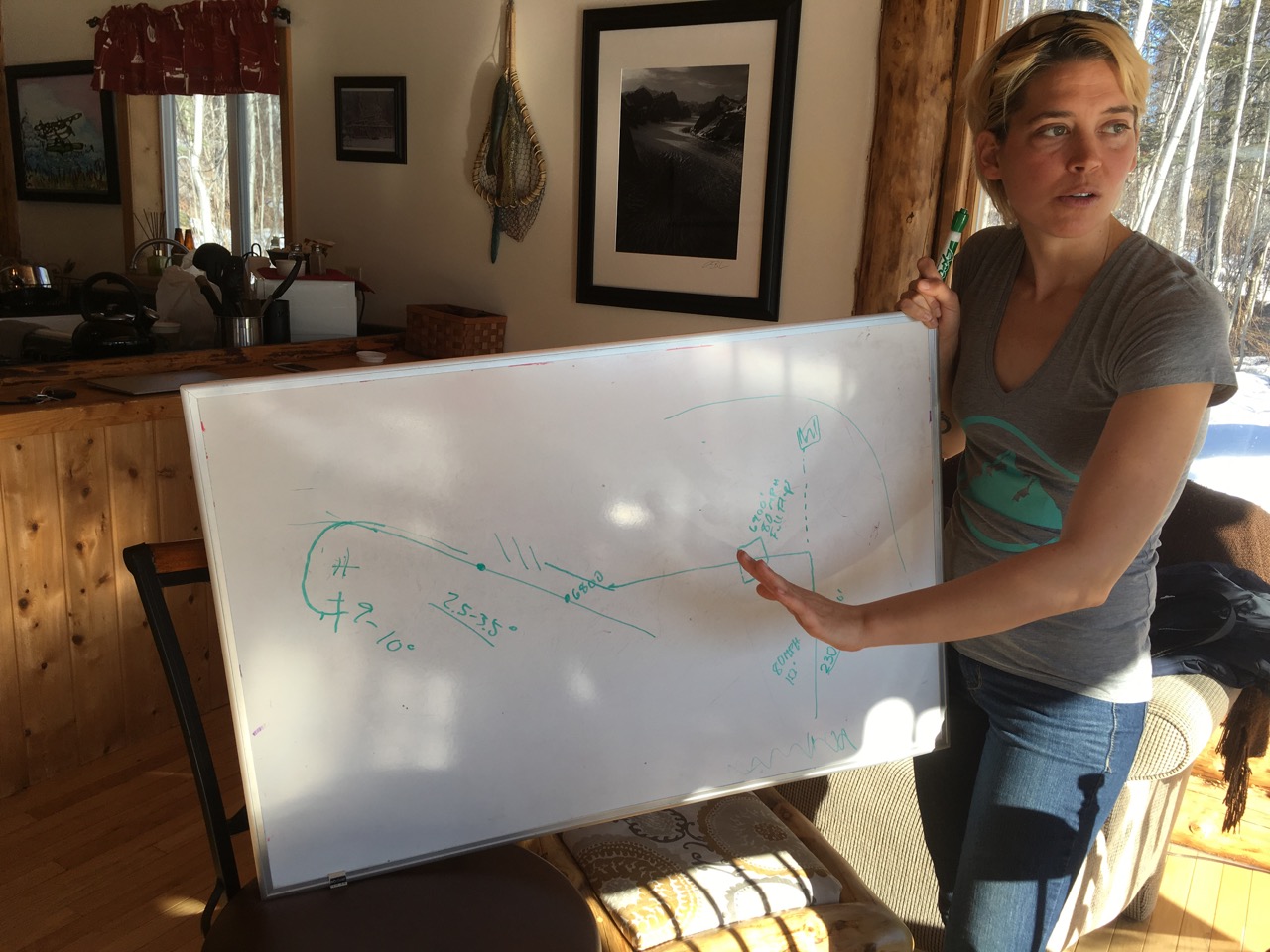
We had our eye on a silk tie on a stick that serves as a windsock, and when Don said we ought to get going, I obliged. While adding power for takeoff, the sensation of leaving the ground as the sloping terrain dropped beneath us felt like an amusement park ride. He reminded me to keep the nose down, and build airspeed before starting to climb. I also checked my airspeed and VSI instruments and made a mental note of the difference from taking off from a flat surface. He reminded me to keep my wings level with the sloping terrain.
One year later, I almost put myself in the same spot of going up to the glacier without the proper glacier flight training. I sat in on one of Don’s flight instructor’s ground school and listened closely to Melissa’s advice. She looked at me as an experienced flight instructor who could just follow them up to the glacier in my plane. Even though I had flown with Don to the glacier, it was one landing and I still wanted some more practice with a flight instructor on board. Melissa and her client were going to take a flight around Denali and then go to the glacier the following day. Don’s other instructor, Brooke Roman, was able to join me in my Piper Cub on skis.
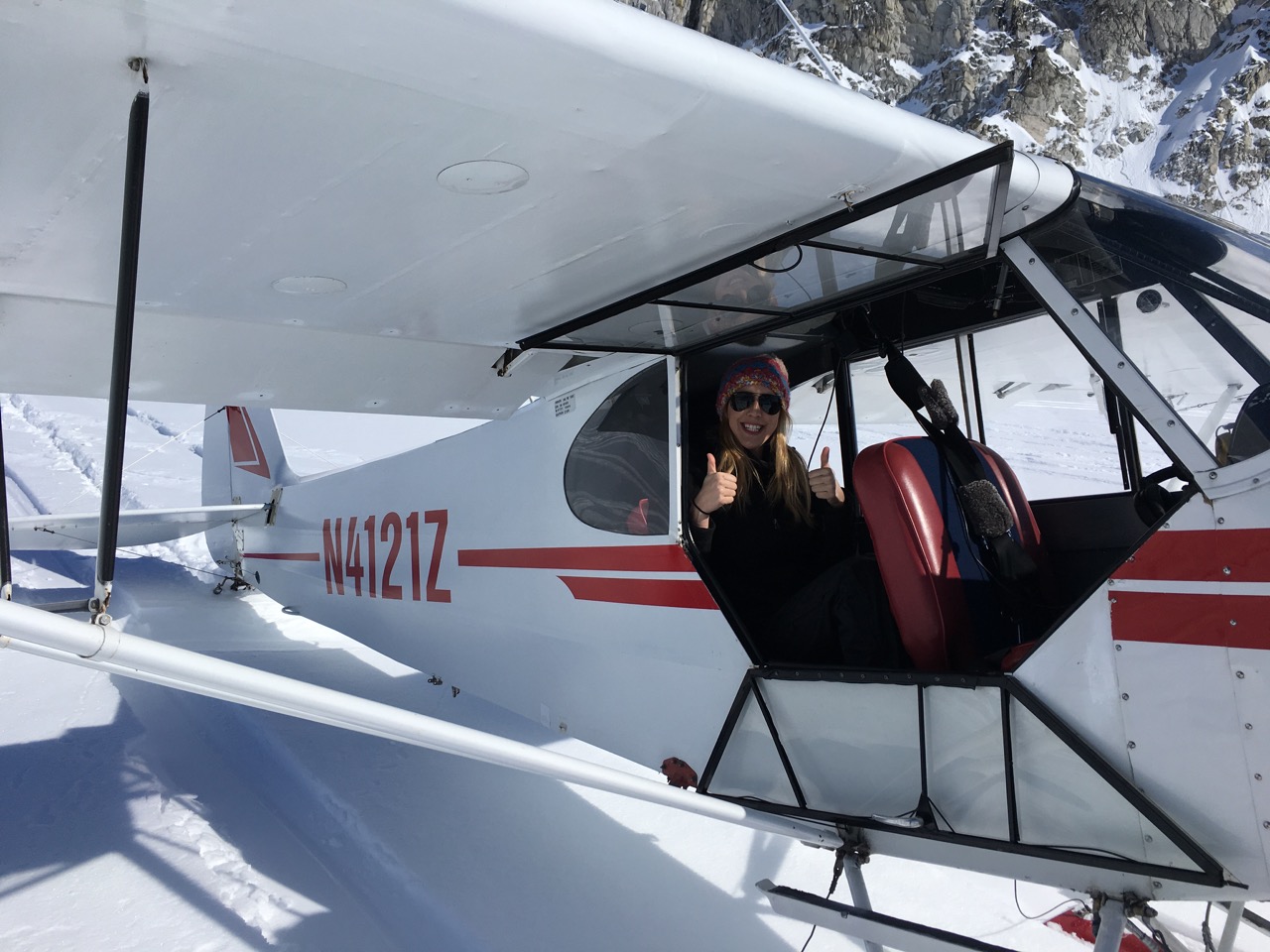
As we flew to the glacier, Brooke covered much of the same information that Don had shared with her about mountain flying. It was great to be refreshed and before we knew it, we were crossing over the last ridge line, my focus narrowed on the landing ahead. Once again, I felt we were high and fast on final, but Brooke said we were perfect, so we landed. I kept in quite a bit of power to taxi up the glacier to our turn around spot, and as soon as we were facing downhill she told me to add full power and take off again.
Even with the higher altitude, the Super Cub performed well, and we were quickly airborne. As the terrain fell away, Brooke urged me to keep the nose down to gain airspeed.
Later as we were flying back, we discussed how glacier landings and takeoffs are counter-intuitive. When you take off, you have to keep the nose down, wings level with the terrain and avoid climbing too soon, which could put you close to a stall. This time, I had really grasped the concepts and was now confident to head out on my own.
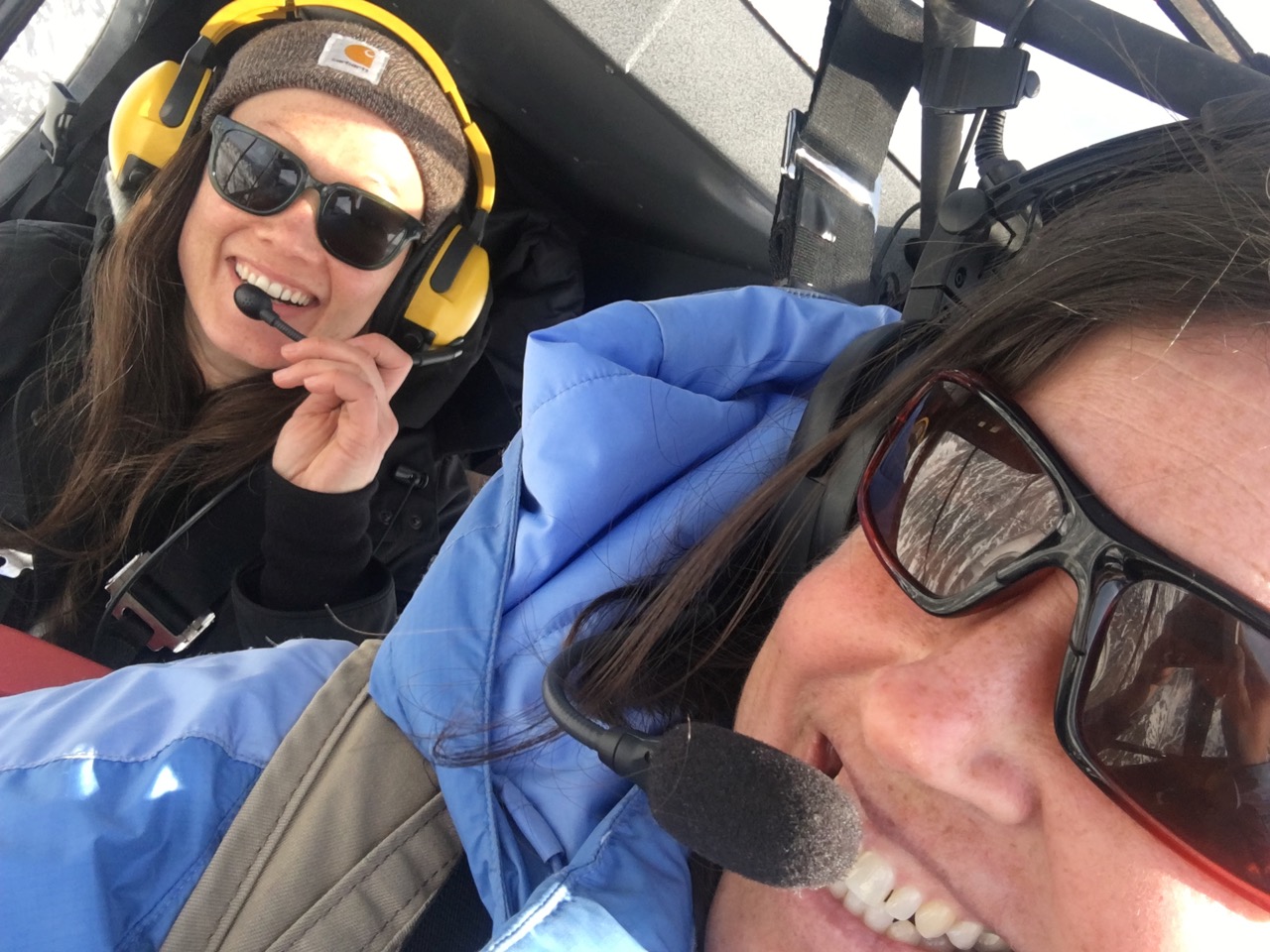
The later part of March of 2017 was exceptional in Alaska with endless days of clear skies and high ceilings. Earlier that month, high winds had battered a majority of the snowscape into packed drifts that made for rough landing conditions, which limited places for landing. The glacier had also been drifted, but there was enough new snow to make it a wonderful surface for ski flight training. Brooke invited me to join a group of friends that were headed to the Swiftsure Glacier, this time I felt well informed. With the proper amount of glacier flight training, I enjoyed my flight into the mountains. As we approached the ridge and did a pass over the glacier to check the winds, I was confident about my approach speed and landed softly on the glacier and taxied up to the other planes. I decided to let my friend out, so that I could set out for some more practice takeoffs and landings.
I like the expression, ‘know fear.’ There is a great satisfaction in facing one’s fears and overcoming them so that you can continue to add to a lifetime of piloting skills. Even the most experienced pilots have their days of being humbled. Whether it’s deteriorating weather, high winds, or days when you are just not on top of your game, it’s the humble attitude that will keep you out of trouble in the long run.
Katie Writer, WAI 11711, enjoys painting, photography, playing with her two children, and exploring Alaska. She’s writing her first book and can be reached at akktwriter@gmail.com.
This story, “Glacier Flight Training” was written by Katie Writer. It first appeared in the January/February 2018 issue of Aviation for Women Magazine.
All photos by Katie Writer except closeup of Katie on Swiftsure Glacier photo by Brooke Roman.