It is time, once again, for KTNA’s spring fundraiser. We rely on the support of our listeners to report the news and happenings of the Susitna Valley. If you value what we do, please consider becoming a member by clicking here or on the blue “Donate” button above. Thank you for your support of your community radio station.
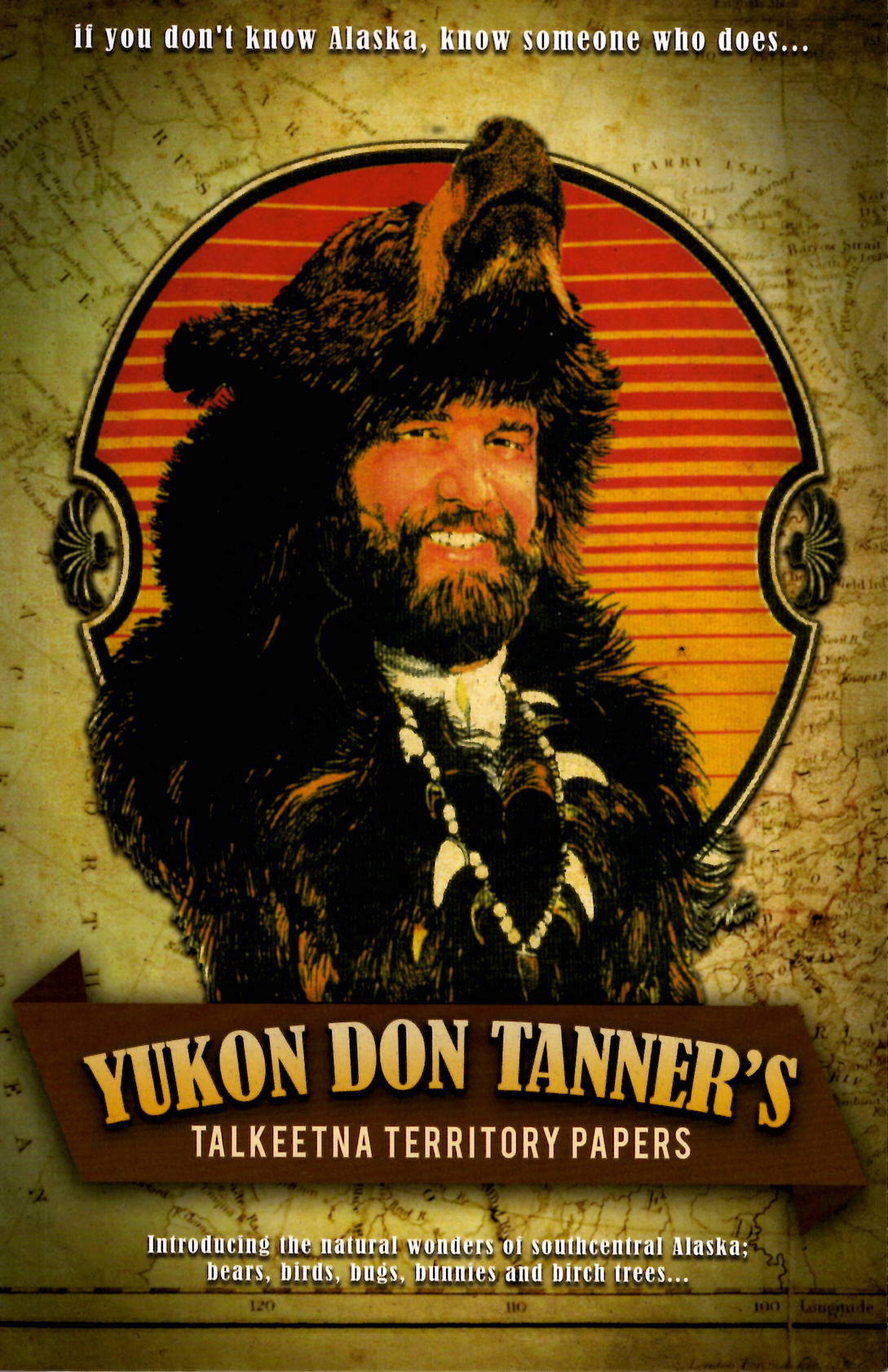
The tagline of the new book Talkeetna Territory Papers is, “If you don’t know Alaska, know someone who does.” After more than fifty years of living and adventuring in Alaska, it’s fair to say Yukon Don Tanner knows the state, and particularly the Susitna Valley. He sat down with KTNA’s Phillip Manning to discuss his new book and how it came to be.
You can listen to Yukon Don reading Chapter 7 and Chapter 12 of the book here on our website. In 2015, he also recorded Parts 1, 2, and 3 of his Yukon River adventure story.
Partial interview transcript follows:
Phillip Manning: Give us just a thumbnail sketch of what this book is.
“Yukon” Don Tanner: Well, it’s a compilation of local information on all the subjects, basically, that tourists inquire about when they come through our territory. They want to know about burls, and they want to know about diamond willow. They want to know about bears–everybody wants to know about bears. They want to know about land availability, homesteading, homestead history. They want to know a little bit about edibles, sometimes. They want to know what kind of trees they’re looking at, what kind of critters they’re likely to see on their little journey through the territory. Just a nice overview, twenty chapters.
PM: So, when we spoke the other day, you said a similar thing, that this book is kind of geared toward the thousands and thousands of visitors who come through every year, but, from what you were telling me, it sounds like it’s had a pretty good local reception.
YDT: I’m just so encouraged and really blessed by the receptions of the locals here in the Valley, and I’ve sold 200 copies just to people I know around the Valley, and had just great comments.
PM: Yeah, and the season–the first bus and first train has yet to show up.
YDT: Yeah, I don’t think I’ve sold to the first tourist yet (laughs).
PM: So, tell me a little bit about the process. How long did it take you to put this all together? You know, are you sourcing from stuff you just remember? Do you have notes?
YDT: Well, most all my life in Alaska, my family came up here in 1959, has been, in one way or another, touching nature in more or less a wilderness sense. Not just taking a walk in a park, but taking a walk where there is no park. And so, I’ve accumulated a really, really good library of nature books on Alaska, and I decided I wanted to pursue some test of my knowledge of nature, so I looked for a certified naturalist class. Lo and behold, there was one online out of University of Alaska Southeast out of Sitka…
…So in the process of taking the class, I realized there were a lot of subjects that weren’t in there that were related to what I call “Talkeetna Territory,” which is the area here surrounding our homestead and the area we live in. So, I asked the instructor–The final examination for the course was you had to ask yourself twenty questions, and answer the twenty questions with three references and a typewritten page. So, I looked at my library and made a list, and my list was primarily composed of questions that, after having a bed and breakfast in Wasilla for fifteen years, that the tourists ask. That made it really easy, because you know what their inquiring mind wants to know about. So, that’s what I did. I wrote extensive papers, the twenty questions were answered, and [I] got my certificate, and it laid around for a couple years. [I] initially didn’t have the idea of doing a book, but when I met Cecil Sanders, who owns Last Frontier Magazine, and he wanted to publish my Yukon River story, which we talked about on radio last year, which was a journey of 2,300 miles from Lake Bennet to the Bering Sea. In the course of that conversation, I told him about this information that I had, and he got excited. He said, ‘You ought to do a book on that.’ Not only that, but he said, ‘I would like to use this as curriculum for the Mat-Su schools.’ He said, ‘I’m teaching classes there, and maybe we could incorporate that in some way. So, that was the seed for the book.
PM: So, folks who are interested in your book can either get it directly from you–
YDT: Yes.
PM: –Or it will be popping up at some of the stores Downtown as well.
YDT: Yes. They can call either Beverly or I, and I keep some in my truck now, because I’ve encountered folks on the street who said, “Hey, I want to see your book.” It’s worked out well.