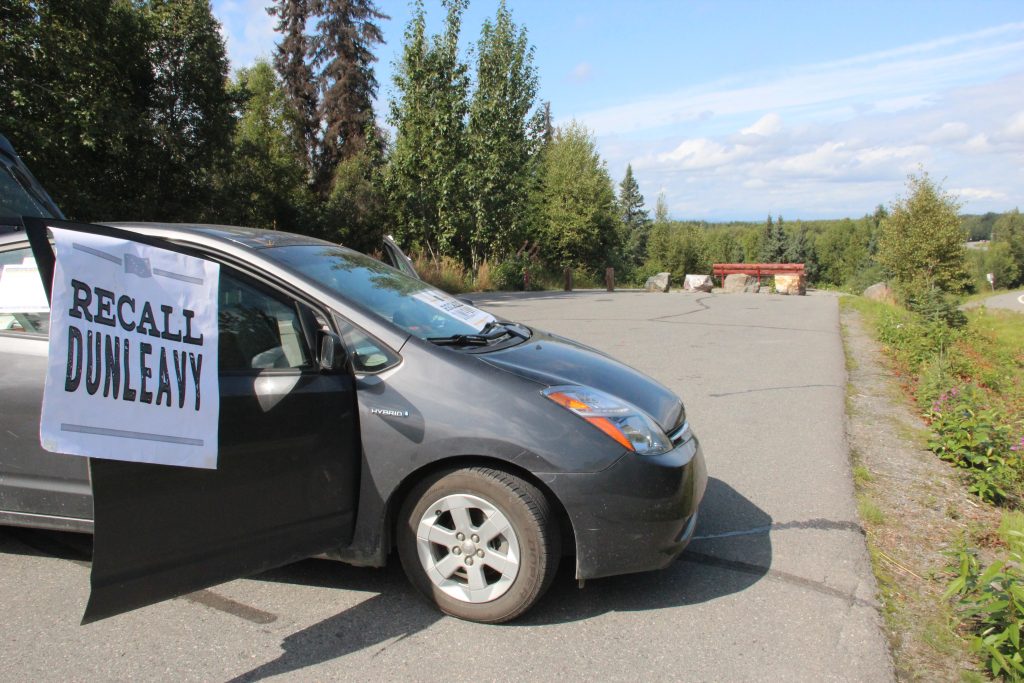
The statewide effort to recall Gov. Mike Dunleavy set up a pop-up petition signing at the Denali overlook pullout in Talkeetna for eight hours on Aug. 6.
“People can’t make it to central places, so these pop-up events, these tailgate events are very useful,” said Patricia Faye-Brazel, the recall effort’s team lead in the Matanuska-Susitna Valley. “And it’s never dull. When I got to Wasilla Lake Saturday, there were six people waiting. When I got here today, there were people waiting. And there’s been a steady stream of people.”
Faye-Brazel said that stream totaled 120 people by the end of the event on Tuesday. She and her team plan to have twelve signing events across the Mat-Su Valley by Friday. In the first two hours of the Talkeetna pop-up signing, she had filled four sheets with signatures. Cars honked at the sight of her car plastered with “Recall Dunleavy” signs, and trucks and bicycles pulled off the Talkeetna Spur Road to add their names to the list. Many listed Dunleavy’s funding cuts and vetoes as their motivation to support the effort.
“I’m a fan of education, basically. That’s the bottom line for me, is all the cuts to education,” said Deborah Vaughan, a Talkeetna resident. “I don’t like the cuts for senior citizens, Pioneer Home, that sort of thing, but it’s the schools.”
The recall effort launched on Aug. 1, and collected 10,000 to 12,000 signatures across the state in its first eight hours. The petition says Dunleavy violated Alaska law and the state constitution in a number of ways, including refusing to appoint a Palmer Superior Court judges within 45 days of receiving nominations, using state funds for partisan digital advertisements and direct mailers and using the line-item veto to strike health, education and welfare funds.
The grassroots campaign needs to obtain 28,501 valid signatures from registered voters, or 10 percent of those who voted in the 2018 general election, in order to certify their petition application.
That’s just the first hurdle in the three-step recall process. If the application is certified, then the petition needs to collect more than 71,000 signatures, or 25 percent of those who voted in the last general election, to send it to the Division of Elections, led by Lt. Gov. Kevin Meyer. If those signatures are successfully gathered and approved, a recall vote will be held 60 to 90 days afterwards.
Faye-Brazel said she’s encouraged by the turnout she’s seen in the Mat-Su Valley, regardless of the complicated process. “People who come are ready to sign. They may not know that it’s a three-step process, but we’re careful to explain that to everyone,” she said.
Faye-Brazel says the group collected 120 signatures in Talkeetna on Tuesday. They plan to return later this week. The Recall Dunleavy campaign plans to conduct another statewide count of the signatures they’ve gathered on Thursday.