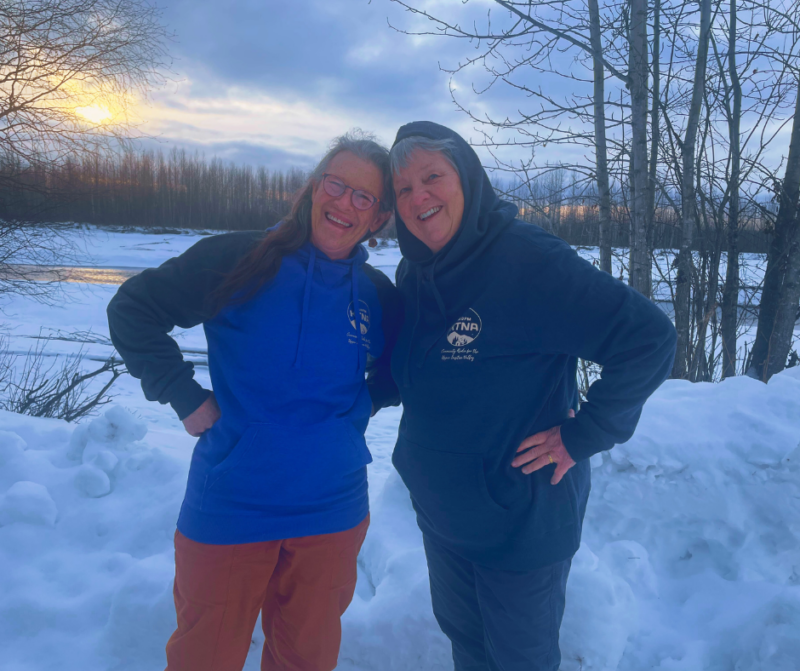
Rebecca Cozad launched her Facebook fundraiser on a Monday morning. Four days later, she had over forty supporters donating over $4,000. The title of the fundraiser reads, “Quirky little Talkeetna needs your help” and the campaign aims to raise funds for legal fees, in order to formally challenge the Alaska Department of Natural Resources in court.
Residents of Christiansen Lake were jolted in the summer of 2017 when trucks rolled in across the street to extract rip rap for a local infrastructure project. Residents were led to believe it would be an unusual situation and they waited for the construction to end.
But in 2019 trucks were back; crushing rock, blasting with dynamite and stockpiling material. Longtime resident, Eric Hestnes, says the industrial noise rattled his windows, and when the explosions occurred, it disrupted the entire neighborhood.
Fed up with industrial activity, the Christiansen Area Lakes and Land Alliance, known as (CALLA), proposed in April that the 153 acre parcel be designated as both habitat and a public recreation area going forward.
CALLA’s proposal notes that Talkeetna enjoys a robust tourist economy that revolves around nature. Visitors head to Christiansen Lake to swim, fish and canoe in summer months. And adjacent Talkeetna Lakes Park is a magnet in the winter for skiers statewide who want to enjoy the quiet wilderness.
Soon after CALLA introduced its proposal, both the Talkeetna Community Council and the Mat-Su Borough both wrote letters of support.
In September of this year, the Chickaloon Village Traditional Council also wrote to DNR, noting their concern about culturally important sites that they believe exist on the parcel, and they urged DNR to conduct cultural resource assessments before engaging in further activity.
But the Department of Natural Resources did not adopt CALLA’s proposal, nor did they put it out for public comment. They also did not agree to conduct environmental or cultural resource assessments.
According to Marty Parsons, the Director of DNR’s Division of Mining, Land and Water, the division feels strongly that the site should remain an active materials site because of the type of material that’s found there.
“This is an intermittently used materials site. It’s used for revetments because it’s one of the few sources of what we call rip rap that’s close to the Talkeetna area.”
Talkeetna sits in a flood plain, and Parsons feels the rip rap might be needed to save property there during future emergencies.
This led DNR to publish its own plan which would place the parcel under the jurisdiction of the Department of Transportation (DOT) in what is called an Interagency Land Management Assignment (ILMA). This designation would give DOT the right to use the parcel at its will.
According to Parsons, if the ILMA goes through, then DOT will take over management of the land and they will have the ability to use it as it bests serves transportation needs throughout the state. However, if the ILMA does not go through, DNR will have to use a broader standard when issuing land use permits.
“If we don’t go through with the ILMA, then we’ll have to look at the comments that were made and see if there’s other options or other actions that the state needs to take. It would still be under management by DNR and then if there was an opportunity or someone came to us to do another material sale then notice would go out to the public and if there were significant concerns that were raised, we would do our best to put stipulations in that permit or authorization that took those concerns into account.”
Rebecca Cozad, who is the President of CALLA and a resident of Christiansen Lake, feels that DNR is placing a higher emphasis on the development of rock products than on the development of a nature tourism economy.
“I think that they (DNR) have a very strong focus on extraction and that’s a single-minded focus, but that’s not what their mandate is. That is what DOT’s mandate is. DOT is the transportation department for the State of Alaska, responsible for safety and roads and airports and all of these things that are really important infrastructure to the state, but DNR best serves the state by serving the public. They have to balance all of the different requirements and needs of the public, not just transportation.”
Cozad feels that the case could be headed to the Alaska Supreme Court, and for that, CALLA will need to pay for legal fees.
Cozad’s Facebook fundraiser shows that she is not alone in feeling the need to fight for a quiet neighborhood area.
DNR has given a deadline of October 25th for the public to comment on its ILMA proposal with DOT.