On Tuesday, a local disaster was declared by the Mat-Su Borough for rapid erosion in Downtown Talkeetna.
At a special Mat-Su Borough Assembly meeting on Tuesday, Public Works Director Tom Adams gave an update on the status of the Talkeetna revetment, and the current plan to stop further damage.
According to the borough, more than 300 feet of the revetment was washed away by the Talkeetna, Susitna, and Chulitna Rivers in a recent high water event. In addition, the riverbank near the end of Main Street has eroded back by more than sixty feet, putting rental cabins near the river at immediate risk. Adams says the concern is stopping future erosion.
“The concern is, as this riverbank continues to erode, that we’re susceptible to losing more of our revetment as it moves downstream, and not only jeopardizing the cabins that are there now…but there are facilities further downstream that could be exposed.”
Adams says steps going forward are a balancing act of acting quickly versus waiting for more complete information.
“The more that the river recedes, the better opportunity we have to do a more effective job. The gambling part is really looking out ahead and seeing, ‘How is the river going to react?’ It’s not just about precipitation. The Susitna River moves channels quite frequently.”
Gauges on the Talkeetna and Susitna Rivers have been slowly dropping in recent days. If that trend continues, Adams says work is expected to begin at the end of this month or early October.
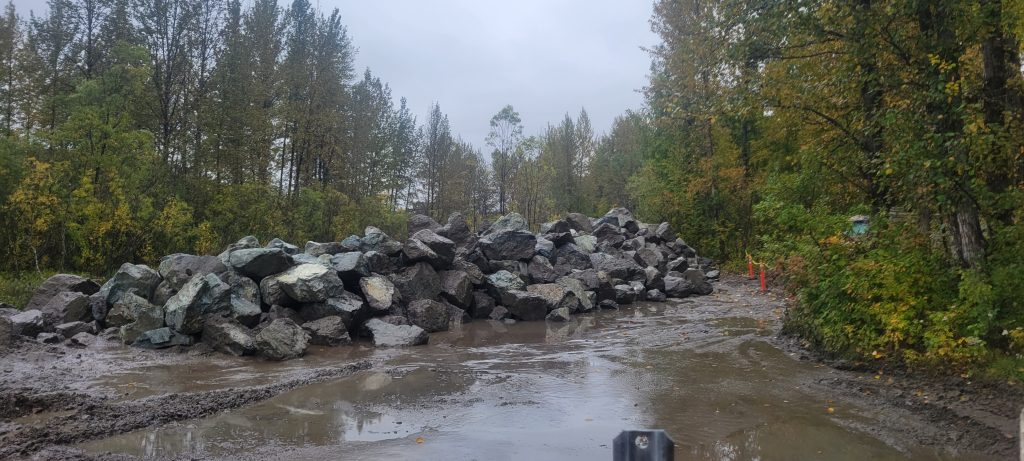
As of now, the borough has staged 900 tons of rock at the end of Main Street, but Adams says that’s about a third of what will be needed. That estimate could also go up, depending on how deeply the river has eaten into the bank.
“The water, while receding, is still flowing quite heavily. And we’re just unable to get the depth of the river, which is a pretty significant variable with respect to the volume of riprap we need to place in the water.”
Borough Manager Mike Brown says the work this fall is intended to stop the immediate erosion problem. Addressing the problem in the long term will come later.
“You know, what we’re doing here is a temporary repair. This is not expected to last twenty years or, you know, fix the problem for the foreseeable future.”
Currently, the priority is sourcing the large rock, also known as riprap, that will be needed to complete the temporary repair. There is a quarry in Talkeetna near Comsat Road that has been the subject of administrative and legal disputes between local residents and the State of Alaska. The quarry is not currently in active use. Brown says he’s not sure at this time if the Comsat quarry could provide the material needed.
“And that’s one of the things we’re looking at….Obviously, I think it would be in our best interests to go into a pit that’s already operating. It’s just a much faster process if someone…has already been operating in the pit and is producing material already.”
The riprap currently staged in Talkeetna was brought in from Chugiak, and Brown says the borough is in the process of sourcing more in time for work to begin in two to three weeks.
Brown says the borough is working with both the state and the U.S. Army Corps of Engineers to address the current disaster and will continue to work with them to explore long-term solutions.