



Avian flu not detected in Upper Valley cranes
The first pair of migrating sandhill cranes arrived in Trapper Creek in 1959 at what was then a barley field. That barley field is now the Dale Saunders Crane Sanctuary.
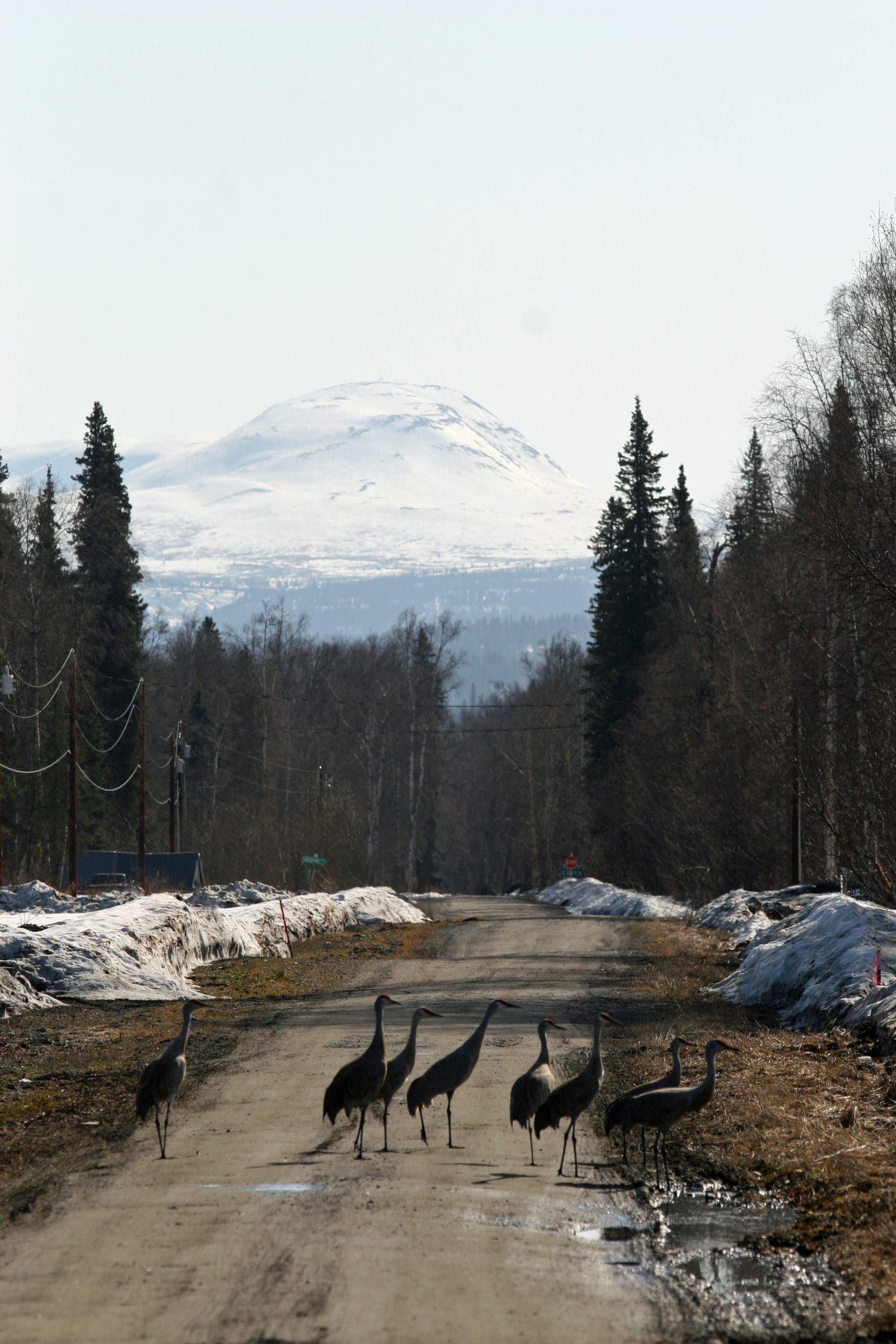
The first pair of migrating sandhill cranes arrived in Trapper Creek in 1959 at what was then a barley field. That barley field is now the Dale Saunders Crane Sanctuary. And, according to local birder Kathy Ernst, the sandhill cranes will arrive just in time to usher in spring.
“Pretty much it’s Earth Day plus or minus ten days.”
And with those birds come worries of avian influenza. Wildlife infected with the highly contagious disease has become a concern, especially in migrating birds.
According to the Alaska Department of Fish and Game website, many thousands of cranes destined for the Yukon-Kuskokwim area and points north and west, hail from Texas, southwestern US, and Mexico. The Susitna Valley’s sandhill cranes migrate along the Pacific Flyway from the San Joaquin Valley of California. Only about 20,000 cranes use this pathway. Ernst says that only a small group of those land in Trapper Creek.
“The most I’ve counted is 350 or so.”
Of all 11 sandhill cranes tested in the San Joaquin area since 2022, none were positive for avian flu. That’s according to California Department of Fish and Wildlife Senior Environmental Scientist Krysta Rogers. But there is evidence that they are very susceptible to the avian flu.
The lack of disease in the San Joaquin flocks is a stark contrast to the sandhill crane populations in Indiana where more than 1,500 birds have died from the H5N1 avian flu this year.
So far, the cranes destined for the Saunders Crane Sanctuary show no signs of avian flu. Which is welcome news for birders like Kathy Ernst who love seeing the cranes in the field every spring and fall.
“Well I think the cool thing is that these birds live a long time. I think they can live to be 30 years old. They have an incredible, fascinating communication system. The dances mean things. The different positions they hold their head means different things. They’re definitely a flock bird.”
The sandhill cranes will usually begin their northward migration from the San Joaquin area in mid-March. As long as the flock stays healthy along their route, expect to see them, as usual, in mid to late April this year.
Read More
Trapper Creek Traffic Study Does Not Support Speed Reductions
Despite Monday’s fatal car accident in Trapper Creek, a recent D-O-T traffic study does not support slower speeds.

2026 Alaska Voters Guide
Early voting in the state’s November 2026 Midterm Election is underway in most of Alaska. Find out where to vote early.
Su Valley Voice for October 22, 2026: Willow Community
Host Trisha Costello talks with the Willow Library, the Willow Community Emergency Response Team, and KTNA News Producer Marion Chesterton.

Susitna Writer's Voice - October 19th, 2026, Acceptance pt 2 by Ruth Wood and Kathy Trump
This is the second of a new 3-part Susitna Writer's Voice featuring a story written and read by Kathy Trump and Ruth Wood.